
Today in History: May 11

At the end of a long printed scroll—16 feet—that was found in China in the early 20th Century sits an inscription declaring something about the origins of the scroll: It was “reverently made for universal free distribution by Wang Jie on behalf of his two parents on the 13th of the 4th moon of the 9th year of Xiantong.”

Scholars know when the 4th moon of the 9th year of the Xiantong era was, and they know on what day the 13th fell in that 4th moon: it was May 11 (today) of the year 868 A.D. The Diamond Sūtra, a woodblock-printed Buddhist manuscript that unspools from a bound side, was found by Sir Marc Aurel Stein in an expedition in 1907. It is the oldest printed book that carries a date on it. It is 1148 years old today. (Photo at top.)
Read More

Today in History: May 10

One definition of the word “promontory” is “point of high land over water.” Another would be “great view here.”

The First Transcontinental Railroad was completed with a single golden spike on this date in 1869 at Promontory Point, Utah, almost 5000 feet above sea level. The rail lines were laid down on a steep incline to such a high elevation because the Great Salt Lake was considered an impediment; the west-to-east Central Pacific line detoured around the lake. Great view, indeed.

Promontory Point was selected by cartographers after conferences in Washington, DC, were held to determine where the Central Pacific line construction (heading east, over the Sierra Nevada Mountains) and the Union Pacific line construction (heading west across the plains, from Omaha, Nebraska) would meet.

The meeting of the rail lines (the “Wedding of the Rails” as newspapers headlined it at the time) was to take place on May 8, but bad weather held the ceremony (photo above) until May 10. Remarkably, the last 10 miles of track had been laid down in only 12 hours to be ready for the May 8 ceremony.
Read More

Today in History: May 9

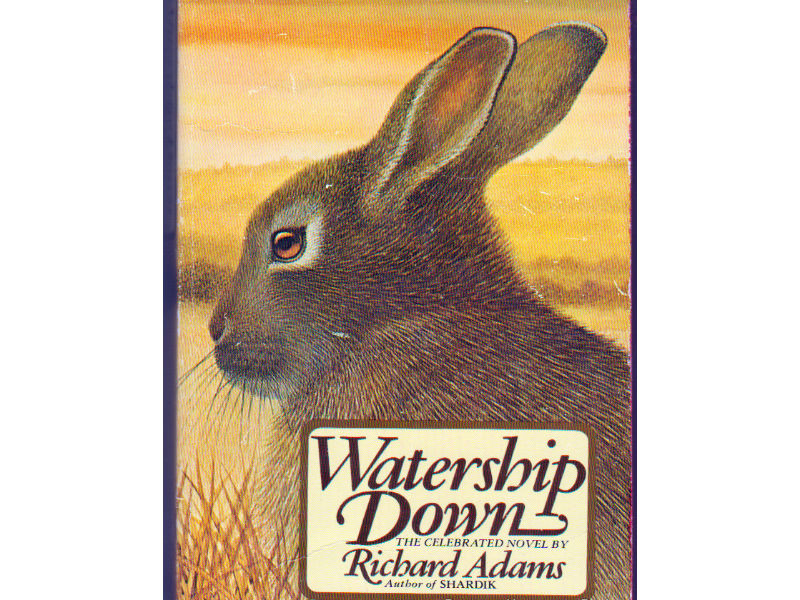
The story of the publication of the novel Watership Down is almost as beloved as the novel itself: Richard Adams, part of the U.K. Ministry of Housing and Local Government throughout the 1950s and ’60s (he rose to the rank of Assistant Secretary), began composing a story to tell his two daughters for each day’s drive to school.

Richard Adams is 96 today. He told the Telegraph in 2014, “The stories I told in the car had nearly always been shaped and cut and edited by myself for oral narration. When I was lying down to go to sleep in the evening I would think out the bit of story I was going to tell the girls the next day.” In 1972, at the age of 52, he typed up the story that he had been telling his daughters and sent it to literary agents and publishers. Four publishers rejected it, as did three agencies.
Read More