Today in History: March 7

U.S. Patent Number 174,465 was awarded to Alexander Graham Bell 140 years ago today. It carried the mundane title, “Improvement in telegraphy,” but for all intents and purposes the patent is for the telephone, and so is one of the most noteworthy patents in history.

One key description describes the intent of the invention: Bell’s “improved” technology provides a new “method of, and apparatus for, transmitting vocal or other sounds telegraphically … by causing electrical undulations, similar in form to the vibrations of the air accompanying the said vocal or other sound.” On March 7, 1876, however, the intention was all Bell and his lab assistants had. He ha not developed an operational device. Three days later, on March 10, Bell’s assistant Thomas Watson heard his boss’ voice transmitted on the experimental apparatus in a legendary moment: “Mr. Watson—Come here—I want to see you.”
Read More
Today in History: March 6

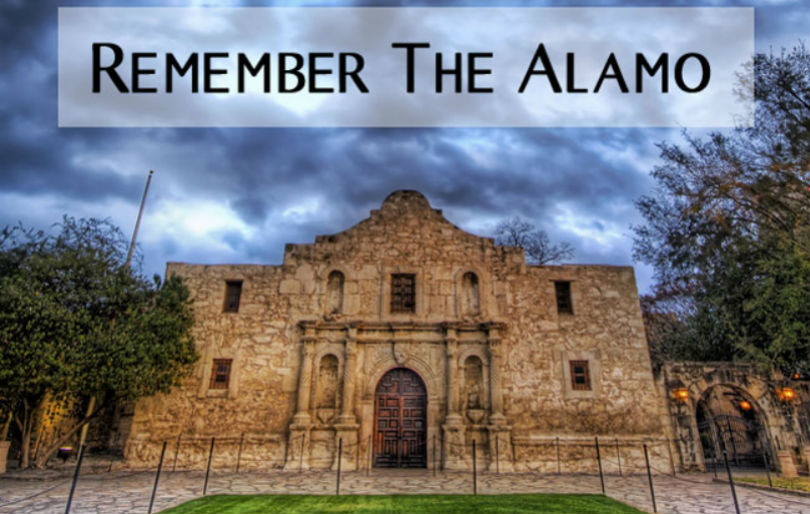
The Battle of the Alamo concluded 180 years ago today. The 13-day-long siege of the Alamo Mission near San Antonio, Texas, ended with the utter defeat of the Texas independence fighters (all but a handful of the Texian defenders died on this date, including Davy Crockett and Jim Bowie), but an ironic, existential, conclusion: the fight for independence was now seen as something worth fighting and dying for, so enlistments in the Texas Army boomed, and the Texas army defeated Mexico in the Battle of San Jacinto just five weeks later.

* * * *
On March 6, 1899, a chemist named Felix Hoffmann received a patent for his new synthetic form of acetylsalicylic acid for his employer, Bayer AG. His new drug was trademarked under the name aspirin.
Read More

Today in History: March 5

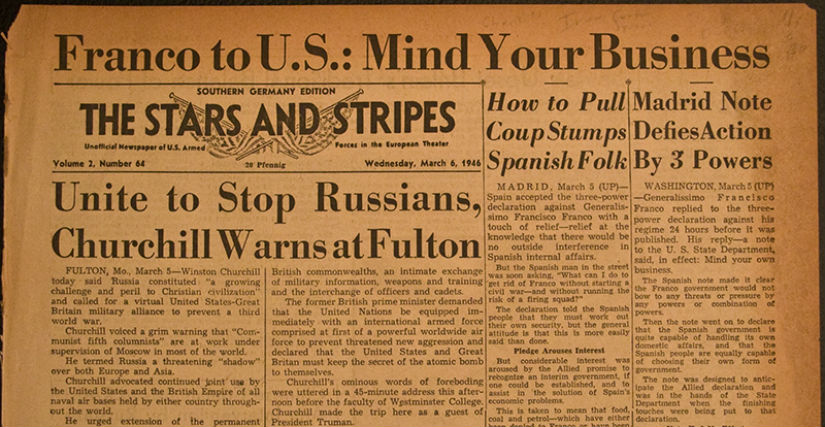
From Stettin in the Baltic to Trieste in the Adriatic an “Iron Curtain” has descended across the continent. Behind that line lie all the capitals of the ancient states of Central and Eastern Europe. Warsaw, Berlin, Prague, Vienna, Budapest, Belgrade, Bucharest and Sofia; all these famous cities and the populations around them lie in what I must call the Soviet sphere, and all are subject, in one form or another, not only to Soviet influence but to a very high and in some cases increasing measure of control from Moscow.—Winston Churchill

Seventy years ago today, former (and future) British Prime Minister Winston Churchill delivered a speech in a gymnasium at Westminster College, a small school in Fulton, Missouri, in which he described the “sphere of influence” he feared the Soviet Union was striving to develop, expand, and force on Eastern Europe. He employed a phrase that had been in use for decades but had recently regained popularity: Eastern Europe was now behind an “Iron Curtain.” The official title of the talk was, “The Sinews of Peace,” but it is known to this day as Churchill’s “Iron Curtain” speech.

Many historians consider the speech as a useful moment to mark the start of the Cold War between East and West, the USSR and the US.
Read More