Time Travel

In his “Confessions,” St. Augustine writes, “What then is time? If no one asks me, I know; if I wish to explain it to one that asks, I know not.” He decides that time is an idea, unique to humans, and also unique in that we can simultaneously grasp the past in memory, the present by attention, and the future by expectation. In our minds, but only there, we are not locked to one perception of one reality.

Earlier, I deleted everything that I had written up to that point by dragging my unbuttoned shirtsleeve across my laptop’s touchpad while reaching for my coffee. (No, I can not replicate the results in an experiment; yes, like an idiot, I have attempted to replicate these results in an experiment.) In a feat of memory, I retyped all that I had written to that point: simultaneously, I remembered what I had written, was super-present and typed it attentively in the moment, and I lived in expectation of a future in which I regularly saved my work, a lesson I first learned, oh, 20 years ago.

I was in three specific time-experiences at once, and each one sucked.
Read More
An Untold Story

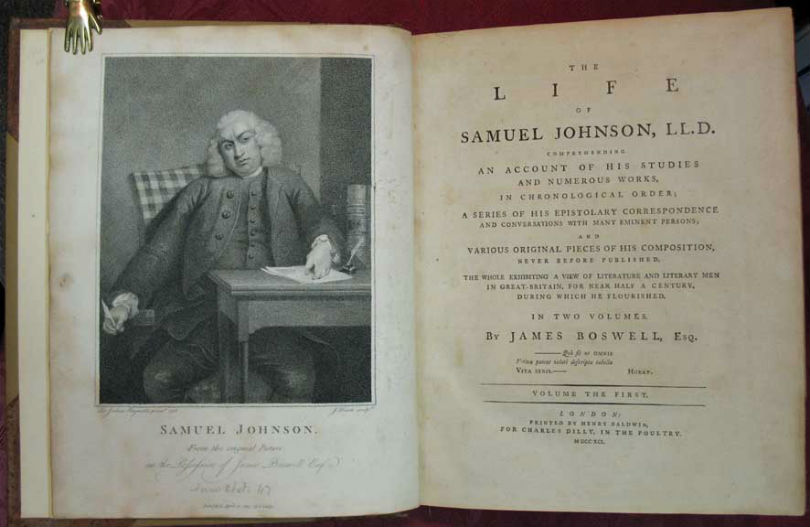
“We cannot tell the precise moment when friendship is formed. As in filling a vessel drop by drop, there is at last a drop which makes it run over; so in a series of kindnesses there is at last one which makes the heart run over.”—James Boswell, The Life of Samuel Johnson, LL.D.

Boswell’s “Life of Johnson” was published in 1791, a little more than six years after Johnson’s death. It is not a biography as readers may think of a biography: the recounting of incidents from a life of action. The poet W.H. Auden said that writers are “makers, not doers” and thus he, Auden, was not going to write his memoirs. We need biographies of the doers in order to learn what was happening behind the scenes, how close the men of action came to disaster and saved their (and sometimes, our) day, he suggested. Johnson’s life was the life of a man of letters, a life spent writing plays, compiling the first major English dictionary, compiling an edition of Shakespeare’s plays, writing weekly columns on every topic his extraordinary mind could entertain. He was a maker.
Read More

Wandering

If the photo above is not of the actual car that my family owned in 1979, it is the same model Chevy Malibu station wagon that my memory has chosen to remember as the actual car that my parents drove to cart my sister and ten-year-old me around that summer and every other summer, before 1979 and after. (My memory is not what it used to be: It is better!)

Our family road trips over about two decades included vacations in Vermont (to see family) and weekends on Cape Cod, in Pennsylvania, along the Connecticut shore. We were not a wealthy family, so our family vacations were always road trips to a destination that we could reach in one day or less of driving. My father was the only driver, so this was more than fair. The long(ish) car ride was simultaneously unendurable and somehow, maybe sometimes, the only part of the trip that was worth remembering.
Read More