Daily Prompt: Factory Unmade

The WordPress Daily Prompt for July 31 asks, “Automation has made it possible to produce so many objects—from bread to shoes—without the intervention of human hands (assuming that pressing a button doesn’t count). What things do you still prefer in their traditional, handmade version?”

Give me an old-fashioned, handmade iPad every time. You know the kind: Each one unique and prone to its own errors and quirks but the one that does some things uniquely better than any other iPad.

I know. It doesn’t exist, and why should it? But I have had favorite typewriters. And I continue to insist that I did not like the “feel” of certain computers, knowing that they are each the same, but still insisting that I can feel a relationship.

In one of my all-time favorite conversations, a friend and I attempted to identify whether various everyday objects were digital or analog. Not digital and analog devices and tools themselves, mind you. Not a digital watch versus a watch with a face, or “old” things versus “newfangled” digital things. We were looking at whether a device’s form or its function define its role in our world. (Of course, strictly speaking, we all live in an analog world in which digital—either/or—devices play a part.) In our game, if an object’s function defined its form, we declared it analog. If form ruled function, it was digital. (I know that this is a very incomplete analogy for digital versus analog.)

We were on a golf course while having this discussion, and we decided that my eight-iron was analog and his putter digital. You should have seen that putter.

In another conversation, this with my college roommate-slash-house philosopher Mike Pizzo, I found myself explaining in too much detail my ideas about this same concept. He sat patiently, waited for my big finish, and replied, “It’s heart versus brain,” which was his own pet analogy for, well, everything, but it also worked here.

Digital tools break tasks down into minute, discrete chunks. Analog audio records a stream containing a wave of sound, and a vinyl record or magnetic tape plays that stream of sound back; digital recorders also capture a sound wave but do so by capturing snippets of it at regular intervals, and digital players play back those snippets so quickly that it sounds like a stream of sound.

(Here’s a way to understand analog and digital. When I need to remember a letter’s place in the alphabet, I still sometimes silently sing the “Alphabet Song” I learned when I was a child and stop when I get to the letter in question. That is analog. If my brain was digital, each of the 26 letters would be equal and unique unto itself and I would be able to call up a letter’s file in question—the file for “G” says it is the seventh letter, for instance, but I needed to sing the song and count on my fingers to get that—without using its relation to the other letters in the alphabet.)

Digital audio and video are infinitely reproducible and can be manipulated almost to infinity (“that picture is fake! It was Photoshopped!”), and analog audio and video are not. In the digital world, there is no such thing as the phenomenon of “copies of copies,” in which a later generation copy of a document looks very little like the original, master document.

Conversations about a world that is only either digital or analog are digital; the rest are analog.

We live in a (mostly) digital world, a world that offers infinite reproducibility along with speed, the ability to produce the same loaf of bread or pair of pants or pop song again and again, the ability to meet goals more quickly by performing multiple, discrete tasks at the same time when once upon a time one had to perform those tasks in a particular order. (To get to “G,” I had to recite the alphabet part-way. What if I had all 26 letters’ files running in my head at the same time? “G” would be always already available to me.)

Automation gives us the ability to run multiple tasks at the same time with perpetually reproducible results. It gives us products that we can not have a personal relationship with, in spite of my insistence that I have a “feel” with certain computer keyboards. When perpetual reproducibility is something that is desired as a thing in itself, it can be disastrous.

Chaplin ridicules the heartlessness of automation for the sake of automation in one of his greatest films, 1936’s “Modern Times.” (If you are bothered by the sound of silverware scraping on a plate, this clip may irritate you.) It is a part of the famous 15-minute factory scene in which Chaplin’s Little Tramp eventually loses his mind while performing his gruelingly mindless drudge of a job (tightening bolts that are subsequently hammered by the worker beside him). The sales pitch for the “feeding machine” offers it as a way to “eliminate lunch hour” and stay ahead of the competition by keeping workers on the job while they are eating. Of course, the dance that is required to maintain anything like smooth operations is a delicate one and once any small element goes awry, the Tramp is almost beaten to death by the napkin holder.

Was my computer or your iPad built by a worker while they were being fed by a machine that held them in place on the assembly line?

I guess in my sloppy way I’m calling this “digital.” As in the conversation with my friend in which we declared certain things analog (handmade) and others digital, things that are not thought of in these terms, I offer the example of my haircut. The worst haircuts that have ever been foisted on me were automated in this way: a single set of clippers, five minutes and, “Next!” Those haircuts make me look like I have an audition next week for a acting job as a Marine gone bad. (And I am not an actor.) My current barber is more hands-on and takes 40 minutes on my head. He utilizes each pair of scissors in his arsenal. Each task on my head is addressed in turn and not rushed. He does not try to attack the whole job at once with a pair of (digital) clippers, unlike the mall hair cutters. I leave feeling like a piece of marble that had been worked on by Michelangelo. There is a line out his door most Saturday mornings.

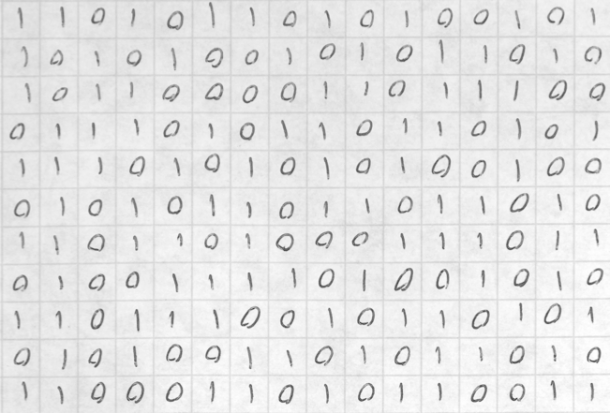
The products of automation, much of the digital world, gives us a lot that is disposable, forgettable. Merely a long sequence of zeroes and ones. Useful, yes, but I like having things that show evidence of a human hand at work, evidence that someone cared. Like my killer haircut. I guess I want to see a hand-written sequence of zeroes and ones that would make a quirky iPad.

Daily Prompt: July 30, 2014. Did I See It Coming?

The WordPress Daily Prompt for July 30 asks, “Is this year turning out to be as you’d expected?”

Predictioning is not among my core competencies. I’ll emend that: I have many apprehensions, so I make a lot of predictions, but few prove correct. It’s a numbers game. I’ll probably do it again. That’s a prediction.

The full Daily Prompt informs me (reminds those who have been participating/using the Daily Prompt since earlier this year—and bless those of you who have been doing so; I have been doing this for less than a week, and it is exhausting) that on January 21, 190 days ago, the Prompt promoters wanted predictions from writers for how day number 211 of the year 2014 would go, and that since today is that day, to let our readers know how those predictions compare to the year we are living. I started publishing The Gad About Town last fall and even, as it turns out, published something that very day, but I was not yet replying to the Daily Post.

Neither January 21 nor today are (so far) days of much note; they are as average and non-noteworthy as the Daily Prompters might have desired. (If everyone was having huge, event-filled days on both dates, that would be spooky. Tomorrow’s Daily Prompt would be: “How did the DP see that coming?”) But if I had sat myself down in January and listed my plans, hopes, schemes, and dreams for the next several months, well, as I wrote a couple days ago:

“… every time I have written out a five-year plan, I have veered completely off from it within six months. The one time I started a 401(k), I lost that job within a month. Three months ago, my housemate and I were supposed to move to a new apartment and the very day that I officially changed my address with the post office, a task that nowadays is more of an official-sounding representation that one is moving than it is something totally necessary, that very day, thirty minutes after filling out the post office’s online form, I was told by my housemate’s mom (of all things) that I was not a part of the move and that my housemate had been lying to me about the move for six months. Two very positive things resulted: I moved in with a part of my girlfriend’s family and my girlfriend and I are closer together, and I no longer live with a sociopathic housemate or the mother. Life has taught me to retain my lack of a detailed and creative imagination and yet be open to possibilities.”

Might I have seen that this fiasco was a possibility as it unfolded? I did not. But fool’s gold rusts, doesn’t it? July 21 was going to be a day spent in one upstate New York town, spent waiting for the (oh, so still distant) day when my girlfriend and I could and would move in together or I could move to a town closer to her. Instead, it is spent in another upstate New York town, but I got what I wanted, sooner rather than predicted, through an infuriating lie that led to the happy anecdote entitled, “How My Girlfriend and I Got Closer.”

According to my journal from the day, January 21 was a day spent shivering in an apartment with heat that only paid an occasional appearance during this past Polar Vortex-cursed winter (consider this the opposite of an ad for Colonial Gardens Apartments), which was the major complaint of my entry.

I did not yet have health insurance, so I did not know if or when I would see an eye surgeon to address issues with my right eye (my left eye had been operated on a year earlier and then my health insurance was cut; these are stories for another post), or when I would see a neurologist again. Health insurance was indeed restored, my right eye now has 20/25 vision, and my new neurologist has updated the official theory as to what is affecting my balance and control of my leg muscles.

In these six-plus months since January, two friends died. If I saw that coming, I would have stayed in bed under the covers, Polar Vortex-winter or not.

And this is merely my personal life. Very little in the news makes much sense, and I used to like that fact. Based on the unfolding of these last six months, I hesitate to even attempt to predict my life in the next 190 days. That is the point to paying attention while living it, though.

Daily Prompt: Stress Is a Six-Letter Word. So Is ‘Human’

The WordPress Daily Prompt for July 29 asks: “After an especially long and exhausting drive or flight, a grueling week at work, or a mind-numbing exam period—what’s the one thing you do to feel human again?”

Historically, I have been a great example of the mock dictum “Take my advice—I’m not using it.” I am someone who can introduce stress into the least stressful, innocuous, and even pleasant experiences in life, so sometimes the parts of life that others find stressful, I hunker down and find the effort inside myself to make them more stressful.

In one of my lesser achievements in the field of stress management, I gave myself a black eye while tying my shoes. These were boots with leather laces (I was not a cowboy) and such laces take effort to yank into position. While securing my “half-knot” on my right shoe, the length of lace in my left hand broke and I clocked myself in the right eye. I was 34-35 years old at the time, not eleven.

One of my co-workers asked, “I’m not sure I ought to say anything, but are you okay?”

“With what?”

“You look like you were in a fight or something.”

“Heh. Funny story, I did this this morning. Heh.” Embarrassed, I mumbled a series of words without connections between them to sound like a sentence or two: New laces. Need. Not leather. Store tonight. Because I lived alone and was ostensibly an adult, my friend did not call protective services on my behalf.

But I was perpetually stressed out by that job, a completely stress-less employment (technical writer in a factory) in a stressful environment (it was a job, and jobs are stressful). I was a contract employee who had been taught that, for contractors, “The last one hired is the first one fired,” and I was the last one hired in this office. Twice, a contractor was hired in my department (the “New Guy”), which afforded me the comfort of being the Not Last One Hired, but both times, the individual quit within days, which restored me to my place as Most Worried. Further, the head of the department who had gone on the hiring spree that had led to my employment was fired in front of us less than a year after I moved to the job. Under these circumstances, in which every week at work was “grueling,” you’d give yourself a black eye tying your boots, too.

It amazes me how much one can accomplish with no confidence in oneself. I held that job for four years, but it felt like twelve.

In those years, I believe I was addicted to being in perpetual (and slight) fear all the time, because I had a method for relieving stress that I trusted above all others, which presented a feeling of relief that sat on the pleasant side of the scale far more heavily than any stress sat on its side of the scale. The method is called vodka and it is no longer a part of my world. So what do I do now?

The question implies that during a stressful period one is not human and needs to be restored to a natural state of calm serenity and continuous need-meeting, but only when you have needs, mind you. When you have no needs, there is no need-meeting, which is perfection. All things in moderation, except moderation.

I have friends from the military, friends who have fought in hand-to-hand combat with enemies, and they report that when a person leaps from one serotonin-soaked event to another, one acquires an either/or outlook on life. They describe post-war life as one in which the soldier will either perceive everyone as an enemy, including the guy taking too long pouring himself coffee, or they return home to a world in which he loves everyone and sees every human being as a fellow traveler on this big blue marble of ours. He’s the vet who hands the half-and-half to you on line and then lets you step in front of him at the counter.

So I am a stress-filled person, certainly not a soldier returning from a war zone, except, perhaps, the one in myself, but life presents me with obstacles and challenges like work, life, relationships, life, long journeys, life, ongoing tests, life. And life. The only plane trips that have been successfully not stressful for me have been the ones in which I struck up a conversation with my seat mate. I am, as I am with much else in life, an uneasy flyer. I am the passenger across the aisle from you with white knuckles and clenched jaw. The trips that I remember most fondly are the ones in which I made a temporary best friend: A flight to Chicago in which my seat was switched on the plane from a seat surrounded by a family with three kids (making me the fourth) to a seat next to a woman who was also doing the crossword puzzle. A flight after 9/11 in which the entire plane got involved in a conversation about coming home to upstate New York and what we missed about living there. This approach to life works well on planes, in waiting rooms, on the coffee line.

When I remember I am a human being, I do not need to do anything to unwind or remind myself that I am human or to feel human. When I don’t, life is a grueling week of work spent on a plane flying me to a final exam that I have not studied for. It’s one broken shoelace after another.