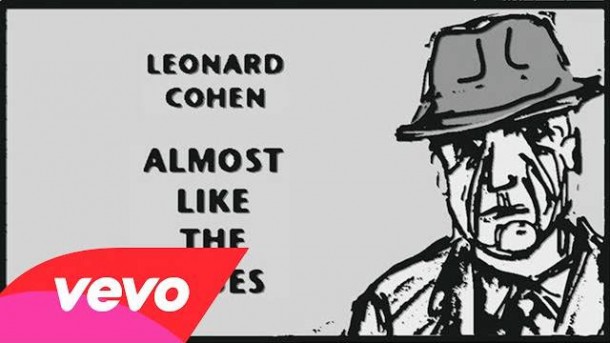
The WordPress Daily Prompt for August 23 asks, “What’s the first line of the last song you listened to (on the radio, on your music player, or anywhere else)? Use it as the first sentence of your post.” __________________________________
I saw some people starving
There was murder, there was rape
Their villages were burning
They were trying to escape
I couldn’t meet their glances
I was staring at my shoes
It was acid, it was tragic
It was almost like the blues
“Almost Like the Blues” is the first song Leonard Cohen has put out in advance of the release on September 23 of his 13th studio album Popular Problems. Cohen will turn 80 on September 21. No tour has been announced.
Have an enjoyable weekend, friends.
41.402038-74.324319
Thank you for sharing this via one of these wonderful services:
Years ago, I urged the young son of a friend to start using a theme song, as he always seemed to be humming something whenever he entered a room. He was 10 at the time and found it funny that something like this would be noticed, but since most 10-year-olds are egotistical, he loved that someone noticed a quirk. I told him that if he had a theme song, whenever people heard it in his absence they would think of him and wish for him to suddenly appear.
I do not know if my friend’s son now has a theme song that reminds his friends of him. I kind of hope not, since it might be insufferable, instead.
It is easy to brand oneself but it is quite hard to re-brand oneself; I have had several experiences with branding myself, being branded by others, and attempting to re-brand myself. And part of that has to do with having had a “signature beverage,” as the WordPress Daily Prompt for August 22 asks: “Captain Picard was into Earl Grey tea; mention the Dude and we think: White Russians. What’s your signature beverage—and how did it achieve that status?”
Having a signature anything usually infers affection from one’s friends towards you. When I was young, I hated getting labeled, in part because it never seemed affectionate at all and sometimes when I heard it, it meant that the next sound I was going to hear was a fist coming at my face. I started wearing glasses at age eight: “Four eyes.” Starting at about that same age, most years, I outgrew my Christmas clothes by spring, leaving me with exposed ankles for the rest of the school year. For some reason, this look, which revealed something but I do not know what about me—poverty? personal clothing cluelessness?—led to the most violent reactions from my school mates: “High waters!” was the exclamation and shoving me was frequently the action. I do not know why, and to this day I check the cuffs on my pants.
Thus, I loved having a “signature beverage” after I went to college. It was a label and it meant I belonged with some group (any group) somewhere (anywhere). And I controlled it. I picked it. I had friends and I was going places.
I have had bartenders who knew which beer I liked. I have had bartenders who made me the perfect martini: “Bone-dry,” I would say. “Allow the vodka and the vermouth to exchange pleasantries but not mingle or get each other’s phone number.” (I was a wit.) A twist of lemon peel. (“Olives? Do I look hungry?”) I have had liquor store proprietors fetch me my bottle upon seeing me enter.
Towards the end of my drinking era, several friends attempted to stage an intervention on my behalf. There is an expression in recovery that a “alcoholic will get you drunk before you get him sober,” and that sums up the intervention. We all drank. I am rarely a charismatic or convincing individual, but when I need to be …
These same friends, when we now go out to dinner, now order for me. They order a pitcher of whatever for themselves and order a Sprite for me. I can order it for myself, but it is a cool moment for all of us because, as secret as I wanted to keep my consumption years ago, it was no secret to them, and my sober life is no secret now. It is the best damn Sprite I have ever had. Each time.
I have a label—a “signature beverage”—a personal brand I can now enjoy.
41.402038-74.324319
Thank you for sharing this via one of these wonderful services:
The WordPress Daily Prompt for August 21 asks, “If money were out of the equation, would you still work? If yes, why, and how much? If not, what would you do with your free time?” __________________________________
I have my final pay stub somewhere around here, detached long ago from the check whose sum it explained. It dates from late June 2010 and I should bronze it like a baby’s shoes.
As it is for me with many other aspects of a common American—well, not just American, human—life, my relationship with work is, um, not uncomplicated. Off the top of my head, from age 15 till 40 I held 14 different clock-punching jobs from almost as many employers, with a couple employers that hired me more than once. Not included in the list is the newspaper reporter job I quit via fax machine the morning of day one, because I really am a terrible employee and I guess I wanted to prove it quickly, and the one time I was paid for an acting gig (onstage with a cardboard box on my head and a ukelele in my hands—it was a little avant garde, and getting paid five bucks made it even more so).
Life for me for the last four years has been nothing but free time, however—yet I have never been quite so productive. I am the person for whom this question was written.
I have not been another person’s employee since the summer of 2010, when I was asked to leave my last job, which I had not enjoyed very much for three years and nine months, because I had not enjoyed it very much for three years and nine months too many. The manager and I decided that I no longer needed to consider him my boss and he no longer needed to consider himself my boss. On that much we agreed, so we parted company and even deleted each other from one another’s Facebook. It was that serious a firing.
The symptoms of my diagnosis had been prominent for most of the three years; I started walking with a cane in 2007. When the symptoms of adult spinal muscular atrophy first showed, they came suddenly. Only recently have I learned that this is a common experience among people with neurodegenerative diseases. When walking becomes difficult—in my case because the nerves that had been sending (ever dimmer) signals to my legs (which had started to atrophy from receiving ever dimmer signals and thus were not being asked to work)—the end of normal walking comes as if everything had been just fine one day and the next day as if one’s shoes had been nailed to the ground or one’s co-workers had painted the floor with superglue. (I must not have liked the job very much, if I thought such a prank was possible!) It is sudden and scary when the progression of deterioration is undetected and even undetectable until the day it is completely not.
Since my last job was not a high-paying one and did not offer free or simply less expensive health insurance, I had none. So I neither spoke with anyone about my developing deterioration, nor did anyone suggest I do so. But being suddenly unemployed (so very unemployed my boss had unfriended me, please recall) meant I could get poor people’s health insurance, Medicaid. (This is before the Affordable Health Care Act, which also has in fact benefited me.)
With Medicaid came the, “Hey, doc, what gives with my legs?” conversation, and, eventually, the answer(s). With the answers came Social Security Disability, which is my sole income as of right now. If I had had insurance at an earlier date, perhaps I would have received the diagnosis and declaration of disability earlier and been able to leave my last employer on better terms. Entertaining such hypotheticals is a highly un-useful pastime, I find.
My barber asked me recently, “What do you do?” And I replied, “I am a retiree.” As I have written elsewhere, I am an alcoholic in recovery, sober several years, and I am living “Mark’s Life, Version 2.0.” The universe has afforded me a second life (not the online virtual community, a real second life), and the opportunity is not being wasted. I am writing, every day, on a schedule of my own fashioning, speaking with and sometimes counseling people.
There are three jobs every person in recovery thinks of pursuing, as I certainly did: becoming a counselor (but the hours of training are arduous), becoming a truck driver (perhaps because a desire to escape partly fueled the addiction and does not leave), and, after being told by enough people, “You oughta write a book about your stories,” a writer. Luckily, I already was a writer.
From Elvis Costello’s 1983 album, Punch the Clock, “Everyday I Write the Book”:
41.402038-74.324319
Thank you for sharing this via one of these wonderful services: