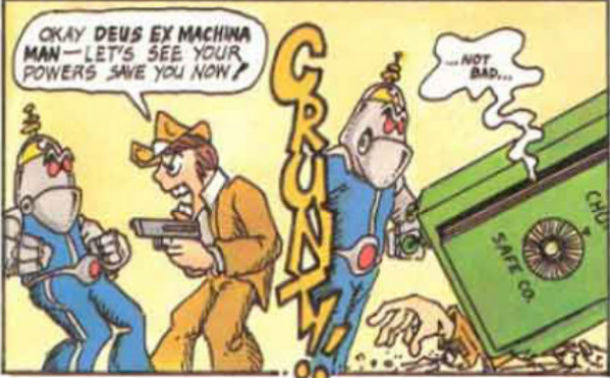
Deus Ex

In classical drama, the term deus ex machina refers to a plot device wherein a plot problem is suddenly solved by the arrival of a previously unannounced character who supplies the answer or solution. “But don’t you know? That’s your brother!” would be a typical line delivered by a deus ex machina character, thus helping our heroes avert a troublesome situation.

When a playwright or novelist needs to fix an intractable plot puzzle, he or she might resort to the tool, which is Latin for “god from the machine,” or “you couldn’t figure it out for yourself with the characters you’d created, so you punted,” but audiences since ancient times have tended to see through the fix. “Where did HE come from?” More often than not nowadays, it is used ironically, but when you find yourself reading a book and seeing lines delivered by a character that you do not remember being introduced to, your inattentive reading is not to blame. That character really was not there 20 pages earlier.

A more restrained writer might use a deus ex machina-type character to do something simpler than solve everything; the character might supply background information. Or another character might do something like get a character who knows a secret drunk to spill the story, turning that character into the god-machine. In vino veritas, the Latin expression declares, and I do not think anyone needs it translated here.

Any deus ex machina fixes that you might encounter in real life are more rightly known as surprises. Anyone who reveals something that they claim to have known about all along is either a busybody or a breaker of confidences, and you ought to do everything in your imagination to make sure they get stuck with the bill for every lunch for a year.

But what if you could learn something secret from one of your friends by administering some sort of truth serum? (I would hope, for all of our sakes, that if we could learn what our friends truly think of us that we would learn they hold us in higher esteem than we think they do. Nothing worse. One hopes one’s friendships are that open-faced and honest.)

There in fact is a drug that some consider a truth serum. It is sodium thiopental, better known by its Abbott Laboratories brand name of Sodium Pentothal, and it is a barbiturate that is used as a general anesthetic. Because it is such a strong anesthetic, it is more frequently administered to induce a coma than it is to knock someone out for a tooth extraction; further, it is usually the first drug injected into the arm of a prisoner as he or she is being put to death.

On and off for many decades, police in certain countries (including this one) have administered the drug to get prisoners to talk, to spill the beans, to yack away the location of whatever it is the police are looking for but can not find. Nothing would help in crime solving or crime prevention more than a real-life deus ex machina, and in sodium thiopental veritas goes the thinking. More often than not, the beans that were spilled under the effects of the drug were hallucinations and dreams and probably more revealing of a psyche under duress and being put to sleep than the location of an un-apprehended bad guy’s house.

But police forces keep searching: for bad guys and evildoers as well as for the perfect drug that would get the apprehended bad guys to talk and thus create a real life deus ex machina. For some, Steven Spielberg’s film of Philip K. Dick’s “Minority Report” depicts one man’s unnecessary interference with a fine legal system rather than the hopeful end of dystopian nightmare.

* * * *
“What’s that, sweetness? Oh, we’re going to dinner? Now? Okay. I’ll finish typing this right about n- -”

____________________________________________
The WordPress Daily Prompt for September 30 asks, “You’ve come into possession of one vial of truth serum. Who would you give it to (with the person’s consent, of course)—and what questions would you ask?”

Fact or Not-Fact

In the 1990s, one of my co-workers at a bookshop used to relocate the paperback sci-fi books inspired by “The X-Files” television series from the Fiction/Sci-Fi section to the Nonfiction/Science section. This was not something she did to be ironic or otherwise witty; she did not know that the books were “made-up” and thought the TV series was a documentary.

She told me one day in a flurry of words that people needed to know the truth about how the world is. I agreed, but I did not tell her what truth I thought “people” should “know”: What was true was I considered her nuts. When I pointed out that the publisher itself labeled the books as fiction, she replied that this was a sure sign of the cover-up, that the publishing house was doing its part to stay safe.

One day, I left the books in the non-fiction section and watched as a customer moved them back to Fiction/Sci-Fi. Another day, I watched as my genre-confused co-worker became an ex-employee of the bookstore.

* * * *
Alf Evers was the historian of the Catskills region in upstate New York. His long (so long it is almost cube-shaped) history, “The Catskills,” was the first definitive text about the area when it was published in 1972. The book is definitive but it is not the resource to turn to if one is searching for dollar figures or numbers of acres. Oh, those appear here and there, when needed, but they are not often needed. Instead, he is a grand storyteller. Here is his epic opening for the chapter entitled, “Made of Wood”:

When permanent settlers arrived in the Catskills, the mountains’ trees began to move out. Before human beings became part of the society of living things which surrounds and covers the Catskills, trees rarely left the mountains. Each tree struggled to live and reproduce on its birthplace and, if it escaped fire, wind, competition from its fellows, and insect and fungus attack, it lived out its destined span of life and died. Then its body would be taken apart by bacteria, fungi, and flying and wriggling things, and it would returned to the earth to become the building material of new bodies. Indians had carried away parts of trees: the gum of the balsam fir for medicine or to calk canoes, maple syrup to sweeten their diet; or bits of wood well adapted to one purpose or another. But this had caused no visible change in the Catskills’ forests. Nor had John Bartram‘s gathering of seeds and seedlings for his British landscape-gardening customers. But when the first settlers and their sawmills appeared, things began to change.

Scene: set. A history of Catskills lumbering follows, but as we read on we carry with us the reminder that each individual tree, cut down or left alone, had and has its own life story. Human beings, Native Americans and European settlers alike, are given much the same respect by Evers, and he reminds us often that there are many individual stories that make the numbers, the quotidian facts, the real part of “real life.”

(I had the honor of interviewing Mr. Evers once. He was in his 90s and hard of hearing and sight but lived on his own in a book-lined and -furnished cabin in Shady, New York. [Yes, that is a real place name.] He passed away in 2004, a few weeks shy of his 100th birthday. The magazine for which I was interviewing Mr. Evers folded before the interview was published and I wrote it many computers ago, so it is long lost.)

The facts, the numbers of life, the details that fill the ledgers in which we count our ups and downs, those can trap some historians. There are some who can make a reader feel like they are doing no better than reading someone’s checkbook for themselves, with no context supplied. Raw facts are not Evers’ concern; he had obviously studied the various deeds and checkbooks and then digested the information and knew a good story when he had one to tell.

A good story. That is the concern of any writer, whether he or she is engaged in fiction or non-fiction. James Joyce by Richard Ellmann is one of the great biographies. It is so detailed and crammed full with letters written by and to Joyce that one sometimes thinks that it might take one as long as Joyce’s 58 years alive to read it. It is often a fun and funny book, and Ellmann certainly knew he had a good life story to tell. (I do not know why there has not yet been a film biography of Joyce’s life; perhaps because it did not end with a sweet redemptive moment, Joyce winning an award, for instance.) Joyce’s novels (his fiction) are enhanced by the experience of reading the biography. And reading Ellmann’s biography is enhanced by reading and loving Joyce’s novels.

Some of the best non-fiction reads like fiction and some of the best fiction reads like non-fiction. That does not mean “The X-Files” books can go in the Science section.
____________________________________________
The WordPress Daily Prompt for September 29 asks, “When reading for fun, do you usually choose fiction or non-fiction? Do you have an idea why you prefer one over the other?”

Just (Don’t Over)do It

One of Oscar Wilde’s pithiest quips (or one of his quippier piths) is, “Everything in moderation, including moderation.” Lampooning his prudish-seeming Victorian contemporaries, he was suggesting we should show some restraint in the not enjoying of this sensual world. We should refrain from overdoing our lack of enjoying pleasure.

Some time ago, I wrote to Wilde, but he did not reply as he died 68 years before my birth. I wrote, “Everything in moderation, except moderation.” His ongoing silence about this speaks volumes.

What about those who do not take too much pleasure in the world? What of the underrepresented excessively self-repressed? Aside from the fact that they probably do not want too much—or any!—attention and thus representation given to them, what can we do for the successfully overly moderate among us?

Those who magnificently overdo their lack of excesses are the non-heroes we can lovingly ignore, um, adore, for our current era of superheroes and superstars.

Every fifth movie or television show seems to be about an average human being discovering quite by accident that they possess previously unknown super powers, whether strength, speed, invisibility, divisibility. They find they have super senses, which they employ to solve crimes (if they had super senses all along, how did they not detect that they had super senses?), which seem to be committed by others who have also discovered that they have super abilities but want to rule the world as a result. (None of these works of fiction seem to depict anyone discovering previously unknown super-capacities for human compassion, but most Christians would say that there was only one such figure, and He was sufficient.)

The cultural desire for superheroes reflects a cultural infantilism, a desire for super-parents in a world that we tell each other—in the news and other movies—is a darn scary place. Many of our original fictional superheroes were created in a similarly scary world, during the Second World War. We felt that we needed rescuing, we desired a rescuer, so we created a spectacular hero in our comic books, novels, movies. The hero represents what we discover we had inside us all along: strength to face any foe, bear any burden. (But “pay any price,” to finish JFK’s quote? Not so much. Maybe a few bucks for a ticket and some popcorn.)

We live in a similarly scary world, so we are seeing a lot of superheroes in our cultural fantasy life once again.

However, not a one is super-moderate in his lack of vices. “Super Moderate Man.” Our movie makers could depict him displaying restraint of tongue and pen and keyboard when confronting things with which he disagrees. He is no teetotaler, but knows his limitations and thus never consumes. (Myself, I am a teetotaler, because I do not know my limitations.) If he stays up late fighting villainy one night, they could show him getting to bed early the next night. He rarely swears, so when he does it makes a point. He “stops and smells the roses,” but not every darn time, because sometimes he has places to go. The movie makers could write a dramatic scene in which he heroically fills out product warranty cards … and pays his taxes. He never lectures or wags his finger and he takes the time to show others how to make a fine pot of coffee. Some complain that the coffee is too strong, and some say it is too weak.

“Super Moderate Man” does not wear a cape, because really, who wears a cape? There is not one rack of capes to be found in any mall anywhere. (He shops in malls.) If he possesses a cloak of invisibility, it is only there to mask any evidence of a sense of style.

Super Moderate Man: A hero some of the time for most people, but it is okay if he is not.

____________________________________________
The WordPress Daily Prompt for September 27 asks, “‘Perhaps too much of everything is as bad as too little.’—Edna Ferber. Do you agree with this statement on excess?”