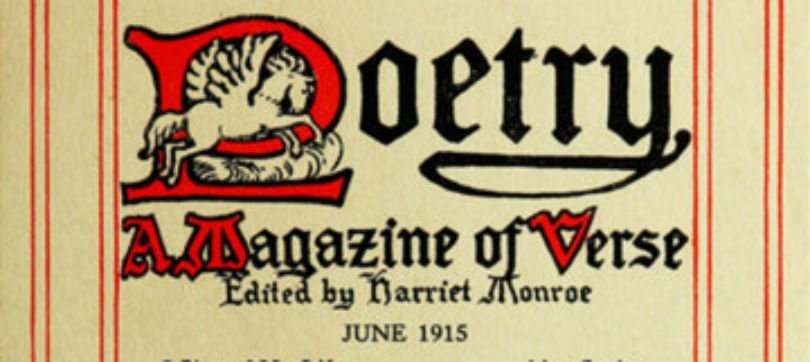
If you were a subscriber to Harriet Monroe’s monthly magazine Poetry in 1915, you received your June edition this week 100 years ago. It was an issue with 16 poems, one of which was “The Love Song of J. Alfred Prufrock” by T.S. Eliot. Eliot was 26, about to marry, wrote the poem in 1910, and put it in a desk drawer. He devoted himself to his graduate studies and then moved to England, where he met his fellow American, Ezra Pound.
Eliot showed Pound some of his poems, including “Prufrock.” Pound, whose skills at publicity sometimes outmatched his poetry (if he were alive today, he would be on Twitter ’round the clock, which is not necessarily something I write out of admiration), talked about a new young poet he had found at every opportunity.
Prufrock and “Prufrock” are 100 this week. The response to the poem in the 1910s was visceral; in the ongoing critical conversations “Where is literature now?” and “Where is literature headed?,” “Prufrock” revealed that 1915 was a moment in which both questions were the same for once. A critic in the Times Literary Supplement wrote a year later, “The fact that these things occurred to the mind of Mr Eliot is surely of the smallest importance to any one—even to himself. They certainly have no relation to ‘poetry.'” That is not a vote in favor. Pound’s positive reaction was no less effusive: “Prufrock” is “the best poem I have yet had or seen from an American.”
Read More
41.401884
-74.321252
Thank you for sharing this via one of these wonderful services:


 The Gad About Town