An Artist of the Surprise Gesture

The WordPress Daily Prompt for August 2 requests that one’s post includes three random items. “Write a post about any topic you want, in whatever form or genre, but make sure it features a slice of cake, a pair of flip-flops, and someone old and wise.” I chose to write flash fiction.
___________________________________

“I don’t know why she makes such a production out of everything,” Aunt Helen said to no one and everyone, shaking her head.

“She likes making the effort,” I offered. She looked directly at me with that. When I continued, “Maybe the reward is in the doing,” it ended as a drifting-off question.

“Not only am I going to look at you like I think you have three heads, I think you have three heads,” the aunt said. She looked out the window. Victoria was digging for something in her car, so far in that her feet were off the ground. “If it’s that far in, shouldn’t she just go around to the other side?”

“I think she is grabbing it by the base.” I hadn’t even walked over to the window to see for myself. It was a Christmas tree, fake, but already decorated with ornaments, and thus unstable no matter which method Victoria employed to retrieve it from the car. She had had her son hold it steady from his position in his car seat.

“Well, if you know what she’s doing, why didn’t you know I just wanted to cook dinner for myself, watch my stories, and go to bed?” Helen’s jowls were in constant motion as she clenched and unclenched her jaw, pursed her lips and forced her mouth to relax. We were bringing her some Christmas on her 89th birthday, and the visit was unannounced. It was unannounced because it was unplanned. Not an hour before, Victoria had remembered that she had a tree “somewhere” and that her aunt did not have a tree anywhere. Thirty minutes later, my legs were the ones off the ground as I grabbed it by its base and attempted to gently remove the tree from its storage box on a forgotten high shelf in the basement. It was still decorated from a Christmas in the ’70s. Fifteen minutes before that, I was failing to find it in a shed behind her house. I awoke that morning to her telling me her plan as if it had already happened, as if it was an anecdote.

Choosing to decide that I indeed hoped that this was an anecdote about something that had already happened—me searching for her childhood Christmas tree and us driving to Aunt Helen’s—I asked “This (story) is from last year?” If the answer was yes, we were then going to make our plans for the rest of the day, plans that I would have been happy to learn included shopping for next summer’s flip-flops or cleaning the house. Anything but one of Victoria’s adventures. Of course, deep down I actually wanted to be a part of one of her adventures, and I knew how to play very well my role of “grudging friend who gets won over.”

Whatever planning that might have been required for the day with her aunt had happened in Victoria’s head during the night before, without her consulting anyone who might be capable of implementing her plan to show love: neither me, the “muscle,” nor Aunt Helen, the recipient. It was up to us to live up to her scheme, a desire to do something so spontaneous and loving and generous that everyone involved would enjoy the spontaneity, embrace the love, and participate in the generosity. But if we failed to live up to the plan in her head, well, life is a challenge with an artist of the surprise gesture.

But something was different about this adventure: Helen was having none of it. “I didn’t ask for a tree! You should have just brought me some cake.” Victoria moved the tree to her kitchen, and while she was out of earshot, Helen whispered something I can not forget: “I don’t know why she tries so hard. It would be easier if she just said ‘I love you.'”
Daily Prompt: Seven Sins Are Enough, But Here Are Two More

The WordPress Daily Prompt for August 1 asks, “Remember the seven cardinal sins? You’re given the serious task of adding a new one to the list—another trait or behavior you find particularly unacceptable, for whatever reason. What’s sin #8 for you? Why?”

“Serious task”? Truly?

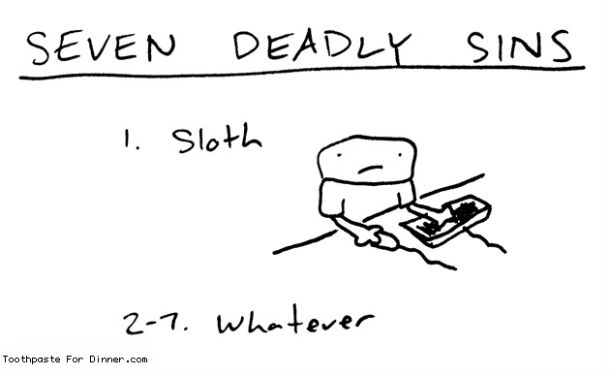
The seven cardinal sins, AKA “The Seven Deadly Sins” on most Most Wanted posters, are Pride, Greed, Lust, Anger, Gluttony, Envy, and Sloth. “Poor Sloth,” a friend once said, “always trailing behind and coming in last on the list. If only he could speed up. There is nothing Sloth can’t do once he sets his mind to it.”

Any personal pique I may have against some irritating something I encounter during the day might find itself labeled as my eighth deadly sin—for that day, anyway—but me naming any personal irritation or pique as a Deadly Sin falls under Pride, doesn’t it?

Intellectual sloppiness, of the type that the internet does not encourage but certainly, in its eternally passive and continuous availability, allows to happen, that’s my biggest pet peeve. So is rudeness hidden behind the mask of anonymity. Comments on, well, any web site that allows comments (except this one, of course. Comments on WordPress sites generally and here on The Gad About Town specifically appear to be uniformly thoughtful and thought-provoking and supportive. It is why this blog is located in WordPress Land. Now of course someone is going to comment below with something along the lines of “Baba Booey!”) are almost always teeth-grindingly awful. I want to tape up the lower half of my computer screen, like my mom did with our television once: After that horrible day of 9/11, American news networks started scrolling news headlines at the bottom of our television screens—only breaking news headlines at first, because the news was coming in so quickly that the continuous scroll was required to get it all out, but then the scroll remained and they all have it all the time to this day, even some local news channels. My mother could not take it. It was too much. Shortly after 9/11, I came home to a television set with packing tape covering the lower portion of the screen, so she no longer felt so overwhelmed and dizzy from the unneeded movement on screen and unnecessary barrage of “Breaking News.”

I need to provide myself with a similar service for the section of comments below videos on YouTube and other web sites. I want to throw a protective layer of packing tape between me and much of the world. And Twitter: Too often you are a part of the problem and not the solution, also. How much dumb can be packed into 140 characters? Sometimes I am happily surprised by things on Twitter, but never by YouTube comments. That world is just a waste land of empty anger, accusations of anger, claims of superior anger, and rudeness.

Is it a sinful-level Pride in me to detest the inane and vague? When one friend posts a disprovable “Internet rumor” online and I attempt to correct it, I almost always regret making the attempt. I insist on gentleness in this task and write something about how this claim is seen online very frequently and that the frequency led me to check some things out and that the claim is just not correct. I have seen people offer rude and not-very gentle “corrections” online, but those merely use another sin: Anger. But, inevitably, the accusation comes that I am full of myself and a question is asked about which Global Institute of Knowing Things Correctly appointed me Head Fact Knower and Associate Checker?

The only thing I know to an expert level is that I know I do not know much, and that I like to look things up. I even found that I was relying too frequently, with too casual an ease about it, on Snopes.com, the famous debunker website. A friend wrote me, “Who has ever Snopes’ed Snopes.com? I hear it’s just some guy without training or anything.” (I never asked what training would be required besides enjoying looking things up.) But the website in fact has Snopes’ed itself and it is pretty open about its writers’ expertise: About Snopes. Other websites have interviewed the founders. The lesson for me was to be more rigorous. And trust Snopes, as far as internet rumors go.

It is odd that people claim to take seriously the idea that they must question authority (we must, definitely we must, question all authority, including our own), especially intellectual authority, so they will defend sloppy assertions over the debunking of these assertions, almost as if they see the sloppy assertion as a child being bullied by the mean truth. (I am withholding concrete examples of sloppy assertions and their corrections, because I do not want to give them the air to breathe.)

Rudeness masked by anonymity, a proud anti-intellectual streak masked by a falsely humble belief that one is an independent thinker, these are the peeviest of my pet peeves. Are they deadly sins, though? Do they meet that standard? I am no expert, but having been a pretty good achiever in my life in the other seven sins, I now do not like it when I encounter any of them.

Daily Prompt: Factory Unmade

The WordPress Daily Prompt for July 31 asks, “Automation has made it possible to produce so many objects—from bread to shoes—without the intervention of human hands (assuming that pressing a button doesn’t count). What things do you still prefer in their traditional, handmade version?”

Give me an old-fashioned, handmade iPad every time. You know the kind: Each one unique and prone to its own errors and quirks but the one that does some things uniquely better than any other iPad.

I know. It doesn’t exist, and why should it? But I have had favorite typewriters. And I continue to insist that I did not like the “feel” of certain computers, knowing that they are each the same, but still insisting that I can feel a relationship.

In one of my all-time favorite conversations, a friend and I attempted to identify whether various everyday objects were digital or analog. Not digital and analog devices and tools themselves, mind you. Not a digital watch versus a watch with a face, or “old” things versus “newfangled” digital things. We were looking at whether a device’s form or its function define its role in our world. (Of course, strictly speaking, we all live in an analog world in which digital—either/or—devices play a part.) In our game, if an object’s function defined its form, we declared it analog. If form ruled function, it was digital. (I know that this is a very incomplete analogy for digital versus analog.)

We were on a golf course while having this discussion, and we decided that my eight-iron was analog and his putter digital. You should have seen that putter.

In another conversation, this with my college roommate-slash-house philosopher Mike Pizzo, I found myself explaining in too much detail my ideas about this same concept. He sat patiently, waited for my big finish, and replied, “It’s heart versus brain,” which was his own pet analogy for, well, everything, but it also worked here.

Digital tools break tasks down into minute, discrete chunks. Analog audio records a stream containing a wave of sound, and a vinyl record or magnetic tape plays that stream of sound back; digital recorders also capture a sound wave but do so by capturing snippets of it at regular intervals, and digital players play back those snippets so quickly that it sounds like a stream of sound.

(Here’s a way to understand analog and digital. When I need to remember a letter’s place in the alphabet, I still sometimes silently sing the “Alphabet Song” I learned when I was a child and stop when I get to the letter in question. That is analog. If my brain was digital, each of the 26 letters would be equal and unique unto itself and I would be able to call up a letter’s file in question—the file for “G” says it is the seventh letter, for instance, but I needed to sing the song and count on my fingers to get that—without using its relation to the other letters in the alphabet.)

Digital audio and video are infinitely reproducible and can be manipulated almost to infinity (“that picture is fake! It was Photoshopped!”), and analog audio and video are not. In the digital world, there is no such thing as the phenomenon of “copies of copies,” in which a later generation copy of a document looks very little like the original, master document.

Conversations about a world that is only either digital or analog are digital; the rest are analog.

We live in a (mostly) digital world, a world that offers infinite reproducibility along with speed, the ability to produce the same loaf of bread or pair of pants or pop song again and again, the ability to meet goals more quickly by performing multiple, discrete tasks at the same time when once upon a time one had to perform those tasks in a particular order. (To get to “G,” I had to recite the alphabet part-way. What if I had all 26 letters’ files running in my head at the same time? “G” would be always already available to me.)

Automation gives us the ability to run multiple tasks at the same time with perpetually reproducible results. It gives us products that we can not have a personal relationship with, in spite of my insistence that I have a “feel” with certain computer keyboards. When perpetual reproducibility is something that is desired as a thing in itself, it can be disastrous.

Chaplin ridicules the heartlessness of automation for the sake of automation in one of his greatest films, 1936’s “Modern Times.” (If you are bothered by the sound of silverware scraping on a plate, this clip may irritate you.) It is a part of the famous 15-minute factory scene in which Chaplin’s Little Tramp eventually loses his mind while performing his gruelingly mindless drudge of a job (tightening bolts that are subsequently hammered by the worker beside him). The sales pitch for the “feeding machine” offers it as a way to “eliminate lunch hour” and stay ahead of the competition by keeping workers on the job while they are eating. Of course, the dance that is required to maintain anything like smooth operations is a delicate one and once any small element goes awry, the Tramp is almost beaten to death by the napkin holder.

Was my computer or your iPad built by a worker while they were being fed by a machine that held them in place on the assembly line?

I guess in my sloppy way I’m calling this “digital.” As in the conversation with my friend in which we declared certain things analog (handmade) and others digital, things that are not thought of in these terms, I offer the example of my haircut. The worst haircuts that have ever been foisted on me were automated in this way: a single set of clippers, five minutes and, “Next!” Those haircuts make me look like I have an audition next week for a acting job as a Marine gone bad. (And I am not an actor.) My current barber is more hands-on and takes 40 minutes on my head. He utilizes each pair of scissors in his arsenal. Each task on my head is addressed in turn and not rushed. He does not try to attack the whole job at once with a pair of (digital) clippers, unlike the mall hair cutters. I leave feeling like a piece of marble that had been worked on by Michelangelo. There is a line out his door most Saturday mornings.

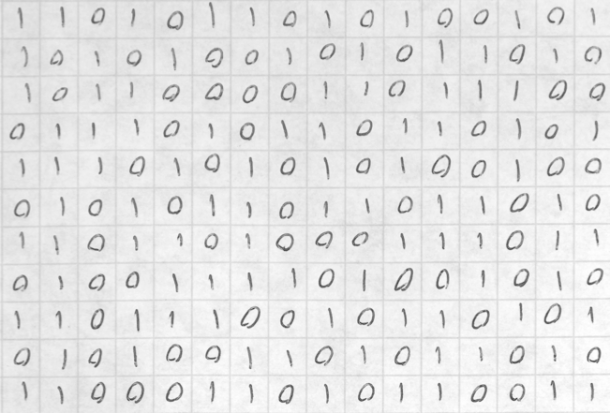
The products of automation, much of the digital world, gives us a lot that is disposable, forgettable. Merely a long sequence of zeroes and ones. Useful, yes, but I like having things that show evidence of a human hand at work, evidence that someone cared. Like my killer haircut. I guess I want to see a hand-written sequence of zeroes and ones that would make a quirky iPad.