Daily Prompt: Home

The WordPress Daily Prompt for August 19 asks, “You’ve been given the ability to build a magical tunnel that will quickly and secretly connect your home with the location of your choice—anywhere on Earth. Where’s the other end of your tunnel?”
__________________________________

“Home, is where I want to be
But I guess I’m already there
I come home, she lifted up her wings
I guess that this must be the place

I can’t tell one from the other
I find you or you find me?
There was a time before we were born
If someone asks, this is where I’ll be, where I’ll be”

—”This Must Be The Place (Naive Melody),” Talking Heads

Give me a country or pop song about home or going home and my immediate reaction is often, “That’s right. That’s what I need.” I am a sucker for cliche. I am not someone who makes wherever I am at the moment into home. The myth of Home will always outweigh the fact of Residence in my psyche.

Conversely, whenever I hear a “road” song like Geoff Mack’s “I’ve Been Everywhere” (best enunciated by Johnny Cash), it becomes a to-do list in my heart. I have not been everywhere, far far from it, but I ran when I could. Not far and not often, but let no one make your journeys anyone’s cliche. My travels are unique to my eyes and ears.

Wherever I have resided, I have carried a deep, living nostalgia for my previous life. Not when I moved from one apartment to another across town (I moved myself on foot across town once, not because I owned so little, but because this is how small the town I lived in is), but certainly when I moved across state or country. My nostalgia for the previous places in my life really only amounted to a present-tense desire for a current someplace else in my life. My friends in Iowa learned much about the Hudson Valley in New York; my friends here in New York, well, they took no interest in the Midwest. My Facebook is full of feeds and updates from different towns and newspapers I have visited and lived in.

So given the offer of a magical tunnel that may carry me from my front door to a location of my choice, I remember that there have not been many homes, but many addresses, and I have a long list of yets: Few photos of me in front of this or that famous place or thing. I have set foot in 22 states and three foreign countries. The countries are Canada (one drunken night in Montreal), Germany, and the USSR (cue the CIA investigation). The states are depicted below, but I am breaking a personal rule of including the states whose air I have not breathed because I did not leave the airport terminal (Minnesota, Missouri).


Visited 22 states (44%)

To me, the question asks where I would like to visit, hassle-free. But the hassle is often the only part of the story that survives the trip. And the return home, with one’s self slightly changed by the experience and one’s home not changed at all but displaying the pronounced evidence of one’s extended absence (dishes still where you admit to yourself you left them all this time), that moment of dreamy sleep-walking from room to room, that experience has always made wherever I was living at the time feel more like home.

For most of my life, I have needed a magical tunnel that would lead me to exactly where my feet were anyway. I desired that sweet sensation of waking from a long deep dreamy sleep every darn sleep-walking day I ever spent here, just to get me to get to work on time. There are many places I desire seeing, and there is a long list of yets on my bucket list or in my bucket, but Home is where I want to be.

Daily Prompt: Falling in Love with Falling in Love with a Place

The WordPress Daily Prompt for August 17 asks, “Take a look at your bookcase. If you had enough free time, which book would be the first one you’d like to reread? Why?”
__________________________________

On re-visiting Cape Cod this weekend, I remembered a favorite book, Henry Beston‘s “The Outermost House,” and decided to re-read it. I have not looked in its pages for 20 years and no longer own a copy. This sad situation was remedied with the money in my wallet being accepted at Yellow Umbrella Books. Since I was on vacation on Cape Cod, finding enough free time to re-read was not an issue.

Beston himself wrote perhaps the best physical description of Cape Cod in the book’s opening lines: “East and ahead of the coast of North America, some thirty miles and more from the inner shores of Massachusetts, there stands in the open Atlantic the last fragment of an ancient and vanished land. For twenty miles this last and outer earth faces the ever hostile ocean in the form of a great eroded cliff of earth and clay, the undulations and levels of whose rim now stand a hundred, now a hundred and fifty feet above the tides. Worn by the breakers and the rains, and disintegrated by the wind, it still stands bold.” He depicts a heroic shoreline, a land that declares its own terms of surrender against a hostile, battering sea. Given that Cape Cod resembles a single raised fist jutting in the air, a heroic, Byronesque, cliff face is only appropriate.

bretenmap1The house itself was a 20 x 16-foot cabin that Beston ordered built on the dunes near Eastham, Massachustts, along the Cape’s forearm, in 1925. It faced the ocean, and its many windows offered him a view of the water that made him feel like he was on a ship. Thus he called the house the “Fo’castle,” but it became known as the “outermost house” for an obvious reason: it sat at what seemed like the end of the earth. Beston never lived full-time in his shanty, but he spent enough time there to write his book which is subtitled, “A Year of Life on The Great Beach of Cape Cod.” Picking epic-seeming events from each of the seasons he experienced gives his “year” an intensity of action and feeling. The book was published in 1928 by Doubleday.

As a young man, I knew that I loved Cape Cod, for reasons of family and fun, but it was not until I devoured this short, 218-page, book, that I found the deeper reasons. It would be beautiful if every place on our planet could have a writer fall so utterly in love with it, as Cape Cod had Henry Beston. Beston’s brief meditation on the slow, usually imperceptible rhythms of nature—imperceptible because few bother to perceive them and communicate them—is written in a muscular language that makes the surf appear to have desires and dreams, the wind have language, the birds individual personalities.

It is not easy to take memorable landscape photos; the camera may capture every detail of a very detailed outdoors scene, but a photographer’s eye and hand is needed to direct our eyes to what he or she finds worth looking at. Otherwise, every beach snapshot is every other beach snapshot; they are alike in their uniqueness of sky and sand. The nature writer has even more difficulties: he could either be yelping on the page, “It was such a stupendous night sky full of stars! You should have seen it,” boring us with banal generalities, or, lurching in the other direction, boring us to tears with specifics. Beston finds the poetry in using the correctly applied terminology of whatever phenomena he describes. This was a revelation to my twenty-year-old self.

winter 2010 nantucket sound2

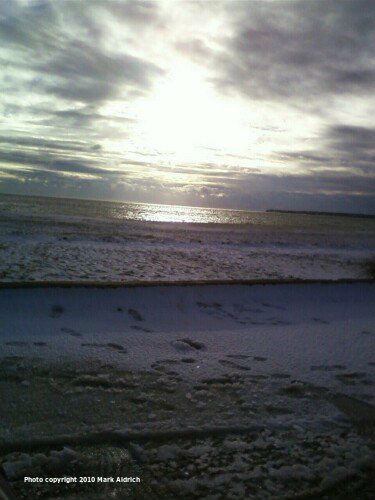
Cape Cod, winter 2010. Photo by The Gad About Town

Winter from atop the dunes is neither “frigid” nor “bitter,” two words that may frequent one’s letters home; rather it is “crystalline” and the snow is dancing and driving:

The snow skirred along the beach, the wind suffering it no rest; I saw little whirlpools of it driving down the sand into the onrush of the breakers, it gathered in the footprints of the coast guard patrols, building up on their leeward side and patterning them in white on an empty beach. The very snow in the air had a character of its own, for it was the snow of the outer Cape and the North Atlantic, snow icy and crystalline, and sweeping across the dunes and moors rather than down upon them.

When the National Park Service was evaluating the arguments for establishing the Cape Cod National Seashore, Beston’s book was cited frequently in the report’s pages. Beston died in 1968, and a sentence from “The Outermost House” is an epitaph: “Creation is still going on, the creative forces are as great and active today as they have ever been, and tomorrow’s morning will be as heroic as any of the world.” The cabin itself was swept away by the Blizzard of 1978, a nor’easter of heroic strength with historic effects; in other words, a storm that Henry Beston would have appreciated. The spot on the beach where the cabin stood, once atop the dunes, is now under the Atlantic Ocean, a portion of the Cape that the sea has claimed for itself.

No single development at any one location on the beach would have phased this wondering, passionate naturalist and writer, though:

And what of Nature itself, you say—that callous and cruel engine, red in tooth and fang? Well, it is not so much an engine as you think. As for “red in tooth and fang,” whenever I hear that phrase or its intellectual echoes I know that some passer-by has been getting life from books. It is true that there are grim arrangements. Beware of judging them by whatever human values are in style. As well expect Nature to answer to your human values as to come into your house and sit in a chair. The economy of nature, its checks and balances, its measurements of competing life—all this is its great marvel and has an ethic of its own. Live in Nature, and you will soon see that for all its non-human rhythm, it is no cave of pain.

* * * *
A documentary about Henry Beston and Outermost House is in production:

Henry Beston Documentary Trailer : Cape Cod from Mooncusser Films LLC on Vimeo.

Daily Prompt: The Li’l Guys

The WordPress Daily Prompt for August 14 asks, “Have you ever named an inanimate object? (Your car? Your laptop? The volleyball that kept you company while you were stranded in the ocean?) Share the story of at least one object with which you’re on a first-name basis.”
__________________________________

Each of the three cars I have owned … was it three? Let’s count. One exploded, caught fire, and melted into scrap before my eyes, one day after repairs to address its long-standing overheating issue. The next car was also prone to overheating—when one has owned a car that met its end via self-immolation, one develops a sensitivity to the matter—and I perpetually thought it was ten minutes from an explosion as well, but I saw it on the roads of my town for five years after I sold it. The last car was repossessed because I was not an adult back then, and banks like doing business with adults. So, yes, three.

Each of the three cars I have owned was always addressed as “she.” No proper names were given, though. As my disastrous history shows, it was best I not get too familiar with something I was going to mourn, sooner rather than later.

I have a superstitious nature, something that I am loathe to admit to. Place two identical pens before me, give me a day or two to use them, and I will declare one a favorite, and the other? I will have held it perhaps once, but I will have felt something about it frustrating or “wrong,” and left it alone. From then on, forever. I buy replacement pens even though I own many pens and have not been without a pen in decades. (The Zebra F-301 or G-301 model, for completeness’ sake. Black ink, 1.0 mm point size.)

blackwing

Pencil porn.

Pencils, too. I am probably the ideal Blackwing 602 customer, but I like money more. A 12-pack of the pencil—oh! Look at those gorgeous creations!—will set a customer back approximately $20 either online or in person at Barner Books in New Paltz. (Full disclosure: I have nothing to disclose and no business interests with Barner Books other than it is one of my favorite bookshops.) That is a lot of money for a dozen pencils, eight of which I might very well ignore for forever in my writing tool superstition. So even though I have held a Blackwing 602 only one time so far in my life and I drooled over its swift action on the page, I have not purchased a set and I tell myself that it is because these are knockoffs made by a company that bought the naming rights and not the classic pencils themselves. Those, the real original ones, pop up on eBay at prices like $60 for three pencils. Yes, unused.

My writing implement superstition has reared its head in my life with computers, though, sad to say for my wallet. At this point, it would take me longer than you have available for me to recount the number of computers, laptops, and handhelds I have owned. (I loved the Treo 90 and owned a half-dozen over the years, some of which felt right and some of which did not.) Some computers I became attached to like a beloved typewriter, others were only employed to go online and make sure I was still alive when I discovered that typing on them just didn’t “feel right.” Four years ago I purchased a full-sized laptop on which I tried to write a book. Either the keyboard was built too sensitively or I typed on it like an orangutan, but it no longer produces the letter C. (One of the top 13 letters in our alphabet.) When the briefly popular Netbooks came out (the era lasted approximately six months in 2006), I bought the Acer seen at top. Upon learning that the full-size machine was resistant to writing, at least any words that needed the letter C, I returned to the Acer and discovered I was making more progress on that book project. It sat, happy to be employed, on top of the full-size laptop and became known as the “Little Guy.”

The silver Chromebook on which the Acer sits in the photo above is the computer on which I have been typing The Gad About Town since 2013. The “click” of its keyboard satisfies some ancient Smith-Corona itch I associate with writing, unlike most of the computers I have superstitiously ignored. (They all “click” when you type on them like I do.) It is also the “Little Guy,” and I am not looking forward to replacing him (cars are she and computers are he in my world, I suppose), as I have a real book contract for a real book now and need to get to work without any superstitions interfering.