Queen of the Hudson

One of the unique things that is somehow common to many people (we are all alike in our uniqueness) is a stated belief that our hometown is no place special. We are taught to be humble, so anyplace that our humble selves hail from must be thought of as not all that special, either.

This often masks a fierce inner secret belief that one’s hometown is in fact the best place to be from and (insert name of a higher power one believes in here) please help those who chose to be born somewhere else, especially those unlucky ones born in the nearest next neighboring town. Those people are the unluckiest of all, perhaps because they were born so near to our town’s greatness but were not, which renders all the more dramatic their failure at their life’s first and easiest task: pick the right place to be born.
Read More

Henry Beston’s Cape Cod in Winter

The photo above was taken at Nauset Beach on Cape Cod on a December afternoon in 2010; the white glaze covering the footprints is ice and snow, and the Atlantic has ice in it—some of the white caps were frozen, and the waves merely swelled them, shifted them.

Henry Beston wrote perhaps the best physical description of Cape Cod in the opening lines to his classic book “The Outermost House“: “East and ahead of the coast of North America, some thirty miles and more from the inner shores of Massachusetts, there stands in the open Atlantic the last fragment of an ancient and vanished land. For twenty miles this last and outer earth faces the ever hostile ocean in the form of a great eroded cliff of earth and clay, the undulations and levels of whose rim now stand a hundred, now a hundred and fifty feet above the tides. Worn by the breakers and the rains, and disintegrated by the wind, it still stands bold.” He depicts a heroic shoreline, a land that declares its own terms of surrender against a hostile, battering sea. Given that from the air Cape Cod resembles a single raised fist jutting into the sea, a heroic, Byronesque, cliff face is only appropriate.
Read More

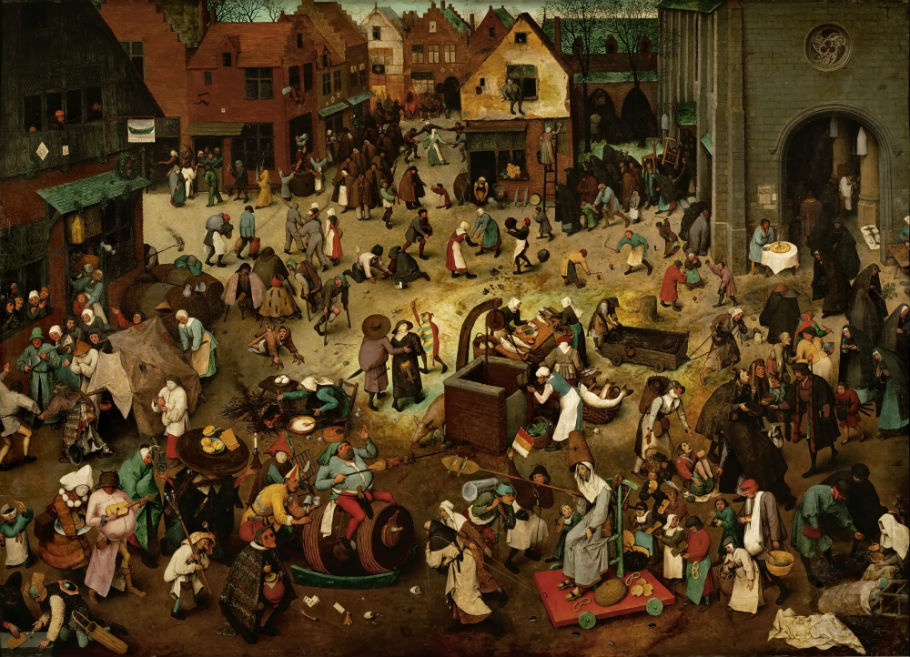
The Fight Between Carnival and Lent

Pieter Bruegel the Elder’s Kampf zwischen Fasching und Fasten (“The Fight Between Carnival and Lent”) depicts today, the day before Lent. Today is an important enough day in the Christian calendar to go by a few nicknames: Shrove Tuesday, Mardi Gras, “Fat Tuesday,” “Pancake Day.”

Any day that is associated with food, whether because restrictions are about to be imposed or restrictions are to be erased for one special day, by rights ought to have as many nicknames as it can bear.
Read More