A Work of Art That Is Both and Neither

Objects do not often speak for themselves. It takes the right artist or poet to find the voice the object demands.

I wish I still possessed a copy of my one published academic paper. I remember its subject but not its point. The late Thomas M. Greene was rumored to have liked it; he may have told someone who told another who eventually (a year later) mentioned to me that he considered my work “unique.” (In academia, “unique” is not always not a back-handed compliment, and if he had been my professor he might have asked me to make it a bit less unique.) Professor Greene was an invited guest to a symposium my graduate studies department was holding; I was one of about ten speakers. My work, unique or not, was not invited to Yale, which Professor Greene called home. I was working on George Herbert and Arcimboldo, who had little to do with one another but were both looking for that moment when a work of art transcends work or art.

George Herbert was an early 17th century poet and Anglican priest, though he might have flipped that order to tell you about himself. In a handful of poems, he gives voices to objects by shaping the poems. Each word is not merely necessary for the sake of meaning, it is needed for the poem to make sense visually. In his poem, “The Altar,” each word is a stone making up the altar that the poem is conceived as being:

A broken ALTAR, Lord, thy servant rears,
Made of a heart and cemented with tears;
Whose parts are as thy hand did frame;
No workman’s tool hath touch’d the same.
A HEART alone
Is such a stone,
As nothing but
Thy pow’r doth cut.
Wherefore each part
Of my hard heart
Meets in this frame
To praise thy name.
That if I chance to hold my peace,
These stones to praise thee may not cease.
Oh, let thy blessed SACRIFICE be mine,
And sanctify this ALTAR to be thine.

One word, a single syllable, too many or one word mislaid or deleted, and there is no altar there. It is an altar made of words but no less central to the life of a church than an altar made of stone. The poem appears in the only book of poems that he compiled himself, a book titled “The Temple,” which walks the reader, a “dejected poor soul,” through a church. Thus, the altar, “The Altar,” is central.

In later eras, poems like this came to be called shape or pattern or emblem poems. They are sometimes used to get elementary school students interested in, captivated by, poetry, the potential playfulness and the playful potentials of poetry. “The Altar” is not one of those poems given to elementary school kids with that playful ambition.

It is an altar, however. A “broken altar,” because words are shards of meaning like pieces of stone fitted together to make the church structure. A heart is the only perfect, unbroken, stone for worship, is the only true altar. But all that his heart can make is something out of these pieces of meaning, words, and if he can get out of his own way (“if I chance to hold my peace”), these words as assembled here only exist to worship and love. They are what they are, words, and the words each on their own are not an altar, and a spoken version of this poem is not an altar, either. When is an altar an altar? At what point is a poem something other than, more than, words on a page?

Printed on the page (or screen), it is an altar for Herbert’s church in book form. “The Temple” is like a 17th Century pop-up book for Anglican communicants.

Just before Herbert was writing his worshipful shape poems, an Italian painter named Guiseppe Arcimboldo was working in Milan. Arcimboldo died the year Herbert was born, 1593, and it is extremely unlikely Herbert ever heard of or saw replicas of Arcimboldo’s paintings. He may have understood them better than many contemporaries—by 1633, the year of Herbert’s death, Arcimboldo was already a forgotten figure in art, out of style, passé.

Arcimboldo openly toys with the conceit that what one is looking at is the thing it is depicting. His subject as an artist is the idea that a painting is only a painting and that you the viewer really do most of the work of “believing” that one is looking at something, some thing. This idea is similar to Herbert’s altar of words serving as an idea of an altar and as an altar at the same time.

When is a face a face and when is it a bowl of root vegetables? When is a painting a painting and something greater than a collection of chemicals on canvas?
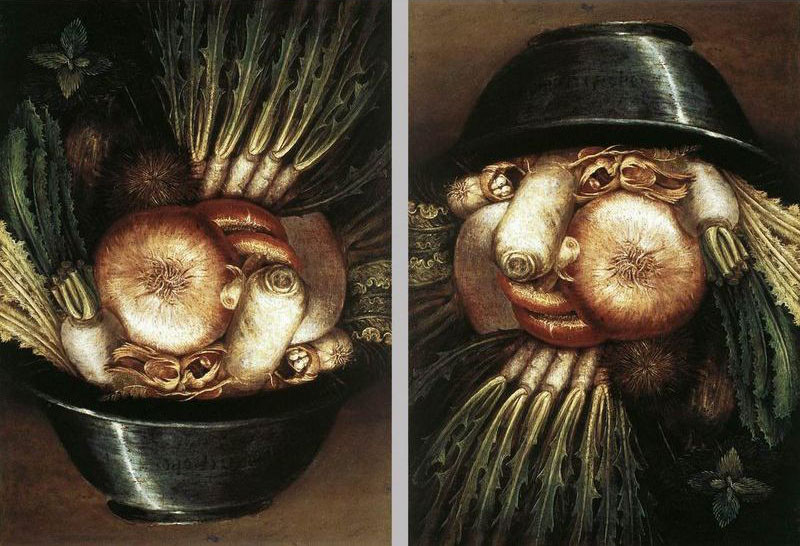
Vegetables In A Bowl, Or, The Gardener

As with Herbert’s “Altar,” one word, one vegetable, too many or one item mislaid, and there is no face there. It is as carefully assembled as all works of art that appear to be casually thrown together are. If only he had included the actual vegetables in the paints he used …

The Surrealists rediscovered Arcimboldo for themselves in the 1920s and ’30s, and his paintings have been popular ever since. Herbert never went out of fashion, because he was never a fashion. They are each the most humble of flashy artists, taking themselves out (“hold my peace”) of the way in the name of depicting an idea about ideas. An idea that was revolutionary in the 20th Century, that art did and did not depict anything and was its own thing, had precursors centuries earlier. A gardener is his vegetables, an altar has a worshipful voice; art is self-conscious in its forgetting of self.

____________________________________________
The WordPress Daily Prompt for November 7 asks, Yesterday, your pet/baby/inanimate object could read your post. Today, they can write back (thanks for the suggestion, lifelessons!). Write a post from their point of view (or just pick any non-verbal creature/object).”

* * * *
Please subscribe to The Gad About Town on Facebook: http://www.facebook.com/thegadabouttown

‘Thank You, Fog’

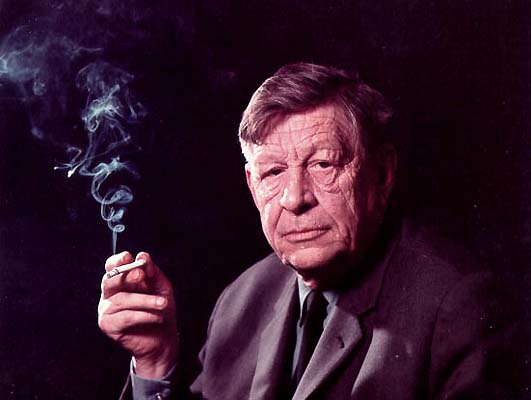
“My face looks like a wedding cake left out in the rain,” quipped W.H. Auden. Indeed, by the age of 60, Auden’s face looked like the most-read library book in the most popular library; it exhausted any adjectives thrown at it—it was its own adjective. His friend Hannah Arendt said he looked “as if life itself had delineated a kind of face-scape to make manifest the ‘heart’s invisible furies.'”

According to one biographer, Auden suffered from something called Touraine-Solente-Gole syndrome,

in which the skin of the forehead, face, scalp, hands and feet becomes thick and furrowed and peripheral periostitis in the bones reduces the patient’s capacity for activity. There [is] no therapy for the syndrome, which does not affect either life expectancy or mental status, but which account[s] for Auden’s striking appearance of grave, lined melancholy.— “Auden,” Richard Davenport-Hines

auden2

W.H. Auden

Auden probably had never heard of TSG syndrome so he may not have known that his rapid aging was the result of anything other than how he was living his life. It was a life lived in a cloud of cigarette smoke and almost continuous writing. Fueled by amphetamines, which he believed made him more productive, he certainly was productive: four hundred poems (many very long), almost the same number of essays and book reviews, several verse plays, and all written between the mid-1920s and his death in September 1973. At night, to bring that constantly working mind to some static place, he took sleeping pills and drank.

Towards the end, in May 1973, he wrote what may be his last loved poem, “Thank You, Fog.” He had lived in New York for decades and “Grown used to New York weather” and was “all too familiar with Smog.” Fog is unnamed until the end, the final word of the last line, but her name is knowable: Fog is smog’s “unsullied sister,” and years away had allowed the poet to forget “what/You bring to British winters.”

Auden in winter is a poet of few, but precious, loves: company and coziness. Fog brings both as he is kept in, with friends, for a week at Christmas. No birds outside, no outside, just friends doing crosswords and paying no mind to worldly concerns. The outside world, where one “minds one’s p’s and q’s,” only interrupts the proceedings in the form of the “Daily Papers,/vomiting in slip-shod prose/the facts of filth and violence/that we’re too dumb to present:/our earth’s a sorry spot.”

Warm by the fire, warmed by the company of friends, cozy. Aware that the earth’s a sorry spot, but unmoved by this for the moment, as coziness and comfort can sometimes trump it all. It is a cat dozing by a fireplace of a poem, and like a cat, it has claws: Who is the poet thanking? “No summer sun will ever/dismantle the global gloom.” (Ever? Ever.) “Thank you, Fog.”

* * * *
It is a rainy, gray November afternoon in upstate New York today, in which the light remains dim from dawn till after dusk; what color there is is colors that were: expired leaves lingering on branches, uncollected rakings shoved into the roads. Autumnal Auden comes to mind.

Thank You, Fog by W.H. Auden
Grown used to New York weather,
all too familiar with Smog,
You, Her unsullied Sister,
I’d quite forgotten and what
You bring to British winters:
now native knowledge returns.

Sworn foe to festination,
daunter of drivers and planes,
volants, of course, will cause You,
but how delighted I am
that You’ve been lured to visit
Wiltshire’s witching countryside
for a whole week at Christmas,
that no one can scurry where
my cosmos is contracted
to an ancient manor-house
and four Selves, joined in friendship,
Jimmy, Tania, Sonia, Me.

Outdoors a shapeless silence,
for even then birds whose blood
is brisk enough to bid them
abide here all the year round,
like the merle and the mavis,
at Your cajoling refrain
their jocund interjections,
no cock considers a scream,
vaguely visible, tree-tops
rustle not but stay there, so
efficiently condensing
Your damp to definite drops.

Indoors specific spaces,
cosy, accommodate to
reminiscence and reading,
crosswords, affinities, fun:
refected by a sapid
supper and regaled by wine,
we sit in a glad circle,
each unaware of our own
nose but alert to the others,
making the most of it, for
how soon we must re-enter,
when lenient days are done,
the world of the work and money
and minding our p’s and q’s.

No summer sun will ever
dismantle the global gloom
cast by the Daily Papers,
vomiting in slip-shod prose
the facts of filth and violence
that we’re too dumb to present:
our earth’s a sorry spot, but
for this special interim,
so restful yet so festive,
Thank You, Thank You, Thank You, Fog

____________________________________________
The WordPress Daily Prompt for November 6 asks, “Someone or something you can’t communicate with through writing (a baby, a pet, an object) can understand every single word you write today, for one day only. What do you tell them?”

* * * *
Please subscribe to The Gad About Town on Facebook: http://www.facebook.com/thegadabouttown

If You Don’t Know Where You’re Going …

George Harrison died 13 years ago this month. For nearly a decade before his death, he had been working slowly on a new solo album while dealing with a cancer diagnosis, surgery and treatments, a remission, and then, a new cancer and its eventual metastasization. He was also stabbed 40 times in a house invasion about two years before his death.

So George Harrison’s late 1990s was a period in which the “material world,” as he once called life, appeared to be a genuinely unpleasant place, one that no longer wanted him around, but he retained a sharp wit about it anyway. Asked about his attacker, Harrison said that he “clearly wasn’t auditioning for the Traveling Wilburys.” (The attacker suffered from untreated schizophrenia and was found not guilty of attempted murder by reason of insanity.)

Working on his music through all of this, Harrison finished enough tracks to have a rough cut of a full album, but he finally ran into the ultimate deadline when cancer was found in his brain and he was given weeks to live. He wrote out instructions for his son, Dhani, and musical collaborator, Jeff Lynne, and they produced his final work, the album “Brainwashed,” which they released a year after his death, in 2002.

James Boswell reported that Samuel Johnson once said, “Depend upon it, sir, when a man knows he is to be hanged in a fortnight, it concentrates his mind wonderfully.” Many variations of this quip are bouncing around literature, some of which credit Boswell, some Johnson, and some no one. “Death concentrates the mind.” It is one of those sentences that does not beg for an author because it feels like a thought no one would be the first to think.

A music critic, Robert Christgau, used a variation of the phrase in his one-sentence review of “Brainwashed”: “Say this for death—it focuses the mind.” Christgau was no Harrison fan; his review of the triple album, 23-track, “All Things Must Pass” read in part, “He’s never been good for more than two songs per album,” which was a reference to Harrison’s usual Beatles contribution per album. He gave it a C.

He gave “Brainwashed” three stars, though, and one of the songs he cited as noteworthy is “Any Road.” The song’s composition dates to the late ’80s, the last fertile period in Harrison’s career, but he had not recorded it or found it a home until the “Brainwashed” sessions.

Some of Harrison’s songs are written in something like the structure of a joke, with the chorus serving as a punchline to a set-up, a reply to the ideas contained in the verses. “Any Road” uses that technique; the line, “If you don’t know where you’re going,/Any road will take you there” feels almost-deep but it winks at knowing that it isn’t deep at all. It, too, is a sentence that does not beg for an author because it feels like a thought no one would be the first to utter. In fact, the Cheshire Cat says something like it to Alice.

The first verse and several after begin with the word “But,” which implies that the singer is replying to someone, something. There is another side to the conversation, but we do not get to hear it; the singer is grateful for the many-roaded ride thus far, and is neither asking for more parts to the journey nor turning down any more rides on any more roads.

Which isn’t deep at all and contains an entire life at the same time. A real Cheshire Cat trick.

Any Road, George Harrison
(Give me that plenty of that guitar.)

But I’ve been traveling on a boat and a plane
In a car on a bike with a bus and a train
Traveling there, traveling here
Everywhere in every gear

But oh Lord we pay the price
With the spin of the wheel with the roll of the dice
Ah yeah you pay your fare
And if you don’t know where you’re going
Any road will take you there

And I’ve been traveling through the dirt and the grime
From the past to the future through the space and the time
Traveling deep beneath the waves
In watery grottoes and mountainous caves

But oh Lord we’ve got to fight
With the thoughts in the head with the dark and the light
No use to stop and stare
And if you don’t know where you’re going
Any road will take you there

You may not know where you came from
May not know who you are
May not have even wondered
How you got this far

I’ve been traveling on a wing and a prayer
By the skin of my teeth, by the breadth of a hair
Traveling where the four winds blow
With the sun on my face, in the ice and the snow

But oooeeee it’s a game
Sometimes you’re cool, sometimes you’re lame
Ah yeah it’s somewhere
And if you don’t know where you’re going
Any road will take you there

But oh Lord we pay the price
With the spin of the wheel with the roll of the dice
Ah yeah you pay your fare
And if you don’t know where you’re going
Any road will take you there

I keep traveling around the bend
There was no beginning, there is no end
It wasn’t born and never dies
There are no edges, there is no sides

Oh yeah you just don’t win
It’s so far out, the way out is in
Bow to God and call him Sir
But if you don’t know where you’re going
Any road will take you there
And if you don’t know where you’re going
Any road will take you there
If you don’t know where you’re going
Any road will take you there

____________________________________________
The WordPress Daily Prompt for November 5 asks, “You’re asked to recite a poem (or song lyrics) from memory—what’s the first one that comes to mind? Does it have a special meaning, or is there another reason it has stayed, intact, in your mind?”

May 13’s “Occupy Daily Prompt” is titled, “They’re Talkin’ ‘Bout Me,” and offers the George Harrison quote as a topic. I wrote about it in November.

* * * *
Please subscribe to The Gad About Town on Facebook: http://www.facebook.com/thegadabouttown