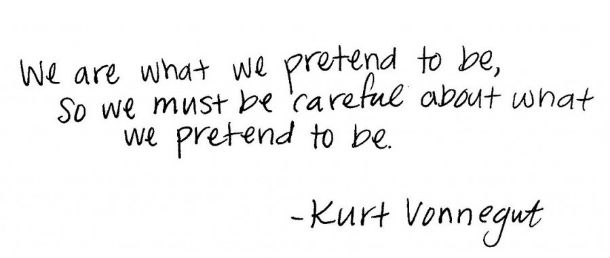
‘So it goes …’

Humans of New York, a website of photos and interviews with New Yorkers, was created and is operated by one young photographer who calls himself simply “Brandon.” It features Sidney Offit today.

Offit is a writer, nearly 90 years of age, who is better-known as a friend of the famous, a memoirist, and a curator of great writing—he helped found the National Book Critics Circle, which gives out one of the top-level book awards each year.

sidneyoffit

Sidney Offit

The caption to the photo at left reads: “Vonnegut said we live too long. He said: ‘You had your children. You wrote your book. Now don’t be greedy.’ Yet we all live with this fantasy of recuperation. We see an old photo of ourself, and we momentarily feel like that person again. We think: ‘I’m going to get back to that place.’ And we never get back there. But that desire gives us the ferocity to hold onto life no matter how bad it gets.”

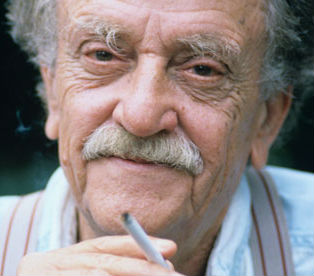
Offit was great friends with Kurt Vonnegut for four decades. Vonnegut’s birthday is tomorrow, November 11. He would be 92. He lived to be 84 and he considered what he told Offit to be a sort of ideal, but it was one he fell short of again and again, as he published fiction past 75 and opinion pieces until the end.

The accidental beauty of a pacifist writer born on November 11, which is Armistice Day—Veterans Day in the U.S. since 1954—was not lost on the novelist.

In “Breakfast of Champions,” Vonnegut reflected on the coincidence:

So this book is a sidewalk strewn with junk, trash which I throw over my shoulders as I travel in time back to November eleventh, nineteen hundred and twenty-two.

I will come to a time in my backwards trip when November eleventh, accidentally my birthday, was a sacred day called Armistice Day. When I was a boy, and when Dwayne Hoover was a boy, all the people of all the nations which had fought in the First World War were silent during the eleventh minute of the eleventh hour of Armistice Day, which was the eleventh day of the eleventh month.

Kurt-Vonnegut

Kurt Vonnegut, 1922–2007

It was during that minute in nineteen hundred and eighteen, that millions upon millions of human beings stopped butchering one another. I have talked to old men who were on battlefields during that minute. They have told me in one way or another that the sudden silence was the Voice of God. So we still have among us some men who can remember when God spoke clearly to mankind.

Armistice Day has become Veterans’ Day. Armistice Day was sacred. Veterans’ Day is not.

So I will throw Veterans’ Day over my shoulder. Armistice Day I will keep. I don’t want to throw away any sacred things.

What else is sacred? Oh, Romeo and Juliet, for instance.

And all music is.
The moment war ends is not a moment that ennobles the war effort that preceded it, or converts the two opposing sides into concrete moral certainties like right and wrong, but that one minute of peace is sacred. It may have been the only minute of serenity the world has known.

In Vonnegut’s work, remembering the past is sometimes the only way for a character to know that there even is a now. The past, the present, and the future may as well as be characters in his books. Three characters, each of whom considers the other two as being irritating and self-important.

* * * *
Here is a thought that I, Mark, visit and re-visit: I see an old photo of myself and I think I can return there. A previous year, another existence, is merely another place I have visited, lived in, breathed the air of. The 1990s are only as far away as a bus ticket whose price is a bit out of my reach; I think I can visit 1979 as easily as visit Phoenix if I would just save up for a couple months. I am going to see Vermont again, I am going to visit Iowa again; I have not seen the Pacific Ocean yet, but I know I will. Next year, maybe.

I know what the 1980s sounded like, what food tasted like then/there, just as I know what Cedar Rapids, Iowa, or Poughkeepsie, New York, sounds like. The ability to visit one (Poughkeepsie) but not the other (1983) offends me.

* * * *
Now is all we have and Vonnegut knew this, better than most. Reliving the firebombing of Dresden in February 1945 is fine, was necessary for him; coming to understand that February 1945 and November 1918 and November 2014 all co-exist in an eternal now is spiritual, somewhat; finding oneself frustrated at the expense of a bus ticket to 1983 is Hell in its exquisite pointlessness.

In one of his last interviews, recorded in October 2005, Vonnegut told public television’s David Brancaccio the point of it all. What life is too short and too long for.

He said that his wife asked him why he would go to the store for “an” envelope. Apparently he used to make his errands last all day: buy an envelope, bring it home, put the letter in it, bring it to the post office, and then treat the next letter with similar care. Vonnegut:

Oh, she says well, you’re not a poor man. You know, why don’t you go online and buy a hundred envelopes and put them in the closet? And so I pretend not to hear her. And go out to get an envelope because I’m going to have a hell of a good time in the process of buying one envelope.

I meet a lot of people. And, see some great looking babes. And a fire engine goes by. And I give them the thumbs up. And, and ask a woman what kind of dog that is. And, and I don’t know. The moral of the story is, is we’re here on Earth to fart around.

And, of course, the computers will do us out of that. And, what the computer people don’t realize, or they don’t care, is we’re dancing animals. You know, we love to move around. And, we’re not supposed to dance at all anymore.

____________________________________________
The WordPress Daily Prompt for November 10 asks, “Fill in the blank: ‘Life is too short to _____.’ Now, write a post telling us how you’ve come to that conclusion.”

* * * *
Please subscribe to The Gad About Town on Facebook: http://www.facebook.com/thegadabouttown
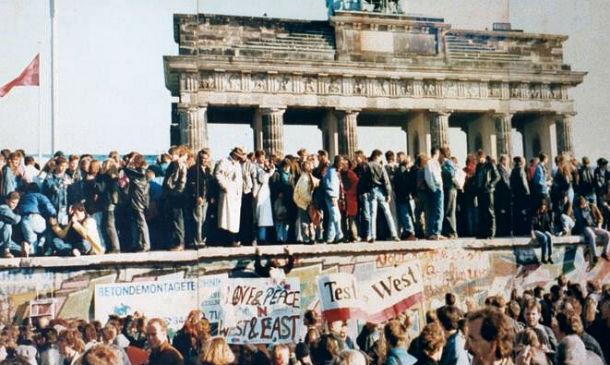
The Fall of the Berlin Wall

The demolition of the Berlin Wall started 25 years ago today, November 9, 1989. Nine days later, I turned 21, so every minute of my first 21 years except for a week was lived in the bipolar world of the Cold War.

Us versus them. It was served with our breakfast cereal, our school lunches, and the nightly news watched during dinner. The Cold War was a fact, a background noise, a tinnitus-like hum heard 24/7, sometimes from far away and sometimes next door. Its removal seemed to make us aware that it had always been there, how loud it was, and that it had been driving us all insane.

Since 1989, there have been many movies set in post-apocalyptic nightmare futures but by the mid 1980s our movies were starting to entertain the notion of depicting the apocalypse itself; in 1964, “Dr. Strangelove” ends with a sequence of images of mushroom clouds, which is shocking and direct—and very far away. On November 20, 1983, ABC television aired a made-for-TV movie called “The Day After” which graphically depicted the moment of apocalypse. In Kansas. (According to its Wikipedia entry, it remains the highest-rated made-for-TV movie in American television history.

A military build-up in East Germany leads to a standoff and diplomatic breakdown and both sides launch missiles. The movie does not dwell in the plausibility of the geopolitical story, though, since that really would not matter to innocent citizens on the ground; it shows the missiles exploding and the instantaneous and not so instantaneous deaths everyday people would experience. Conscientious history teachers sent their pupils home with requests that the students be allowed to watch in order to participate in discussions the next day; ABC announced at what minute the most horrifying scenes would begin (I seem to remember the broadcast was commercial-free).

My parents did not sign; I remain one of the few who did not see “The Day After.”

vilniusbBy 1989, it appeared that the end was beginning. In January of that year, I traveled to the USSR with a school group. We saw what it looks like when a country maintains borders not to keep people out but to keep its own citizens inside. In Vilnius, Lithuania, a truly beautiful city, an elderly woman approached us (our professor was Lithuanian, so he translated) and declared, “God bless Reagan!” In Kiev, Ukraine, something similar happened but the elderly woman did not need to be translated; she said it in English. In Leningrad, the same thing.

(I happen to be a liberal, a Democrat usually, and this love for Ronald freaking Reagan was not winning any points with me. But even I understood what was happening. I just wanted some love for Michael Dukakis, who had recently lost to Reagan’s vice-president, George Bush, in November.) Even I understood what was happening. Asked why the people we were meeting, both those speaking freely and the minders who could not speak freely, were not praising Gorbachev and perestroika, our professor spoke metaphorically: “When a jailer removes a prisoner’s head from a bucket of water, the prisoner is not going to thank the jailer for his kindness.” Maybe it wasn’t all that metaphoric.

I do not know if we were more or less closely watched than other groups usually were during our two-week visit, but no attempt was made to conceal watching us. The professor and I were given a personal last-moment tour of the inner workings of an interrogation room on our way out of the country.

From November 9, 1989, until Christmas 1991, when the USSR declared itself closed for business, the Cold War came to a sputtering conclusion. One side won or at least declared victory. It began with an exclamation point, the crowds atop the Berlin Wall, and many revolutions in many countries unfolded over those two years before the final chapter was written. For generations before, from the late 1940s on, the Cold War was the defining fact of life for citizens in dozens of countries on the two declared sides.

For people 40 years old and older, we grew up in an era in which the end of the world was a legitimate conversation topic. The images of the happiest people on earth breaking through that terrible wall 25 years ago today are a reminder of “The Day Before,” a period when “The Day After” of our cultural imagining was unspeakable horror.

Ever since, both sides have been working hard to replicate that bipolar worldview, that us versus them mentality. It makes for an easier foreign policy, which sometimes makes for an easier domestic policy. Looking at the 25-year-old images is like getting a message from a stranger letting us know that it is still all over, but we do not know who the caller is or what is still all over.

____________________________________________
The WordPress Daily Prompt for November 9 asks, “Someone’s left you a voice mail message, but all you can make out are the last words: ‘I’m sorry. I should’ve told you months ago. Bye.’ Who is it from, and what is this about?”

* * * *
Please subscribe to The Gad About Town on Facebook: http://www.facebook.com/thegadabouttown

Clean-up in Aisle Shakespeare

There is nothing wrong with Shakespeare that couldn’t be fixed by getting rid of all the violence, and, oh! those sad endings. So many of his plays end with a pile of bodies on stage and no detective to sort it all out for us and arrest the bad guys. No one leaves the theater smiling after seeing one of those productions.

For the first few generations of critics and theater producers that followed Shakespeare, this was a common attitude. The audiences loved Shakespeare from the start, the 1590s, when his plays started to be performed in London, even if they missed some of his … finer points. There were a lot of entertaining murders, after all.

Dr. Simon Forman was a doctor and astrologer of the era who would be forgotten except he kept a diary about his day-to-day life in 1610. In it, he recounts seeing several Shakespeare plays live in production at the Globe Theater. He describes seeing “Macbeth” on April 20, 1610, in what may have been the earliest production of the tragedy. He only devotes a couple paragraphs to describing the play and crams several acts into this:

Simon Forman's diary

Simon Forman’s diary

Then was Macbeth crowned kings; and then he, for fear of Banquo, his old companion, that he should beget kings but be no king himself, he contrived the death of Banquo, and caused him to be murdered on his way as he rode. The next night, being at supper with his noble men whom he had to bid to a feast, to the which also Banquo should have come, he began to speak of noble Banquo, and to wish that he were there. And as he did thus, standing up to drink a carouse to him, the ghost of Banquo came and sat down in his chair behind him. And he, turning about to sit down again, saw the ghost of Banquo, which fronted him so, that he fell into a great passion of fear and fury, uttering many words about his murder, by which, when they hard that Banquo was murdered, they suspected Macbeth. Then MackDove fled to England to the kinges sonn, and soon they raised an army and cam to Scotland, and at Dunstonanse overthrue Macbeth. In the meantime, while MacDove was in England, Macbeth slew MackDove’s wife and children, and after in the battle MackDove slewe Macbeth. Observe also how Macbeth’s queen did rise in the night in her sleep, and walked and talked and confessed all, and the doctor noted her words.

“Macbeth” was an action movie. Did Dr. Forman notice the themes of ambition, the arrogance inside pointless ambition, or the violence that that begets? Perhaps, but the revenge plot seems to have been the shiny bauble that caught his attention.

Enter Nahum Tate to the rescue. The Poet Laureate from 1692 till his death in 1715, in 1681 he wrote “King Lear.” You may have heard of “King Lear,” but that one, the one by William Shakespeare, is too sad. Cordelia is killed, Lear carries her dead body to the stage where he then dies, every audience member with a heart is weeping, and “Who wants a snack now? Anyone?” Everyone wants to go to bed and hide under the covers. Dr. Samuel Johnson thought that Shakespeare had gone too far in killing Cordelia; it “shocked” him, he said. He preferred “The History of King Lear” by Nahum Tate.

Tate’s Lear ends with Lear killing Cordelia’s executioners and Lear’s subsequent announcement of a wedding: He is giving Cordelia’s hand in marriage to Edgar. Lear then says that he is old and will retire to die sometime soon and gives his kingdom to the newly engaged. Edgar speaks the last line: “Truth and Virtue shall at last succeed.”

Tate did not try to put across his play as Shakespeare’s; the title page of the printed edition says it was “revised with alterations” and he writes a poem of praise to his forebear:

‘Twere worth our While t’ have drawn you in this day
By a new Name to our old honest Play;
But he that did this Evenings Treat prepare
Bluntly resolv’d before-hand to declare
Your Entertainment should be most old Fare.
Yet hopes, since in rich Shakespear’s soil it grew,
‘Twill relish yet with those whose Tasts are True,
And his Ambition is to please a Few.

Shakespeare’s rich soil. He goes on to state that plays ought to teach morals:

Why shou’d these Scenes lie hid, in which we find
What may at Once divert and teach the Mind?
Morals were alwaies proper for the Stage,
But are ev’n necessary in this Age.
Poets must take the Churches Teaching Trade …

This is a perfectly reasonable aesthetic stance and one that can be argued over, but not here, not today.

For over a century, Tate’s Lear was the play that theater-goers saw when they attended a production of King Lear. In the mid-1800s, the tragic ending was restored and around that time Shakespeare’s original version became the revolutionary and new version that everyone was talking about.

In the early 1800s, Thomas Bowdler came up with an idea: an edited edition of Shakespeare. His thinking was that if Shakespeare’s plays are of value, why not make those values more obvious? His “Family Shakespeare” promised to be an edition “in which nothing is added to the original Text: but those words and expressions are omitted which cannot with propriety be read aloud in a family.” A parent or teacher could confidently place the “Family Shakespeare” in the hands of a pupil and leave them alone with it “without fear”:

From [it] the pupil may derive instruction as well as pleasure; may improve his moral principles, while he refines his taste; and without incurring the danger of being hurt with any indelicacy of expression, may learn the fate of Macbeth, that even a kingdom is dearly purchased, if virtue be the price of acquisition.

Bowdler’s version of Macbeth sounds a bit boring after Dr. Forman’s description of an action-movie Macbeth from two centuries before.

Among his edits, Bowdler changed “Out, damned spot!” to “Out, crimson spot!” and he converted Ophelia’s suicide in “Hamlet” to an accident, which gives the lie to his claim that there would be “nothing added to the original text.”

Just as Tate was ridiculed in his time yet saw his renditions of the plays become popular in their own right, Bowdler was also ridiculed in his time but saw his editions become the best known version of Shakespeare’s plays for generations.

His name became a verb: “To bowdlerize” means to clean up a famous work and make it more “family-oriented.” A hundred years later, the entry for Thomas Bowdler in the 1911 Encyclopedia Brittanica, the most famous edition of that encyclopedia, plainly states what drives bowdlerization: “false squeamishness.”

____________________________________________
The WordPress Daily Prompt for November 8 asks, “A restaurant that removed your favorite item from the menu, a bad cover of a great song … Write a post about something that should’ve been left untouched, but wasn’t. Why was the original better?”

* * * *
Please subscribe to The Gad About Town on Facebook: http://www.facebook.com/thegadabouttown