Words and Things

The only message worth devoting much time and effort to communicating is love. Today, a sad news day, is a good day to remember that.

A few months ago I wrote about two artists who played with the question of whether what they are depicting is anything more or less than words on a page or paint on a surface. Both George Herbert and Arcimboldo (and Andy Warhol, in his own way) make art of the question, What is art? Is it what it depicts, an idea about what it depicts, both at the same time (which makes it a third option), or something less than? Is art, by definition, always a misfire, in that a depiction of a thing is not the thing and never can be?

Arcimboldo painted portraits of character types rather than individuals; for instance, a librarian composed entirely of books or a gardener made of vegetables in a bowl. That latter painting depends on the viewer to decide to see the bowl filled with veggies or a human “face.”

When is a face a face and when is it a bowl of root vegetables? When is a painting a painting and something greater than a collection of chemicals on canvas?
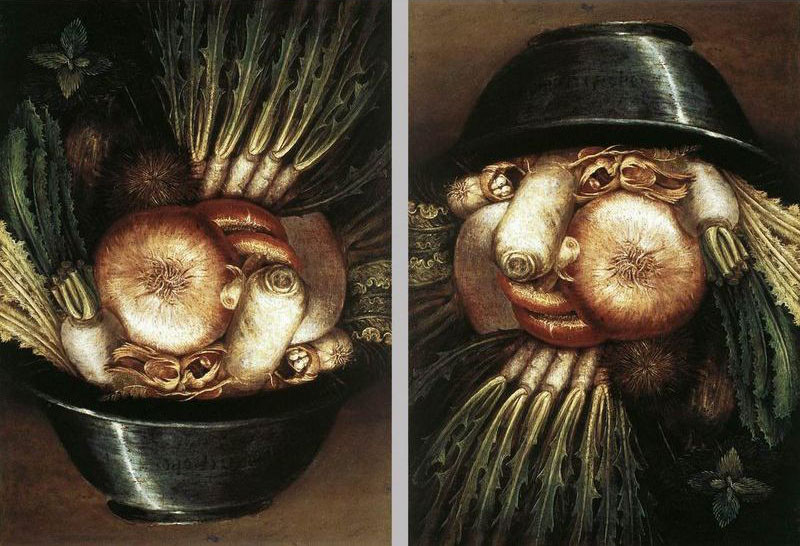
Vegetables In A Bowl, Or, The Gardener

George Herbert wrote poems about the only idea that he deemed to be worth considering: The eternal love of his Christian God and man’s time-and-space-and-language-constrained attempt to return that love. Two of his poems are written in the shape of what they are about. Like Arcimboldo painting a root vegetable for a nose, Herbert uses words to build an item; in one, “The Altar,” each word is a “stone” making up the altar that the poem is conceived as being:

A broken ALTAR, Lord, thy servant rears,
Made of a heart and cemented with tears;
Whose parts are as thy hand did frame;
No workman’s tool hath touch’d the same.
A HEART alone
Is such a stone,
As nothing but
Thy pow’r doth cut.
Wherefore each part
Of my hard heart
Meets in this frame
To praise thy name.
That if I chance to hold my peace,
These stones to praise thee may not cease.
Oh, let thy blessed SACRIFICE be mine,
And sanctify this ALTAR to be thine.

One word, a single syllable, too many or one word mislaid or deleted, and there is no altar there. It is an altar made of words but no less central to the life of a church than an altar made of stone. The poem appears in the only book of poems that he compiled himself, a book titled “The Temple,” which walks the reader, a “dejected poor soul,” through a church. Thus, his altar, “The Altar,” is central in the book. (At Herbert’s request, the book was published posthumously, with his stated desire that it might bring “consolation of [to] any dejected poor soul.”)

It is probably an untranslatable poem, in fact if not sentiment. (Indeed, an admittedly brief survey has not yielded one.) The shape of the poem is dictated by the number of syllables in his choice of words; it is a translation of an object, a real thing, into words anyway, and as such is forever a failure. It is a “broken altar.” The human heart is the only perfect, unbroken, stone for worship, is the only true altar. All that his mind can make is something out of these pieces of meaning, words, and if he can get out of his own way (“if I chance to hold my peace”), these words as assembled here only exist to worship and love. They are what they are, words, and the words each on their own are not an altar, and a spoken version of this poem is not an altar, either. When is an altar an altar? At what point is a poem something other than, more than, words on a page?

However well-constructed it may be—it looks like an altar, for crying out loud—it does not matter. It is no altar. Not even a photorealistic painting of an altar would be an altar. Further, no altar is truly an ALTAR, as no earthly object is made of the only stone of faith that exists: the human heart “cut” by God.

Herbert’s faith was that of a man for whom questions about faith were a part of it. His worship and his poetry exist in a space of failure, where a poem of an altar is not an altar but is a sort of altar, an attempt at one. His poetry depicts a figure who is struggling in every way to comprehend and return eternal love and who is met every time by a figure who replies that it is all a bit easier than he is making it. But all I have is language, Herbert’s speakers proclaim: “We say amiss / This or that is: / Thy word is all, if we could spell.”—”The Flower.”

Herbert often describes the moment when the perceiving of love comes easily, and it is always sensuous, often reads as if it is written to a new love:

Who would have thought my shriveled heart
Could have recovered greenness? It was gone
Quite underground; as flowers depart
To see their mother-root, when they have blown
—”The Flower”

But Herbert’s worshipper is always doubting himself, his faith, whether his faith is correct or not. In “Love (iii),” Herbert’s speaker is an unworthy guest in God’s (Love’s) home, but his host is gently persistent:

Love bade me welcome: yet my soul drew back.
Guiltie of dust and sinne.
But quick-ey’d Love, observing me grow slack
From my first entrance in,
Drew nearer to me, sweetly questioning
If I lack’d anything.

A guest, I answer’d, worthy to be here:
Love said, You shall be he.
I the unkinde, ungrateful? Ah, my deare,
I cannot look on thee.
Love took my hand, and smiling did reply,
Who made the eyes but I?

Truth Lord, but I have marr’d them: let my shame
Go where it doth deserve.
And know you not, sayes Love, who bore the blame?
My deare, then I will serve.
You must sit down, sayes Love, and taste my meat:
So I did sit and eat.

So if poetry is always at best an approximation of True Love, why not try to sing this struggle, as well? The “cheerfully agnostic” (which pretty much describes me, as well) English composer Ralph Vaughan Williams created five songs out of four Herbert poems a little over a century ago. The suite is called “Five Mystical Songs,” and one, “Love Bade Me Welcome,” is a setting of “Love (iii).” Some churches use the last song, “Antiphon,” as a hymn sung by the congregation.

Here is Sir Thomas Allen performing the set (in two sections) with the BBC Symphony Orchestra:

____________________________________________
The WordPress Daily Prompt for December 16 asks, “You have to write a message to someone dear to you, telling that person how much he/she means to you. However—instead of words, you can only use 5-10 objects to convey your emotions. Which objects do you choose, and what do they mean?”

* * * *
Please subscribe to The Gad About Town on Facebook: http://www.facebook.com/thegadabouttown

A Christmas Tree Story

I am sitting in my girlfriend’s office looking at her office Christmas tree. It is white, snow white, like a snowman in a a Rankin/Bass stop-motion cartoon. (Paul Frees would provide the voice.) We will be trimming it in a few moments.

office xmas

A white Christmas.

I think that tree trimming was my least favorite trimming when I was young. I still lack the eye necessary for decorating a tree correctly; in fact, I believe that almost every tree I have attempted to decorate has been quietly fixed upon my leaving.

(Two things transpired within moments of me writing the above: 1. My girlfriend credited me with expanding her notions of tree decoration—she said, “You’re the first person I’ve seen who does not put all the decorations on the ends of the branches,” which is true, I sometimes place them on the middle or even closer to the trunk; and 2. We found that I had overloaded one section with the same color ornament and we needed to correct it.)

One winter, a friend enlisted me in a project to cut down a real live Christmas tree from a Christmas tree farm so her son could experience a Christmas like the one she and I had never ever had. (The sum total of my experience with freshly cut Christmas trees was buying one in a parking lot from a seller who was asked by the police to pick up his trees and move it along seconds after we made an offer. We did not receive an “Everything Must Go Because I Am Being Busted” discount.)

Neither my friend, her seven-year-old son, nor I knew what cutting a live, six-foot-tall or smaller tree would take, so we brought the only saw that she knew she had. (I believe it was one that her uncle had rejected forty-five years earlier for one that was actually sharp; now, forty-five years later, it also had some rust.) We then drove to a tree farm in Dutchess County, New York. I have chopped wood plenty of times, and I have helped take dead trees down; neither of these experiences served me on this day.

The first task in cutting down a fresh Christmas tree for oneself is finding something to occupy the seven-year-old son of your friend—allowing the child to select the winning tree to preserve your friendship with his mom is advisable. Next up is failure in the negotiations with the seven-year-old to pick a tree that is not on a steep, snowy slope. (Happy people with skis were walking almost as far up as our tree was located. Almost. I was wearing sneakers.)

Many will ask the question, “Should I cut two notches to make a V or cut straight across?” I know I did, just not out loud or in the presence of someone who could tell me the answer. With my tiny, rusty saw and no one holding the other side of the saw, I started notching one side of a V. The blade sliced some bark off and did not penetrate the green wood underneath. The snow had already penetrated my shoes, though. The trunk was no thicker than two inches wide, if that—hey, I’m no tree-ologist!—but it was quickly apparent that I was going to need help.

With that in mind, I drove away my companion and her son with my grumpy “attitude.”

After an hour alone, my inner debate over cutting straight through versus cutting a V had produced several partial starts—some up, some down—all the way around the trunk of the tree. Instead of a V, I had notched something like a lowercase w but less useful, partway to the center of the tree. My friend returned and we commenced cutting straight across, because it was “taking me too long,” when we discovered together that there is nothing quite as unsatisfying as the sound of a tree not coming down no matter how far one has cut through it until it is ready to come down. Nothing unites like mutual frustration.

It eventually came down. I accompanied it down the slope … okay, I rode it down the hill like Slim Pickens at the end of “Dr. Strangelove.” I had not reminded my friend or her seven-year-old son to bring rope to tie it to the roof of her car, so we drove home with it sticking out one of the backseat windows. In my lap.

* * * *
My family had one plastic tree for twenty or more Christmases. It was a well-constructed one, actually, a bare metal trunk with a two or three hoops to hook in each individual branch around the tree. It actually had an instruction manual. Our Christmas tree and boxes of ornaments occupied several boxes in the basement; the annual production of “putting up the tree” was my introduction to grown-ups not being able to remember from one year to the next the locations of things they put away in the same box in the same place every year. And now I am that grown-up.

I am sure that my mother and father found it necessary to re-position my ornaments; I swear that something happens to me when I approach a tree, ornament in hand. I have hooked ornaments into shirt buttonholes when I swear I was aiming for the tree. Just as I wanted to cut my one live tree down in one graceful and strong sawing motion, I always want this ornament here and now to be the first, last, and only one needed to make this year’s tree the complete and perfect Christmas statement. I want someone to exclaim, “This is the most Christmas ever!” Christmas brings out the perfectionist in all his mistake-prone grumpiness in me.

Thus, the only part of decorating that I relax and enjoy is either throwing tinsel everywhere or putting the angel on top. (That is an unsung rite of passage, growing tall enough to top the tree with a star or angel.) We had an angel, a cardboard seraph with glued-on glitter and thin, stringy blonde hair. Its halo was glued-on, as well. But it was our angel, and when nicer, more expensive-looking, ones found their way into our house, they were always relegated to lower branches. My family’s underdog mentality extended to angels.

That mentality may have been the best, most lasting, gift from my family.

* * * *
(An earlier version of this was first published last December on my previous website. My girlfriend and I will be decorating the tree again this weekend.)

____________________________________________
The WordPress Daily Prompt for December 11 asks, “As it’s been a while since our last free-write … set a timer for ten minutes. Write without pause (and no edits!) until you’re out of time. Then, publish what you have (it’s your call whether or not to give the post a once-over).”

* * * *
Please subscribe to The Gad About Town on Facebook: http://www.facebook.com/thegadabouttown

Punching Out

I have my final pay stub somewhere around here, detached long ago from the check whose sum it explained. It dates from late June 2010 and I should bronze it like a baby’s shoes.

As it is for me with many other aspects of a common American—well, not just American, human—life, my relationship with work is, um, not uncomplicated. Off the top of my head, from age 15 till 40 I held 14 different clock-punching jobs from almost as many employers, with a couple employers that hired me more than once. Not included in the list is the newspaper reporter job I quit via fax machine the morning of day one, because I really am a terrible employee and I guess I wanted to prove it quickly, and the one time I was paid for an acting gig. (I was onstage with a cardboard box on my head and a ukelele in my hands—it was a little avant garde, and getting paid five bucks made it even more so.)

Life for me for the last four-and-a-half years has been nothing but free time, yet I have never been quite so productive. I will explain.

I have not been another person’s employee since the summer of 2010, when I was asked to leave my last job, which I had not enjoyed—with pay—for a total of three years and nine months, which is three years and nine months too many. The manager and I decided (quite amicably) that I no longer needed to consider him my boss and that he, equally so, no longer needed to consider himself my boss. On that much we agreed, so we parted company and even deleted each other from one another’s Facebook. It was that complete a firing.

The symptoms of my diagnosis had been prominent for most of the three years and nine months; I started walking with a cane in 2007. When the symptoms of adult spinal muscular atrophy first showed, they came suddenly. Only recently have I learned that this is a common experience among people with neurodegenerative diseases. When walking becomes difficult—in my case because the nerves that had been sending ever dimmer signals to my legs (whose muscles had started to atrophy from receiving ever dimmer signals, and thus were not being asked to work)—the end of normal walking comes as if everything had been just fine one day, and the next day it as if one’s shoes had been nailed to the ground or one’s co-workers had painted the floor with superglue. (I must not have liked the job very much, if I thought such a prank was possible!) It is sudden and scary when the progression of deterioration goes undetected and is even undetectable until the day it is completely not.

Since my last job was not a high-paying one and did not offer free or simply less expensive health insurance, I had none. So I neither spoke with anyone about my developing deterioration, nor did anyone suggest I do so. But being suddenly unemployed (so thoroughly unemployed my boss had unfriended me, please recall) meant I could get poor people’s health insurance, Medicaid. (This is before the Affordable Health Care Act, which also has in fact benefited me.)

With Medicaid came the, “Hey, doc, what gives with my legs?” conversation, and, eventually, the answer(s). With the answers came Social Security Disability, which is my sole income as of right now. If I had had insurance at an earlier date, perhaps I would have received the diagnosis and declaration of disability earlier and been able to leave my last employer on better terms. Entertaining such hypotheticals is a highly un-useful pastime, I find.

My barber asked me recently, “What do you do?” And I replied, “I am a retiree.” As I have written elsewhere, I am an alcoholic in recovery, sober several years, and I am living “Mark’s Life, Version 2.0.” The universe has afforded me a second life (not the famous online virtual community, a real second life), and the opportunity is not being wasted. I am writing, every day, on a schedule of my own fashioning, speaking with and sometimes counseling people.

There are three jobs every person in recovery thinks of pursuing, as I certainly did: becoming a counselor (but the hours of training are arduous), becoming a truck driver (perhaps because a desire to escape partly fueled the addiction and does not leave), and, after being told by enough people, “You oughta write a book about your stories,” a writer. Luckily, I already am a writer. My days are mine, every day.

(This is a revision of a column from August 21, 2014.)

____________________________________________
The WordPress Daily Prompt for December 9 asks, “You’re given unlimited funds to plan one day full of any and all luxuries you normally can’t afford. Tell us about your extravagant day with as much detail as possible.”

* * * *
Please subscribe to The Gad About Town on Facebook: http://www.facebook.com/thegadabouttown