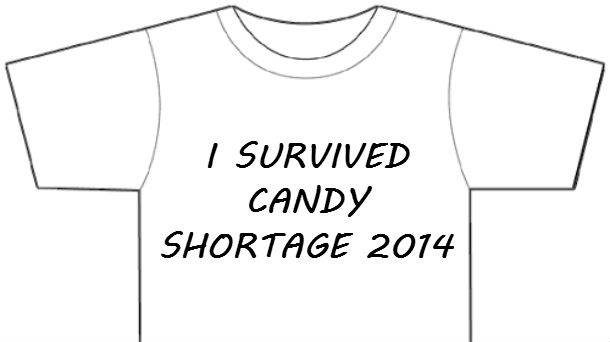
Candy Crisis 2014

As the 2014 candy shortage spread from city to city and finally house to house, the hoarders were found out. The police records from that autumn show a system overwhelmed by the sugar-starved criminal element. Pages upon pages detailing baroque crimes of candy hunger give way to long lists of numbers with no further details and then to blank pages, which speak volumes in their emptiness.

The shortage was blamed by politicians of one party on politicians of the other party. Banks blamed insurers and insurers blamed a system built to only anticipate the anticipatable. Leaders were few.

The more headline-devoted media outlets dubbed it the Candy Apocalypse but they were unready for the sudden absence of advertising revenue. The criminal element sent spokesmen to express shame that it was now connected to such bizarre crimes of hunger that even hardened criminals were abashed.

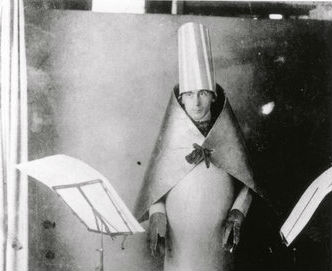
The Dadaists saved me. Surrealism only put off the candy-seeking hordes for a moment, long enough to shoo my family into a far room, but not long enough to protect my property. I dimly remembered a phrase, that drastic times called for something. It seemed that these were drastic times. “Drastic times call for … drastic leisure?” That did not ring a bell. “Drastic pleasure?” “Drastic times call for something really big,” I declared.

The doorbell rang that fitful Halloween night and I was prepared with my drastic big things to meet the drastic times; I prayed that confusion was my only chance to at bringing any sense to these fructose-enslaved zombies.

I was dressed as a sort of sorcerer, put a rug on my head to indicate fortune telling and oven mitts on my hands for claws. I spoke as slowly and as quickly as I could:

jolifanto bambla o falli bambla
großiga m’pfa habla horem
egiga goramen
higo bloiko russula huju
hollaka hollala
anlogo bung
blago bung blago bung
bosso fataka
ü üü ü
schampa wulla wussa olobo
hej tatta gorem
eschige zunbada
wulubu ssubudu uluwu ssubudu
–umf
kusa gauma
ba–umf
hugo_ball

Hugo_ball_karawane


The stunt was a raging failure and tonight I am writing this on the road, leading the procession to the next neighborhood, hunting, forever hunting in a soul-less search for more candy, candy that will never more be found.

* * * *
A flash fiction for Halloween 2014. We have plenty of candy here. Boo.

____________________________________________
The WordPress Daily Prompt for October 31 asks, “It’s Halloween, and you just ran out of candy. If the neighborhood kids (or anyone else, really) were to truly scare you, what trick would they have to subject you to?”

* * * *
Please subscribe to The Gad About Town on Facebook: http://www.facebook.com/thegadabouttown

‘The Way’

At one point in “The Quest,” his modernist version of a quest romance told in 20 sonnets, the poet W.H. Auden derides occult fascinations as “an architecture for the odd.”

The particular sonnet, which in some editions is titled “The Tower,” but in Auden’s official Collected Poems is simply called number “IX,” concludes with a warning from magicians caught in their own tower:

Yet many come to wish their tower a well;
For those who dread to drown, of thirst may die,
Those who see all become invisible:

Here great magicians, caught in their own spell,
Long for a natural climate as they sigh
“Beware of Magic” to the passer-by.

Contemporary pop astrology is one of those towers, as Auden might call it. The zodiac is a carving up of the night sky according to real geometry, with each of the twelve signs occupying a perfect 30°, which lends it a mathematical credibility and grounds it in things we might consider “real.” Pop astrology is not real. Once upon a time, the zodiac was a coordinate system grounding observers in a spot on the earth (if this star is in the sky at this angle I must be in Iowa) at a particular time at night (if this particular star is in the sky at this angle it must be autumn; further, it must be 1:00 a.m. Now, how did I wind up in Des Moines?) and so it was very useful. The sky was every traveler’s GPS. The zodiac was one way of reading it.

The belief that there is a connection between things happening on Earth and things happening in the night sky at the same time is such a seductive one that it has transcended human eras, societies, religions, and politics. Dictators and democrats alike have believed in auspicious and inauspicious times to begin initiatives or end policies. (Or lives.)

It is understandable that we humans would think of ourselves so non-humbly, that we would see ourselves not only as the conclusion to nature’s long eternal statement but that we would view ourselves as not merely a conclusion, a period mark, but as THE conclusion, an exclamation point. We are the one who knocks. We aren’t much, but we’re all we think about. In the universal scheme of things, however, humanity’s history may not even show up as a comma in eternity’s sentences.

And that is just fine. Nature or the Big You Know Who Upstairs granted us a wonderful gift, life, for no reason at all, which is the definition of grace.

The zodiac is as attractive as it is, even for those who recognize astrology as a human attempt to think like a god, because it contains and describes just about every human flaw and foible and positive attribute and success in such a compact container that it makes almost every human type seem predicted and even predictable. It appeals to writers for those same reasons, writers who were Jungian long before Jung existed. People born on November 18 (my birth date; it was a Monday, at dinnertime, 41.7000° N latitude) may carry with them certain tendencies and characteristics, or they may not, and the beautiful thing about astrology is that both of those statements—we may be similar and we may not be—are equally true. There is no need, or way, to add to such a comprehensive package.

In skies far from here, our sun might be a part of a constellation dictating zodiacal decisions on some other planet, in alien eyes wondering up at a night sky very different from and yet very similar to ours.

Sonnet number XIV of Auden’s cycle “The Quest” breaks with the previous chapters and their preoccupation with classical sonnet structures—Petrarchan, Shakespearian—and is written in a couplet form. It asks a question that is difficult for both skeptics and believers to answer: “[H]ow reliable can any truth be that is got/By observing oneself and then just inserting a Not?” In some editions the poem is titled “The Way.”

Fresh addenda are published every day
To the encyclopedia of the Way,

Linguistic notes and scientific explanations,
And texts for schools with modernised spelling and illustrations.

Now everyone knows the hero must choose the old horse,
Abstain from liquor and sexual intercourse,

And look out for a stranded fish to be kind to:
Now everyone thinks he could find, had he a mind to,

The way through the waste to the chapel in the rock
For a vision of the Triple Rainbow or the Astral Clock,

Forgetting his information comes mostly from married men
Who liked fishing and a flutter on the horses now and then.

And how reliable can any truth be that is got
By observing oneself and then just inserting a Not?
— W.H. Auden, XIV, “The Quest

____________________________________________
The WordPress Daily Prompt for October 28 asks, “You’re tasked with creating a brand new astrological sign for the people born around your birthday—based solely on yourself. What would your new sign be, and how would you describe those who share it?”

* * * *
Please subscribe to The Gad About Town on Facebook: http://www.facebook.com/thegadabouttown

An Actor in a Box

In his new novel, “The Zone of Interest,” Martin Amis gives us a fake fairy tale about a king and a wizard and a mirror:

Once upon a time there was a king, and the king commissioned his favorite wizard to create a magic mirror. This mirror didn’t show you your reflection. It showed you your soul—it showed you who you really were.

The wizard couldn’t look at it without turning away. The king couldn’t look at it. A chestful of treasure was offered to anyone who could look at it for sixty seconds without turning away. And no one could.— “The Zone of Interest,” page 34.

The character who recounts this fairy tale, Szmul, is a Jew who is a member of the Sonderkommando, those concentration camp prisoners who kept themselves alive for another week or two by taking the worst job possible in the entire history of jobs: stripping the corpses of their valuables. He calls Auschwitz a magic mirror, but one you can not look away from. Everyone in such a harrowing, forsaken place is utterly true, to their innermost core.

If there is such a thing as a soul or souls, a place like Auschwitz would be where one might find every kind, full of love or full of evil.

* * * *
I am an enormously self-conscious actor, yet I continue to half-heartedly work at it now and again. Here is an example from 2014 (I am the secret housemate, heard third in this radio improv):

As I said, I am enormously self-conscious and even hesitant as an actor or performer—I blush easily, which makes radio the perfect venue for the experiment (and if you write for that type of character, a blushing, stuttering sort, I’m your man)—but I was utterly free as a bird as a performer exactly once.

There is no record on paper or video of the single performance of the group Venus Effluvia. I do not even know how I remember our name, especially since I only remember two of its three member’s names, and I was one of them. (Mine is one of the names I remember.) We performed two songs, neither of which I remember; we lip-synced to a tape of two songs but actually played our instruments, three ukuleles. (It was most likely inspired by Andy Kaufman’s famous “Mighty Mouse” lip-sync act and also by a fear of flop-sweat driven by the fact that none of the three of us had come up with anything until the night before. As with many of the projects I have found myself in, the publicity preceded the creativity or was itself the creativity: We were on the advertised bill but had no act.)

It was a visual joke of performance art more than anything else, or anything at all: the three of us wore identical black suits and ties and each of us wore a plain cardboard box taped around our heads. I think someone’s girlfriend drew a smiley face on each one. This was in the summer of 1990, I was 21, and our afternoon audience in a coffeehouse in Cold Spring, NY, ironically or honestly requested an encore, which we did not give. There is such a thing as an honestly ironic appreciation, and I may have met it that day.

That cardboard box was my friend. I could not see anyone’s face or reaction and thus I clearly remembered our minimal choreography and even solo’ed on my ukulele. I am certain our effort was an embarrassment of poverty, but I lost myself in that box of non-self.

We were paid $20, split three ways; to this day, that five bucks is the only money I have yet earned as a performer. But that box-mask brought out a performer in me whom I have rarely met.

* * * *
“Authenticity” is a word that is much used in contemporary life. It is most often used to compliment someone when his or her outward presentation appears to be happily close to what we think is an inner self. “He keeps it real,” is a phrase I think I have heard too many times. There is a reason I prefer writing to performing—and I even blush while writing—and that is the myth of control I am choosing to embrace; that idea that I am giving the world my authentic self when writing, with no pollution from other influences. Staring at a piece of paper or at a computer screen is like staring at the inside of a cardboard box and the self-consciousness, the self-centeredness, the self, melts away.

But that may be a fairy tale I tell myself, because I know I would not look at a magic mirror for six seconds, much less sixty.

____________________________________________
The WordPress Daily Prompt for October 25 asks, “We’re less than a week away from Halloween! If you had to design a costume that channeled your true, innermost self, what would that costume look like? Would you dare to wear it?”

* * * *
Please subscribe to The Gad About Town on Facebook: http://www.facebook.com/thegadabouttown