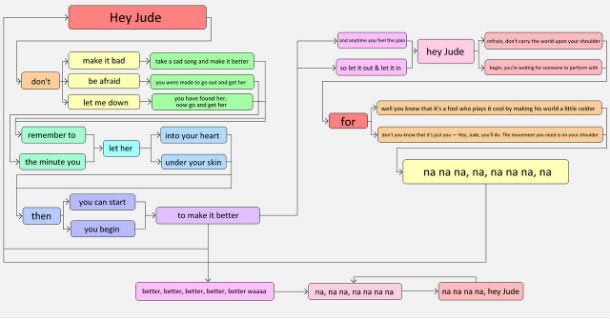
‘Hey Jude,’ November 1968

Paul McCartney was having a pretty successful season the autumn of 1968. Now, most of the autumns Paul McCartney has spent on this Earth in his adult years have probably felt quite successful, but 1968 may have been special.

In August of that year, The Beatles had two songs prepared for release as a single: “Revolution” and “Hey Jude.” The band was about to release its double album, “The Beatles” (more commonly known as the White Album), but these two songs were not going to be included. A rendition of “Revolution” appears on the album, but the group had another, a faster version, that it wanted released. “Hey Jude” and the hit single version of “Revolution” did not fit that already over-stuffed album, so the two songs were slated to be their new record label’s (Apple Records) first single.

The concept of an A-side and a B-side for a single seems quaint now in our era of digital downloads or Spotify and Pandora. It seemed quaint even then, too, as everyone knew that the two sides were equally easy or hard to play—anyone with functioning hands and limbs could place the record A-side up or B-side up as they wanted to—the B-side was not “unlocked” by playing the A-side a certain number of times. Thus, plenty of B-sides became hits in their own right and the record-buying public would school the labels in the matter of what it wanted to listen to.

The Beatles played games with the idea over time and even sometimes marketed singles as having “two A-sides”; when the band is The Beatles and most of the band’s songs are A-sides anyway, this makes sense. Apple’s first released single was not going to be treated as a gimmick like that. John Lennon wanted his composition, “Revolution,” to be the A-side, but the other three members thought otherwise. Because of The Beatles’ one-Beatle/one vote democracy, “Hey Jude” was backed by the feedback-heavy “Revolution” on a single that was released on August 26, 1968.

By the end of September, it was number one in the United States where it sat until the end of November.

The week that I was born, November 18, The Beatles not only had the number one song but also the top-grossing film. “Yellow Submarine” took over the top spot from “Head,” the cult film starring The Monkees and co-written by Jack Nicholson. Four different films topped the box office that November, with each one coming close to or topping three million dollars in tickets sales for the week, numbers that might not crack the top ten for a weekend now. They were: “Ice Station Zebra,” “Head,” “Yellow Submarine,” and “Lady in Cement.” “Yellow Submarine” outdid the other three that month.

Of course, The Beatles are not in “Yellow Submarine” except for the very last section. The voices of their animated counterparts were provided by actors, and the film studio, United Artists, was pleased but not happy about this. The Beatles owed one more film to the studio but to a man they had hated the experience of making movies; when the concept of an animated film spotlighting a handful of songs that might not have found a home in any other album was proposed, it sounded like a grand idea to the group. United Artists thought that this did not relieve The Beatles of their obligation, however, and demanded one more film, again, which is how “Let It Be” came to be made.

November 1968 was Paul McCartney’s month—more than anyone else’s except mine—because of a couple other songs. Apple Records had started to sign artists to its roster of performers, and one, a Welsh singer who was not yet 20, became his project. Mary Hopkin’s biggest hit briefly knocked her boss’ band’s “Hey Jude” out of number one in England but never got past number two in the United States. Even if one does not know it by name, if one has attended a wedding or a prom at any time in the last four decades one knows the song and her version: “Those Were the Days.”

McCartney also decided to produce a single with his favorite comedy group, the Bonzo Dog Doo-Dah Band. (I wrote the first of I hope many pieces about the Bonzos in March: Vivian Stanshall.) And so we have the tuneful, Beatles-esque, but utterly unique and Bonzo, “I’m the Urban Spaceman,” written and sung by Neil Innes and produced by Apollo C. Vermouth, a name McCartney awarded himself because …

Not many artists have had better months.

____________________________________________
The WordPress Daily Prompt for November 21 asks, “If your life were a movie, what would its soundtrack be like? What songs, instrumental pieces, and other sound effects would be featured on the official soundtrack album?”

* * * *
Please subscribe to The Gad About Town on Facebook: http://www.facebook.com/thegadabouttown

Perfect Day?

“You’re going to reap just what you sow.”

“Excuse me?”

And he repeats it four more times.

After deftly sketching some snapshots of a perfect day—a walk in the park, a moment in a zoo, me and you—the speaker/monotone voice in Lou Reed’s song of that same name leaves us with that pushy, inexplicable, and echoing last line.

On its surface—and like many good songs, it has more than one level—on its surface “Perfect Day” describes just that: The small moments of togetherness that make a perfect day. Heck, I would like this to be a song at my wedding, if I have one, except for that last line.

It was the B-side to Reed’s one top-40 hit, “Walk on the Wild Side,” so “Perfect Day” has been a radio regular for over four decades. Of the two songs, “Walk on the Wild Side” is the less complicated lyric, being a list and description of the personalities populating Andy Warhol’s Factory in the late-’60s–early-’70s.

“Perfect Day” starts out as a verbal picture postcard:

Just a perfect day
drink Sangria in the park
And then later
when it gets dark, we go home

Just a perfect day
feed animals in the zoo
Then later
a movie, too, and then home

“Just” is a heartbreaking word. The singer does not say it was a “merely,” “only,” or “simply” perfect day. Those modifiers look down at the word they are assisting. “Just” indicates completeness. A day spent doing whatever one planned on doing, visiting the zoo or not visiting a zoo, is perfect, complete unto itself. Further, “perfect” is not a step above good or excellent and has nothing to do with the quality of the day. It is not a “good” day or a “bad” day; it is a perfect day. A complete one, a full one. If all your ambitions for the day are small and are met, yes, that is just a perfect day.

And it sounds like it was a fine day, too. The activities are unimportant in the way that the mundane details of lives other than our own are not all that important. When we hear details about a friend’s date, we nod, smile emptily, and say that it sounds like it was “nice.” When our friend tells us he went to the movies with his new girlfriend, we don’t ask about the ticket price or how dirty the theater appeared to be, even though those are details that might be interesting, more interesting than “later a movie, too, and then home.” “Perfect Day” sounds like it is about a “nice” date, which is part of why the song is loved: We all (I hope) have experienced a nice date. It makes the song seem universal.

But then something happens:

Oh, it’s such a perfect day
I’m glad I spend it with you
Oh, such a perfect day
You just keep me hanging on

“Such” is not “just.” This is how tautly the song is composed, that a minor shift in the language betrays a change. “Such” is emphatic. Now, “perfect” seems to be statement about the quality of the day, and it is almost pushy, demanding agreement. “It’s a PERFECT DAY!” your scary friend declares when he has had a few too many. In performance, this is where most singers, Lou Reed included, start to sing. Here is where the music shifts, too. Up till now, it has been the singer’s voice and a piano, at least in most recordings. From the very first recording of the song, it is at this moment that strings appear and the voice gets double-tracked, bringing out the sweetness of the melody. In one famous performance, Luciano Pavarotti sings/bellows the “Oh, such a perfect day” line.

In 1966, The Supremes had a number one hit called “You Keep Me Hanging On.” Its opening verse

Set me free, why don’t cha, baby
Get out my life, why don’t cha, baby
‘Cause you don’t really love me
You just keep me hangin’ on

is not something that would be sung or spoken by someone having a “just” anything sort of day, much less a perfect one. It is one of The Supremes’ biggest hits, it is one of Motown’s most loved songs, and a songwriter can not quote it without invoking all the upset that that song contains and the declaration of independence that it presents. In Lou Reed’s song, the perfect day now is less of a nice postcard and just got interesting.

But he returns to the narrating of the day/evening/date, and now problems are acknowledged:

Just a perfect day
problems all left alone
Weekenders on our own
it’s such fun

Just a perfect day
you made me forget myself
I thought I was
someone else, someone good

That is a compliment that anyone in a good relationship would like to pay to their beloved. I would love to say this to my girlfriend, except the “someone good” phrase. Someone who says that you make them think they are someone good is either fishing for a compliment (“Honey, you ARE someone good”) or thinks that he or she is not good.

In 1997, the BBC created an ad to promote itself and came up with a clever idea: have over thirty performers sing one line each of a classic song. The song was “Perfect Day,” and Reed not only gave his blessing, he performed on the single. His is the first voice heard, thus giving the single (it raised money for charity) his imprimatur. It was a huge hit and went to number one in the United Kingdom, Reed’s only number one there.

Depending on the singer, the final line, “You’re going to reap just what you sow” can sound demanding, creepy, a declaration of independence, or the promise of a treat. Because now we have a distinct you versus me, no longer a we, and the singer is passing judgement. It could be a happy judgement: the object in the song has been sowing love and understanding so the singer could be promising a sweet result. But when sung in the same song as “You keep me hanging on,” something malign is being foretold. “Reap what you sow” is something usually said as a tsk-tsk, at minimum.

The BBC rendition has several participants share duties on the line, and they all seem to emphasize the interpretation of the song that promises a happy future with more perfect days to come. Especially Tom Jones.

I am not a reader or a critic who thinks that the absence of evidence means that whatever is absent from a work is what the work is “about.” There lies madness. Some critics have interpreted the song as a love song to addiction or at least to a substance. This is because Lou Reed was a heroin user, a junkie. Is this a love song or a conflicted love song to the needle? Perhaps, but the needle is not in the song. When Reed wanted to sing about heroin, he did, clearly and emphatically. (“I’m Waiting for the Man.” “Heroin.”) What is in the song, what the song is about, is a not-unconflicted, not-uncomplicated love story, which is every love story, and thus is about one perfect day in that.

Thus, conflicts hinted at and all, it is a nearly perfect song, but that is why it will not be played at my wedding.

____________________________________________
The WordPress Daily Prompt for November 20 asks, “What’s your idea of a perfect day off: one during which you can quietly relax, doing nothing, or one with one fun activity lined up after the other? Tell us how you’d spend your time.”

* * * *
Please subscribe to The Gad About Town on Facebook: http://www.facebook.com/thegadabouttown
Who’s My Great-Great-Great-Great … Grand-Who?

“All happy families are alike; each unhappy family is unhappy in its own way.”—Leo Tolstoy, Anna Karenina

To the best of my knowledge, there are no murderers in the part of the family tree that leads directly to me. I have done my best to maintain this streak of successfully not murdering anyone, but if I am ever accused, I will not be the first person named Mark Aldrich to be charged with murder.

Almost every person with the last name Aldrich in the United States is descended from George Aldrich of Derbyshire, England, a tailor who was born in 1605 and emigrated to America in 1631, a decade after the Pilgrims. He is my great-great-great-great-great-great-great-great-great grandfather and probably the only one whose name I will know. George and his wife Katherine Seald Aldrich settled in Dorchester, Massachusetts, had 10 children (one, a daughter who died in infancy, bore a classic Puritan name, “Experience”) moved to Braintree, and then moved to Mendon, Massachusetts, where his name is inscribed on a monument naming the town’s first settlers.

His second son, Joseph, is the great-great-great-great grandfather of Rhode Island Senator Nelson Aldrich, whose daughter Abby, married John D. Rockefeller II and was the mother of several prominent Rockefellers. One son, Nelson Rockefeller, carried “Aldrich” as his middle name.

Another son, Jacob, had a dozen children, and those from his son, Joseph, were early settlers (in the 1740s) of Mattituck, on the east end of Long Island, and the Tafts, including President Taft.

One of Jacob’s other sons was named Peter, born in 1686, and he is my direct ancestor.

The sheer proliferation of Aldriches in America—when ten children have ten children, the family tree suddenly has a lot of branches on it—makes research a challenge. The genealogies have notes like, “Jacob 2 and Jacob 4 both had sons named Jacob who married wives named Sarah, or they are the same Jacob.” I exaggerated that a little.

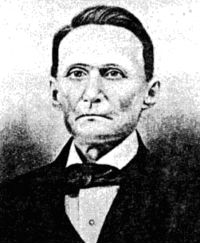
Thus I do not know which line in upstate New York produced Mark Aldrich. The one in 1801. The Mark Aldrich from upstate New York born in 1968, that one is me, last I checked. But in 1801, Mark Aldrich was born near Lake George, New York, son of Artemus Aldrich. He is not my namesake. By the date of his death, September 1873, in Tuscon, Arizona …

Tuscon?

His death notice in the Arizona Citizen fills in some blanks: “Hon. Mark Aldrich died in Tucson, Sunday evening, of old age. … A very large number followed his remains to the grave. The Masonic Brotherhood took charge of his remains and buried him in accordance with the rights of the order.

Mark Aldrich. Not me.

Mark Aldrich. Not the me Mark Aldrich. The other one.

The deceased was seventy-one years of age. He was born in the state of New York, but subsequently settled at Warsaw, Hancock County, Illinois. We know but little of his early history, but are informed that he was three times a member of the Illinois Legislature, and served with Lincoln, Douglass, and other distinguished men who have since written their names high on the roll of fame.He came to California in 1849, and we believe engaged in mercantile pursuits. Of his history while there we are not informed.

He came to Arizona in the latter part of 1855, and has since resided in Tucson. He was the first American merchant in this town, the first postmaster, and the first alcalde.

“Mercantile pursuits” in California in 1849? Whatever might those have been? That was the year the Gold Rush started. The first alcalde of Tucson? “Alcalde” is spanish for “Mayor,” so he was the first American mayor of Tuscon, Arizona.

But the early history that the newspaper writer “knew little of?”

Hancock County, Illinois, in the 1830s was where Joseph Smith had led his followers in the Latter Day Saint Movement. Aldrich tried to sell Smith and his followers some land that he owned but Smith did not purchase. After renting the land, however, Aldrich turned into one of the worst landlords (or best, for Mormon history) and started changing the terms of the lease at whim. Smith and the early Mormons left and settled what became Nauvoo, Illinois; Smith named himself mayor and announced a run for President of the United States. Aldrich went bankrupt.

Nauvoo is in Hancock County, the same county that Aldrich’s land had been on. Now a vocal opponent of the incipient LDS movement, Aldrich was also one of those figures one still sees a lot of in small-town America: he seems to have always been in at least one elected or appointed position wherever he resided. He was a major in the Illinois State Militia, and in June of 1844, Joseph Smith had been arrested and was being held in the Carthage City Jail.

Smith was charged with ordering the destruction of the Nauvoo newspaper facilities because the paper, founded by former associates who turned against him, had printed stories accusing Smith of polygamy. The newspaper was declared a public nuisance and its press was destroyed, but so was its building. When a neighboring town issued a warrant for Smith’s arrest, he declared martial law in Nauvoo, which turned the issue into an Illinois issue and the governor ordered Smith put on trial.

Smith was held with his brother in the Carthage City Jail and on June 27, 1844, a mob of hundreds stormed the jail. The two prisoners were killed. Someone had to have let the mob in. Someone had to have directed the mob. Aldrich, a militia major with men under his command who took part in the mob, was charged with four other men. A trial was conducted and an all-non-Mormon jury acquitted the five. Aldrich ran for sheriff of Hancock County the very next year.

When I lived in Iowa, near Nauvoo, a friend invited me to visit Nauvoo. She did not know this history and I decided against risking matters.

Within a decade, Aldrich was an early settler of Tuscon and its first American mayor. And his body is, to this day, buried under the streets of Tuscon. The cemetery in which he was interred was closed by 1890 as the city grew into city-hood and paved things. Most remains were moved to other locations in subsequent decades but no record exists that states that any Aldrich relative claimed the body of the former mayor and accused-but-acquitted murderer of the founder of the Mormon Church.

____________________________________________
The WordPress Daily Prompt for November 19 asks, “We all have that one eccentric relative who always says and does the strangest things. In your family, who’s that person, and what is it that earned him/her that reputation?”

* * * *
Please subscribe to The Gad About Town on Facebook: http://www.facebook.com/thegadabouttown