Daily Prompt: Unasked Questions

“AMA” no longer stands for the “American Medical Association” or “Ameliorating My Attitude.” (Never heard of that one? Neither have I. It doesn’t exist.) In our Twitterverse and Redditworld, AMA is now the acronym for “Ask Me Anything.”

And we can. Even Pope Francis (yes, THAT pope) has a Twitter account, @Pontifex, as does the Dalai Lama, other religious figures, and every politician. Or at least their offices have Twitter accounts. Here is a recent papal Tweet:

The sentiment may be true enough, but what stands out is that the pope gets a lot more retweets than I do. This is irking, as I have been on Twitter (@MarkSAldrich) for far longer.

For the last few years, public figures from the president to famous actors have scheduled AMA sessions on Reddit, on Facebook, and on Twitter, the start of which is usually announced with a photo of the famous person holding a handwritten sign stating “Ask Me Anything” and the day’s date. The “holding a sign” part often makes the famous person look a bit like a hostage. Like poor Bill Gates (well, those three words do not often appear in that particular sequence!) here:

reddit-600x303

In the old days of any time before now, if one wanted to ask a famous person a question, one had two available methods: A. Study and work very hard and become famous oneself and learn to befriend other famous people, one of whom is the person you always wanted to ask something, anything. Sidle up to that famous person and say something like, “You know, I have always wanted to ask you something. In fact, I worked and studied very hard to become famous myself and I became famous and I became friends with you just so I could ask you something. And now I do not remember what it was. What an amazing short story this would make! More caviar?” B. Write them a letter, purchase a stamp, place the letter in an envelope and the stamp outside the envelope, mail it and hope to receive a reply.

Somewhere, my mother has a scrapbook filled with autographed photos of Hollywood celebrities of the 1950s; in some rare cases the movie star hand-wrote a note of thanks. I do not believe she “asked them anything” personal, so she did not receive any news making replies. (Luckily, she did not have this mailman working in her neighborhood: “Brooklyn Postal Worker Arrested for Not Delivering a Decade’s Worth of Mail.“)

Part of the appeal to the contemporary social media “ask me anything” sessions, and to the fact that many famous actors and writers and some famous politicians personally work on their Twitter/Facebook accounts and reply to us everyday sorts, is to be impertinent to them. Call it the “BaBaBooey Effect.” This is the opposite to the “Access Is Everything” attitude which we sometimes see in the press, the “‘Meet the Press’ Effect,” in which reporters whose employment depends on continued access to important people do not ask difficult, impertinent, questions, questions that might make the important person cut off future access. People who are not reporters might shout a verbal graffito (“Bababooey”) and make some noise, become a part of the story. They are easily ignored, but so are the Sunday morning talk shows, on which news is rarely found or broken.

Instead, news is more often broken when a reporter who knows that he or she will lose access to a famous news maker if they in fact ask them anything, goes ahead and asks that one question. Or when, as with shows like “60 Minutes,” the show reports on some shady business whose practices are worth exposing by sending a national reporter who will not face backballing in his or her own neighborhood because he or she exposed a neighbor’s shady business practices, like a local reporter would.

Early in my brief local newspaper reporting career, I actually heard this from the sidewalk below my second-floor apartment: “We can’t talk here. I see the light on in that hack’s room.” That felt like a huge compliment coming as it did from someone I was publicly writing about. “I’m a hack! I’ve made it.” Then I thought, “How does he know where I live?”

It was a criminal matter I was writing about, after all. But given one question to ask one person, I might go back in time to that night and yell out my window, “How do you know where I live?”

____________________________________________
The WordPress Daily Prompt for September 26 tells us, “You’ve been given the opportunity to send one message to one person you wouldn’t normally have access to (for example: the President. Kim Kardashian. A coffee grower in Ethiopia). Who’s the person you choose, and what’s the message?”

Daily Prompt: Life Is Steep

I read a phrase today that I think should be used more commonly. Where I saw it, though, I do not remember. It appeared to be a typo, but if it was written like this on purpose, it looked like an artful accident. The writer described a learning experience as a “learning curb.” How great a pair of words is that?

I like collecting phrases like that. I enjoy proudly coining them myself even more, so I wish I could claim credit for this one. But I can not. I wish I could credit this writer—but does he or she know that there were was this epic phrase in their post? As I said, it looked like an accident, a typo. In the context it looked like they thought they had typed “learning curve.”

Many of my learning experiences did not have mere learning curves or even steep learning curves; indeed, there were “learning curbs,” on which I banged my forward progress to a sudden stop or flipped my vehicle.

Learning to drive, of course. An easy example. My first driving teacher was my father, and he is still with us and driving, and I am still here, so he must have done a good job. (I no longer drive, because of my spinal muscular atrophy; more than once I have watched my right leg move when I meant to move my left leg, my left for my right, and neither leg when motion from either one would have been good, which sucks and is sufficient to keep me unambitious about driving again. There are cars with hand controls, though.) My sole memory of my father teaching me to drive is his selection of an unreasonably steep hill in the City of Poughkeepsie (Noxon Street) to test my parallel parking skills. It was smart in that it made the lesson difficult and made the point: For my dozen years as a driver, I successfully avoided all parallel parking situations. I parked across town and walked to avoid parallel parking. I still have dreams in which I fall off the side of a city.

My next driving instructor was a coach at my high school, and he made me aware of something that I have struggled with my entire life, and not only when driving: I am a control freak, to use that overused expression. He gazed on my white knuckles pushed against the steering wheel, my fingers spread wide to enclose as much of the wheel as I could hold in my hands at once, and said, “Relax your hands. Those cars have drivers, too. You can only drive this one.”

I failed my first driving test. Of course. Sixteen years old (or whatever age) and a white, preppy-ish, suburban kid, like the boy-child I was? If anyone reading this is a driving tester, I hope you please flunk anyone matching that description, at least once. I earned my license on the second test, which my memory tells me I took later that same day, but knowledge of how things actually happen on Planet Earth tells me that this could not have been so.

I am a control freak. And I usually fail the first test, the tests in life where any coincidences between information in books and the facts in reality are revealed to be rare or nonexistent. (Any script that any retail manager has given me, no matter how well I have memorized it, has been blown up by the first real customer on the sales floor, who inevitably asked me something that did not appear anywhere in the script. Like if I knew the location of a bathroom.) But life has given me more than my share of second chances at these tests, more than I deserved or expected, deserve or expect. Eventually I learned that you can drive your vehicles far better than I can drive yours for you, as long as I pay attention to mine. Life gives us some steep learning curbs.

__________________________________
The WordPress Daily Prompt for September 25 declares, “Our free-write is back by popular demand: today, write about anything—but you must write for exactly ten minutes, no more, no less.”

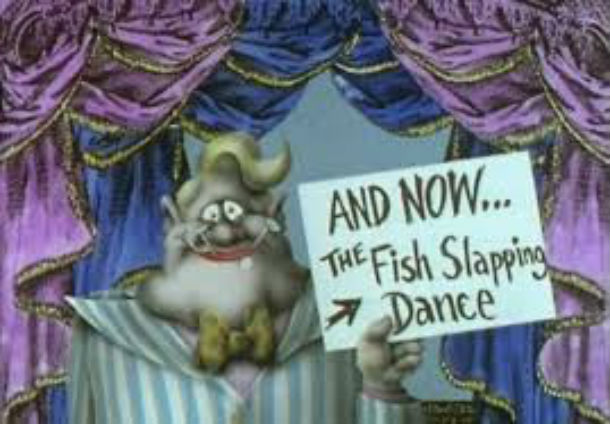
The Fish-Slapping Dance

“If you had to come up with one question, the answer to which would determine whether or not you could be friends with a person you’ve just met, what would it be? What would the right answer be?”

“That’s a great question. Oddly comprehensive, yet a little intrusive at the same time.”

“I agree, but my usual ice breaker question is to ask people that I have just met what their ice breaker question is. So, what is it?”

“Did you want more coffee?”

“That’s your question?”

“No. Your cup is empty. Free refills, hon’.”

* * * *
The speed with which one can determine the depth or length of a friendship—somewhere between forever and not at all—is inequal to the facts of a friendship. How many reminiscence-conversations have you had with friends in which you have learned that either your memory of meeting a friend is faulty or that the friend did not like you on first encounter? I have had both types.

I hinted in a recent column, okay, I explicitly stated in a recent column that if you find the “Fish-Slapping Dance” funny, you and I will more than likely be friends for life.

It may be the Monty Python troupe’s quickest route to the biggest laugh. I wrote, “If you do not find the ‘Fish-Slapping Dance’ funny, it may be because you find the waste of intellectual effort offensive. Or perhaps fish jokes generally turn you right off. ‘How is this funny?’ becomes the same question as ‘Why is this funny?’ ‘Why is T H I S on my screen?’ The ‘Fish-Slapping Dance’ actually can be seen as a depiction of the ‘How is this funny?’ conversation. Michael Palin, the ‘little fishes,’ dances the question, and then John Cleese, the ‘big fish,’ delivers the only possible retort: ‘It is or it is not.’ Splash.”

I can over-intellectualize and explain how the bit does not work, but every attempt I make falters the moment Michael Palin hits the water, when I laugh, sometimes quietly and sometimes out loud, every time.

I knew approximately two things when I wrote this a couple of months ago: that my girlfriend, the closest friend I have, probably does not know much if any Monty Python material and that I do not know if we share a sense of humor, even though she and I laugh a lot at many of the same things and same comics. For instance, her response after listening to some recordings of my radio show was to say that it was nice hearing my voice and that I sounded like I was enjoying myself. It is a comedy show.

Thus, I was rather nervous when I posted the Monty Python video above, several weeks ago, as she might very well read what I wrote, view the classic bit of comedy, and then instant message a break-up with me. I did not know what I did not know, but I was going to learn sooner or later. Are we companions for life, based on one sixteen-second joke?

“I’ve been sitting in my office, laughing at that.” she wrote me that night. Thus, my belief that the Monty Python “Fish-Slapping Dance” is the litmus test of comedy, a proof of companionability, was sustained.

Kindergartners may have the most effective conversations for establishing a friendship: favorite color, up versus down, best food. Matters of eternal importance like those. I try to remember this and always keep track of what is important to me, just in case someone wants to know on the spot: Green, the number 4, the letter N, the word Yes.

__________________________________
The WordPress Daily Prompt for September 23 asks, “If you had to come up with one question, the answer to which would determine whether or not you could be friends with a person you’ve just met, what would it be? What would the right answer be?