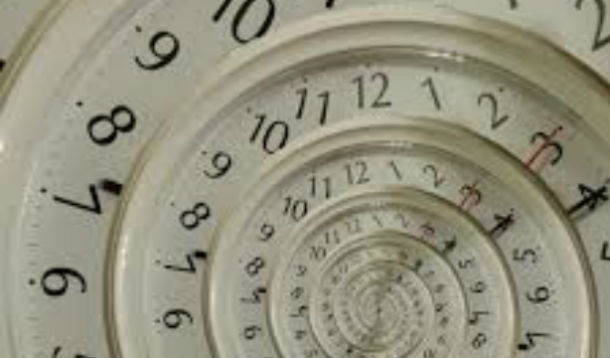
Some Time Travels

In his “Confessions,” St. Augustine writes, “What then is time? If no one asks me, I know; if I wish to explain it to one that asks, I know not.” He decides that time is an idea, unique to humans, and also unique in that we can simultaneously grasp the past in memory, the present by attention, and the future by expectation. In our minds, but only there, we are not locked to one perception of one reality.

Yesterday, I deleted everything that I had written up to that point by dragging my unbuttoned shirtsleeve across my laptop’s touchpad while reaching for my coffee. (No, I can not replicate the results in an experiment; yes, like an idiot, I have attempted to replicate these results in an experiment.) In a feat of memory, I retyped all that I had written to that point; simultaneously I remembered what I had written, was super-present and typed it attentively, and expected a future in which I regularly saved my work, a lesson I first learned, oh, 20 years ago. I was in three specific time-experiences at once, and all of them sucked.

* * * *
For decades, it has been known that subatomic particles can be in two places at the same time. In yet more recent (2014) experiments, physicists have “simulated” time travel. Science reporters tell us that time travel is in the “near future,” or, more prosaically, “just around the corner.” If this is so, no one from the future has yet visited us, because if it truly is something that we will invent or discover in the future (near or not-so) we would know all about it already. This is because, oh, you get it.

Many therapy techniques suggest remembering oneself in a childhood moment and reaching out to that younger self; the thought is that we carry every self we have yet been forward into our psychological present and can communicate something of a healing nature to those past selves. Whenever I have attempted anything of this sort, I have cried. I have received no reports from the younger self about what he made of the unexplained appearance of an older man leaning on a cane.

* * * *

How the false truths of the years of youth have passed!
Have passed at full speed like trains which never stopped
There where I stood and waited, hardly aware,
How little I knew, or which of them was the one
To mount and ride to hope or where true hope arrives.
— “I Am A Book I Neither Wrote Nor Read,” Delmore Schwartz

* * * *
The thought experiment of time travel has a long history in popular culture. Fantasists invent tools (a jet-pack in every garage) in novels and movies, tools which actually only address the needs of the present moment and do not attempt to imagine the future needs that will be answered by the future tools. In almost every science fiction work that uses the device of time travel, the several paradoxes of “a visitor from the future would influence current history and thus change their present” or “if I go back in time and change a mistake, erase an error, will I not change who I am now?” are addressed.

Many of the heroes decide or discover that the path that brought them to where they are and to the person they are now was always worth taking, errors and all. As long as one is breathing, lessons can be applied. (Ebenezer Scrooge, for example.)

It is a seductive thought experiment, though. Offer a person a time machine to return to a specific moment in the past and take up residence there, from that moment onward, and relive one’s life so one can fix whichever errors and enhance whichever successes that followed, well, it is seductive. Offer a person life from a future moment from which they can see it all unfold, … well.

* * * *
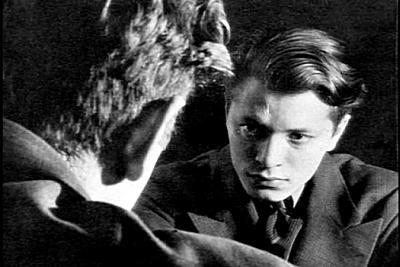
delmoreschwartz

Delmore Schwartz

Delmore Schwartz’s heart-rending short story, “In Dreams Begin Responsibilities,” opens with the narrator in a movie theater as he realizes the feature is his parents on their first date; he becomes frantic and yells at the screen, “Don’t do it!” and gives a list of reasons. (Oh, to have been Delmore’s mother. He was 21 when the story was published.) The audience hisses him down, as he is ruining the movie for them, but he knows how it ends.

My father tells my mother how much money he has made in the week just past, exaggerating an amount which need not have been exaggerated. But my father has always felt that actualities somehow fall short, no matter how fine they are. Suddenly I begin to weep. The determined old lady who sits next to me in the theatre is annoyed and looks at me with an angry face, and being intimidated, I stop. I drag out my handkerchief and dry my face, licking the drop which has fallen near my lips. Meanwhile I have missed something, for here are my father and mother alighting from the street-car at the last stop, Coney Island.

At the end, the narrator is thrown out of the movie theater while on screen his father is refusing to have his fortune told by a Coney Island fortune teller. And then he awakens to “the bleak winter morning” of his 21st birthday. It was all a dream.

* * * *
As Augustine saw, way back in the 4th century, we always live in the three time zones of our experience and psyche simultaneously: past, present, and future. Always.

I no more wrote than read that book which is
The self I am, half-hidden as it is
From one and all who see within a kiss
The lounging formless blackness of an abyss.

How could I think the brief years were enough
To prove the reality of endless love?
— “I Am A Book I Neither Wrote Nor Read,” Delmore Schwartz

* * * *
Neat Thing of the Day: Lou Reed reading “In Dreams Begin Responsibilities” (Reed had been a student-mentee of Schwartz’s at Syracuse University): In Dreams Begin Responsibilities.

____________________________________________
The WordPress Daily Prompt for October 7 asks, “Congrats! You’re the owner of a new time machine. The catch? It comes in two models, each traveling one way only: the past OR the future. Which do you choose, and why?”
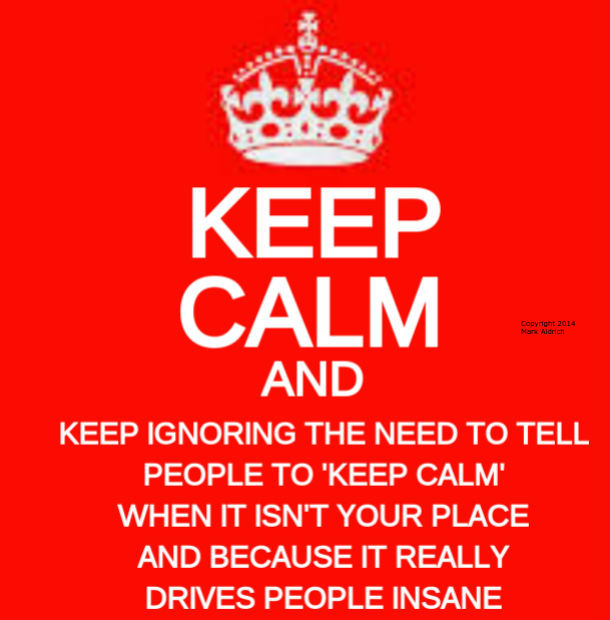
Stop Stressing Me Out!

The same friend who used to reply to my complaints about old pains and new aches with a cheerful, “But you’ve never been 45 (or whatever) before,” also used to say, “Remember, it’s just Tuesday (or whatever day)” when a person would confess to feeling anxious about an upcoming big event or holiday.

“It’s only a Saturday. Same as all the other ones. Sunday will come next.”

Yes, yes, it is the same, definitely the same as all the other Saturdays, indeed, but it is a Saturday with the addition of my wedding or taking the GRE or LSAT or … . An event-focused Saturday is an impersonation of all the other Saturdays. An awards ceremony is not just another setting for a mediocre hotel meal, even though it is that, too. So thanks for not helping us out there, not even one bit, Mister Calm Guy.

How does one keep that inner calm, that sense of appropriate perspective? The answer lies in that word “perspective,” and there is only one thing that adds perspective to one’s life: Doing things. Experience gives one a chance to develop some perspective about whether or not something is worth worrying over or not.

Chaucer’s Wife of Bath says experience gives us no authority to speak on anything but our own experience of life, but it is sufficient.

In “Stress,” a memoir I wrote about my own anxious life lived in anxiety and anxious worries about the possibility of future anxieties brought on by past worries of anxieties that I may be too anxious, I recounted several hilarious escapades involving my personal levels of tension, including giving myself a black eye while mis-tying my shoe.

Thus, my advice to me when faced with a big journey or a ceremonial event or a test is to acknowledge that I will be anxious, remind myself that the fun/important part is in the journey, that I will most likely discover new ways to be flabbergasted and to flabbergast, and to enjoy the ride. Whenever I attempt to deny myself my anxiety, I deny myself feelings, and I re-learn that repressed feelings will explode.

Don’t tell me what to do. Don’t you dare tell me to keep calm, I tell myself. And then calm follows.
____________________________________________
The WordPress Daily Prompt for October 4 asks, “It’s the night before an important event: a big exam, a major presentation, your wedding. How do you calm your nerves in preparation for the big day?”

Just (Don’t Over)do It

One of Oscar Wilde’s pithiest quips (or one of his quippier piths) is, “Everything in moderation, including moderation.” Lampooning his prudish-seeming Victorian contemporaries, he was suggesting we should show some restraint in the not enjoying of this sensual world. We should refrain from overdoing our lack of enjoying pleasure.

Some time ago, I wrote to Wilde, but he did not reply as he died 68 years before my birth. I wrote, “Everything in moderation, except moderation.” His ongoing silence about this speaks volumes.

What about those who do not take too much pleasure in the world? What of the underrepresented excessively self-repressed? Aside from the fact that they probably do not want too much—or any!—attention and thus representation given to them, what can we do for the successfully overly moderate among us?

Those who magnificently overdo their lack of excesses are the non-heroes we can lovingly ignore, um, adore, for our current era of superheroes and superstars.

Every fifth movie or television show seems to be about an average human being discovering quite by accident that they possess previously unknown super powers, whether strength, speed, invisibility, divisibility. They find they have super senses, which they employ to solve crimes (if they had super senses all along, how did they not detect that they had super senses?), which seem to be committed by others who have also discovered that they have super abilities but want to rule the world as a result. (None of these works of fiction seem to depict anyone discovering previously unknown super-capacities for human compassion, but most Christians would say that there was only one such figure, and He was sufficient.)

The cultural desire for superheroes reflects a cultural infantilism, a desire for super-parents in a world that we tell each other—in the news and other movies—is a darn scary place. Many of our original fictional superheroes were created in a similarly scary world, during the Second World War. We felt that we needed rescuing, we desired a rescuer, so we created a spectacular hero in our comic books, novels, movies. The hero represents what we discover we had inside us all along: strength to face any foe, bear any burden. (But “pay any price,” to finish JFK’s quote? Not so much. Maybe a few bucks for a ticket and some popcorn.)

We live in a similarly scary world, so we are seeing a lot of superheroes in our cultural fantasy life once again.

However, not a one is super-moderate in his lack of vices. “Super Moderate Man.” Our movie makers could depict him displaying restraint of tongue and pen and keyboard when confronting things with which he disagrees. He is no teetotaler, but knows his limitations and thus never consumes. (Myself, I am a teetotaler, because I do not know my limitations.) If he stays up late fighting villainy one night, they could show him getting to bed early the next night. He rarely swears, so when he does it makes a point. He “stops and smells the roses,” but not every darn time, because sometimes he has places to go. The movie makers could write a dramatic scene in which he heroically fills out product warranty cards … and pays his taxes. He never lectures or wags his finger and he takes the time to show others how to make a fine pot of coffee. Some complain that the coffee is too strong, and some say it is too weak.

“Super Moderate Man” does not wear a cape, because really, who wears a cape? There is not one rack of capes to be found in any mall anywhere. (He shops in malls.) If he possesses a cloak of invisibility, it is only there to mask any evidence of a sense of style.

Super Moderate Man: A hero some of the time for most people, but it is okay if he is not.

____________________________________________
The WordPress Daily Prompt for September 27 asks, “‘Perhaps too much of everything is as bad as too little.’—Edna Ferber. Do you agree with this statement on excess?”