Grade School Avant Garde

Art that is odd for the sake of the odd is often neither. Sometimes it is both. Meet the Lettrists.

Greil Marcus, in his essential history book, “Lipstick Traces,” describes a particular type of artist:

There is a figure who appears in this book again and again. His instincts are basically cruel; his manner is intransigent. He trades in hysteria but is immune to it. He is beyond temptation, because despite his utopian rhetoric satisfaction is the last thing on his mind. He is unutterably seductive, yet he trails bitter comrades behind him like Hansel his breadcrumbs … He is a moralist and a rationalist, but he presents himself as a sociopath … No matter how violent his mark on history, he is doomed to obscurity, which he cultivates as a sign of profundity.

Marcus’ book places the punk rock movement of the late ’70s in a “secret history” of western culture beginning in the 17th Century but he finds his greatest excitement in recounting the stories of the Dadaists, the Lettrists, and the Situationist International.

Often, it is the same story, though: Revolutionary thinker(s) who create art via revolutionary thought that (sometimes angrily or destructively) confronts the norms of the era are largely ignored by the culture at large except by a few who incorporate the new art in more popular forms. Something that was created with great energy, occupied 100% of its creator’s brain, becomes a tiny part, sometimes less than 1%, of a larger movement and a footnote in history.

The Lettrists are an example. Some of them are still going, 70 years after Isidore Isou came up with the idea. What was the idea? That the alphabet is a random bit of socially acceptable ordering of language, yet we make many more sounds than are indicated by our 26 letters. Sneezes should have a place in an alphabet, because, well, they communicate.

Here is Orson Welles interviewing Maurice Lemaître and Isou, who is the poet in the center who can not seem to stop grinning:

The dedication to the fantasy of a new language is powerful to witness, but I am not a fan of other people’s fantasies. There is little different between Tolkien and Isou in that they both invented unique alphabets; for me, Isou’s attempts at expanding our way of describing life here on earth is more interesting. But interesting is all that it is. It is seductive in its lack of seductiveness.

Give me Lettrism over “Lord of the Rings” and give me the Sex Pistols over either.

Further, the so-called “flash mobs” that have been invading retail spaces over the last decade or so are the offspring of the Situationists of the late 1960s, except the Situationists wrote long manifestos and conducted public debates about things like the idea of society, and flash mob participants consider the fact of a group making a group statement to be the statement, period. And now flash mobs are a part of any media campaign’s advertising budget.

Yes, I am a cranky “get off my lawn” old man in my punk tastes. This is because I am a cranky old man, deep down, deeper than any punk can reach. (Or this makes me very punk, but no one can declare themselves that.) In the late ’70s one of my schoolmates was an import from London named Dan, and he already had terrible teeth (we were 10 or 11), a gaudy accent, and wore torn t-shirts and played music whose major point was its loudness. (Or so it seemed to my ears.) I wish I could write that in 1978-’79 I was friends with a London kid who introduced me to the Sex Pistols and The Clash, but I can not. I detested the noise. I was also introduced to rap music around then or even earlier: another elementary school classmate was rapping like Gil Scott-Heron in 1976, but we were 8 and what little rap that I remember was about his birthday party.

In the 1990s, I fell in love with what was by then ancient punk rock and started to absorb it; around this same time Johnny Rotten/John Lydon started to become a beloved cultural figure in Great Britain, which he remains.

The energy of anger, the cultural energy of anger, the dedication to anarchy (which brooks no dedication), rarely appealed to me and more frequently scared me. Any anarchists in my circle brought out my inner parent, which is probably why I hated them all the more. (Hate? Wait a second. I do not hate …)

The violence of change indicates a world of absolutes, of either-ors; a world that includes shades of gray and a third way presents yet another either-or, however: Either we live in a universe of absolutes or we do not. The revolutionaries live in the hyphen between the either and the or and like the hyphen, life there is brief. Every culture has an avant garde, and every culture defeats it by ignoring and then absorbing it.

* * * *
Image at the top found at: Ideological Art.

____________________________________________
The WordPress Daily Prompt for October 15 asks, “From your musical tastes to your political views, were you ever way ahead of the rest of us, adopting the new and the emerging before everyone else?”

* * * *
Please subscribe to The Gad About Town on Facebook: http://www.facebook.com/thegadabouttown
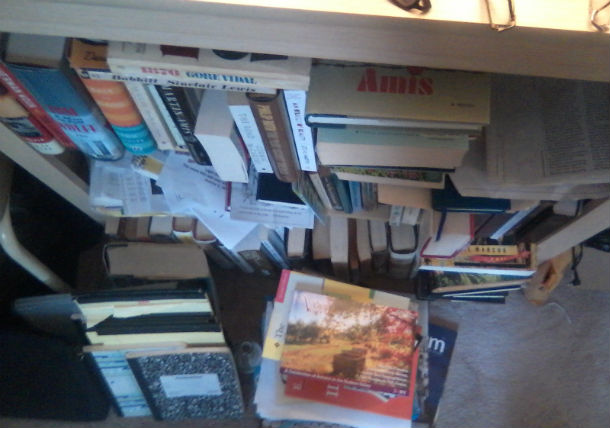
An Attack of the Cleans

It is said that Albert Einstein once asked, “If a cluttered desk is a sign of a cluttered mind, what are we to think of an empty desk?” While not famous for his quips (although E=mc2 is the soul of wit in its brevity), Einstein’s joke came from his one man show, “The Theories of My Relatives.”

His mother was always complaining about his messy desktop and resented that opening the desk drawers was verbotten.

* * * *
The human mind is an organizer, the greatest one in existence, the one that all of our tools and machines are built for in an attempt to replicate its principles and imagined actions. Nature does not organize. Every organizing structure we come up with is an imposition on nature and is thus radically random: no method of organizing is more “correct” than any other.

Alphabetical order? Which alphabet? Which word should be used to alphabetize? “The?”

Chronological? Write your next book from the outside in.

Size? I partly organize my bookshelf by the size of books (see above), the heavier ones on the bottom or on the floor (thus, not even on the bookshelf) because the shelf needs reinforcing.

Or one could organize an argument by number of words used in each section, largest first. Juries would return verdicts of “confused.”

(My girlfriend’s cat has one organizing principle and the work of perfecting her world with it occupies much of her day, for many of her few waking hours: This thing on the space that I want to occupy until I move it off this space, when I will move somewhere else, must go. And she sweeps the offending pen or paper or book off the desk.)

The human mind finds and makes connections between things and ideas, or the representations of ideas: words, papers, books. In an ideal sense, all ideas are equal. The work of organizing, re-cluttering, and finding new connections is a creative act. Dear Albert Einstein’s mom: A cluttered work space is the same as an organized work space, it’s just that only one of them meets your random aesthetic standards of ideal desk appearance.

* * * *
I have lived with hyper-organized spaces that I created for myself: Books separated by subject and then alphabetized (left to right, by author last name) within those. Multiple titles by the same author arranged chronologically by publication date.

(A famous writer’s wife once tried to start a fight with me over how our bookstore organized its books: Alphabetically, but in two different ways, neither of which suited her particular preference for her husband’s name to be prominent everywhere at all times for reasons of income. The majority of the store was alphabetical by author within its various sections, but the privileged section of new hardcovers, nearest the door, well, the books on those shelves were alphabetical by title. Thus, his newest title was on a lower shelf because it did not begin with A, and his paperbacks, with his last name starting with S, were not always at eye height. After she and I stared at each other for a moment, the famous writer paid for his purchases and placed his arm around his wife’s shoulder and they started out the door. But at the door he turned, looked at me over his wife’s head and said, “You’ll have to excuse my wife. She’s rather eccentric.”)

Virtual file folders inside virtual file folders in my computer. A clean computer desktop, with just the “C:” icon and the trash bin and maybe the couple of virtual folders that contained whatever I was working on at that moment.

(I had an officemate who photographed his desktop and made that image his computer screen desktop image, so when you were talking with him at his desk you were looking at a real-life version of Pink Floyd’s “Ummagumma” album cover. Desktop > desktop > desktop. He would regularly update the photo to reflect current changes on his 3D “real” desktop like the content of his IN/OUT box or his children’s school pictures.)

ummagumma

I haven’t listened to Ummagumma in quite a while.

In the past, I have organized my kitchen to discover how inefficient that could make me. I alphabetized the spices. I have arranged the clothes in my closet by color. My baseball card collections (many complete sets) were always divided into American and then National leagues, and then broken into teams, my favorites first, favorite players on each team towards the front.

Perhaps you have noticed that, in the past, I was kind of a rigid idiot.

Finally it occurred to me that the best, most efficient, kitchen organizing principle was “frequency of use near the areas of frequent use.” And that principle, which is a barely controlled entropy, is what guides most of my organization now.

* * * *
Roland Barthes: “My body is free of its (self image) only when it establishes its work space. This space is the same everywhere, patiently adapted to the pleasure of painting, writing, sorting.”

Where am I me? When am I me? When I am not engaged in the illusion of self that I studiously maintain; the image of myself that I carry around in my brain is not me, as it is a fiction. When I am not my image, I am myself. Often, I find myself in the field around me, the space that gives evidence that I occupy it, my work space. My desk. I am found in the outline of things that I use, the adumbration of my stuff: papers, books, pens, glasses. Words. Inside is a space perfectly fitted to me, or to my image of myself. And then, by thinking that thought, it is gone again.

____________________________________________
The WordPress Daily Prompt for October 14 asks, “What’s messier right now—your bedroom or your computer’s desktop (or your favorite device’s home screen)? Tell us how and why it got to that state.”

* * * *
Please subscribe to The Gad About Town on Facebook: http://www.facebook.com/thegadabouttown

No Time. Too Loose. Or, Time’s Mulligan

Nothing is perfect, except for the perfect things. It does not take a precise 24 hours and zero minutes and zero seconds for the earth to complete one spin on its axis; it takes slightly longer, but not so much longer that you could even call it a “tick.”

The earth’s rotation is only a tiny fraction of a millisecond slower than what we otherwise call a day, but these partial seconds add up. Twenty-five times since 1972, the international bureau of standards that handles time issues has added a “leap second” to all of our lives. The last year with a leap second was 2012, so if that year felt longer for you, there is a reason: It was. By one second. Clocks everywhere could have read “11:59:60” at midnight the night of the leap second, but they did not because no one makes clocks that do that.

If it was not for those leap seconds—and, every four years, leap days—our clocks and calendars would slide and slip all over the place compared to what they are measuring; if not for leap days, eventually New Englanders would be confronted with a frigid July and the dog days of December, and vice versa for the Southern Hemisphere.

What our clocks and calendars are measuring is perfect: a year is X number of seconds, days, months, but not the same every year. The earth’s orbit is regular and perfect, but not 365 days every year. It is almost 365 days, and a day is almost exactly 24 hours in length, and we live with the compromise we call clocks and calendars. The ancients came as close to exactly right simply from observation as they could—to within seconds.

* * * *
No one is perfect, except we are each of us perfect, perfectly ourselves.

The clock makers and the calendar printers, heck even the bureau of standards that decides how to measure things, regularly make adjustments to the ways we mark the passage of time. Everything, even time, needs a semi-regular do-over, a mulligan.

(The mulligan is a very specific rule in golf—a rule that does not exist in a place called reality—which states that “sometimes rules do not apply,” so do-overs do exist in the universe. Of course, my friends and I found ways to bend even this non-rule. In informal golf, friendly noncompetitive golf between or among noncompetitors, if one hits an egregious drive [if? when, in my case], a drive that everyone agrees there may be no recovery from, everyone might also agree to grant that player a do-over. That is a mulligan. He or she does not get another one for the remainder of the day, even if the mulligan, the replacement shot, was worse or if an even worse drive came off their club later on. My friends and I came up with the “retro mulligan,” in which a player kept his or her mulligan in the bag if the do-over was a worse shot. That was our contribution to the world of golf and the world of do-overs, and it was super-secret, I think. Maybe I will take a mulligan in tomorrow’s column. The “retro mulligan” was the only mulligan that a player truly had only one of, and using it erased it and the mulligan.)

As an idea, the mulligan is forgiveness from the universe, a creative admission that there is a better version of what you just did still available in you. There is a better version of you. The retro mulligan concedes that sometimes we grab a do-over prematurely in life. There is a saner version of a better version of you.

I have a perfectionist streak that I am striving to lose, because I can not be the best version of myself by placing perfect in my path. Perfectionism leads to procrastination, then paralysis. All those leap seconds and leap days, I needed every last one of them to get to where I am today. And I expect I will need every leap second and leap day yet to come, because I am keeping the retro mulligan in my golf bag of life. Every second counts, yet there is no time to lose.

* * * *
Please subscribe to The Gad About Town on Facebook: http://www.facebook.com/thegadabouttown.

____________________________________________
The WordPress Daily Prompt for October 13 asks, “Good news—another hour has just been added to every 24-hour day (don’t ask us how. We have powers). How do you use those extra sixty minutes?”