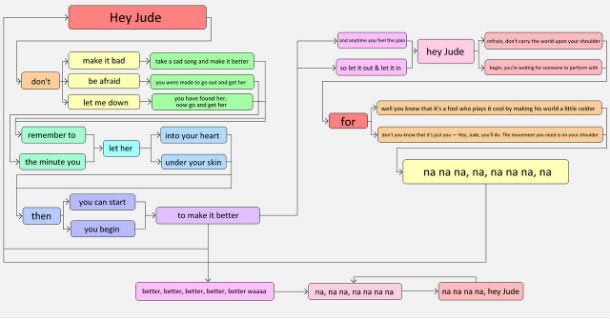
‘Hey Jude,’ November 1968

Paul McCartney was having a pretty successful season the autumn of 1968. Now, most of the autumns Paul McCartney has spent on this Earth in his adult years have probably felt quite successful, but 1968 may have been special.

In August of that year, The Beatles had two songs prepared for release as a single: “Revolution” and “Hey Jude.” The band was about to release its double album, “The Beatles” (more commonly known as the White Album), but these two songs were not going to be included. A rendition of “Revolution” appears on the album, but the group had another, a faster version, that it wanted released. “Hey Jude” and the hit single version of “Revolution” did not fit that already over-stuffed album, so the two songs were slated to be their new record label’s (Apple Records) first single.

The concept of an A-side and a B-side for a single seems quaint now in our era of digital downloads or Spotify and Pandora. It seemed quaint even then, too, as everyone knew that the two sides were equally easy or hard to play—anyone with functioning hands and limbs could place the record A-side up or B-side up as they wanted to—the B-side was not “unlocked” by playing the A-side a certain number of times. Thus, plenty of B-sides became hits in their own right and the record-buying public would school the labels in the matter of what it wanted to listen to.

The Beatles played games with the idea over time and even sometimes marketed singles as having “two A-sides”; when the band is The Beatles and most of the band’s songs are A-sides anyway, this makes sense. Apple’s first released single was not going to be treated as a gimmick like that. John Lennon wanted his composition, “Revolution,” to be the A-side, but the other three members thought otherwise. Because of The Beatles’ one-Beatle/one vote democracy, “Hey Jude” was backed by the feedback-heavy “Revolution” on a single that was released on August 26, 1968.

By the end of September, it was number one in the United States where it sat until the end of November.

The week that I was born, November 18, The Beatles not only had the number one song but also the top-grossing film. “Yellow Submarine” took over the top spot from “Head,” the cult film starring The Monkees and co-written by Jack Nicholson. Four different films topped the box office that November, with each one coming close to or topping three million dollars in tickets sales for the week, numbers that might not crack the top ten for a weekend now. They were: “Ice Station Zebra,” “Head,” “Yellow Submarine,” and “Lady in Cement.” “Yellow Submarine” outdid the other three that month.

Of course, The Beatles are not in “Yellow Submarine” except for the very last section. The voices of their animated counterparts were provided by actors, and the film studio, United Artists, was pleased but not happy about this. The Beatles owed one more film to the studio but to a man they had hated the experience of making movies; when the concept of an animated film spotlighting a handful of songs that might not have found a home in any other album was proposed, it sounded like a grand idea to the group. United Artists thought that this did not relieve The Beatles of their obligation, however, and demanded one more film, again, which is how “Let It Be” came to be made.

November 1968 was Paul McCartney’s month—more than anyone else’s except mine—because of a couple other songs. Apple Records had started to sign artists to its roster of performers, and one, a Welsh singer who was not yet 20, became his project. Mary Hopkin’s biggest hit briefly knocked her boss’ band’s “Hey Jude” out of number one in England but never got past number two in the United States. Even if one does not know it by name, if one has attended a wedding or a prom at any time in the last four decades one knows the song and her version: “Those Were the Days.”

McCartney also decided to produce a single with his favorite comedy group, the Bonzo Dog Doo-Dah Band. (I wrote the first of I hope many pieces about the Bonzos in March: Vivian Stanshall.) And so we have the tuneful, Beatles-esque, but utterly unique and Bonzo, “I’m the Urban Spaceman,” written and sung by Neil Innes and produced by Apollo C. Vermouth, a name McCartney awarded himself because …

http://www.youtube.com/watch?v=SbLDI5lNdRQ

Not many artists have had better months.

____________________________________________
The WordPress Daily Prompt for November 21 asks, “If your life were a movie, what would its soundtrack be like? What songs, instrumental pieces, and other sound effects would be featured on the official soundtrack album?”

* * * *
Please subscribe to The Gad About Town on Facebook: http://www.facebook.com/thegadabouttown

Vivian Stanshall: Not an Eccentric

The Bonzo Dog Doo-Dah Band played the role of jester in the court of the Beatles in the late 1960s, and Vivian Stanshall was the charismatic, curious leader of the leaderless and leader-resistant Bonzos. The missing link between the Beatles and Monty Python (if one was needed), in 1967 the Bonzos appeared in both “Magical Mystery Tour” (partially entertaining the Beatles with a performance of “Death Cab for Cutie”) and in the pre-Python but mostly Python-staffed afternoon television show, “Do Not Adjust Your Set.”

Here, Michael Palin of the Pythons introduces the Bonzos, and Stanshall does his best worst Elvis in “Death Cab for Cutie.”

 
Stanshall, a writer for whom no declarative statement could be too perplexing (“I’ve never met a man I didn’t mutilate”), was paired up with Neil Innes, a songwriter whose Beatles-esque melodies led not only to to the Bonzos being produced by Paul McCartney (the minor hit “I’m the Urban Spaceman”) but also to a Beatles lawsuit after music for his parody group, “The Rutles,” was thought to be too reminiscent for comfort. (Further cementing the Beatles-Python link, “The Rutles” was an Eric Idle project.)

Their collaboration “Mr. Apollo” combines an almost-too-catchy Innes tune with Stanshall’s absurdly deep baritone and lengthy fake sales pitch for an exercise gimmick: “Five years ago, I was a four-stone apology. Today, I am two separate gorillas. No tiresome exercises. No tricks. No unpleasant bending.” It also features a heavy metal guitar lick invented about six months before heavy metal.

 
Vivian Stanshall was born 71 years ago tomorrow, March 21; few people have spent their lives (his ended in a house fire in 1995, a sadly Stanshall-esque end if anyone did not deserve one) confounding more people and delighting in the resulting stares than he. After the Bonzos disbanded, if they ever truly did—the group’s set lineup varied in name and number whimsically and reunited a number of times, so it could be said that its members simply wandered away—Stanshall became known as a presence. He was a person about whom wild anecdotes proliferated, usually starring Stanshall, his friend Keith Moon, and their friend, alcohol; whose voice was heard on overnight radio talk shows that had no set sign-off time except daybreak; and who semi-occasionally emerged with enormously creative, incredibly language-saturated audio theater pieces, usually concerning the fictional family of Sir Henry Rawlinson. (In one of the oddest of all possible odd coincidences, Stanshall and the real Sir Henry share a death date, precisely one century apart, March 5, 1895 and 1995.)

Joycean in its surreal ambitions, Stanshall’s “Sir Henry at Rawlinson End” always opts for the obscure joke and invented pun over the profound statement, which resembles Joyce in many of his Joycean ambitions, too. The recorded piece was made into a film starring Trevor Howard and Stanshall that may as well have been a rumor until its DVD release a few years ago. One can piece together the hour-long film from clips on YouTube. The Rawlinson family saga offers an English Addams Family whose adventures take place in a landscape of long-standing family games with long, obscure, histories behind them and traditions that must be celebrated by exploding them. It is aristocracy viewed through the eyes of an alien, not just to these traditions, but to the idea of tradition.

The opening sentence: “English as tuppence, changing yet changeless as canal-water, nestling in green nowhere, armored and effete, bold flag-bearer, lotus-fed Miss Havishambling, opsimath and eremite, feudal-still reactionary Rawlinson End. The story so far.”

http://www.youtube.com/watch?v=Pa4gPaQjC1M
 
According to radio legend John Peel, the friend on whose programs the Rawlinson stories were first dictated, Stanshall’s appetite for drink and tranquilizers hindered his career. “Unreliability and prevarication, on an epic scale,” is how Peel mournfully described his friend’s habits of work, in a comment about how working with Stanshall could yet be extraordinary and worth the effort.

In most articles, Stanshall is described as an eccentric, a member of the famous English eccentric class. No other country is said to celebrate its eccentrics more than England, or to reflect more on the idea of having a group of people called “eccentrics,” and Stanshall offered plenty of material to draw from: living on a houseboat, showing up in a Nazi officer’s uniform for photo sessions with Keith Moon, cultivating an epic beard. He dressed the part, alternating between hobo-chic and carnival barker classy.

 
But for those who insisted he was an eccentric in the classic, “English” sense, Stanshall had a reply:

A few years ago a woman from the Daily Mail phoned to inform me they were doing a piece on Sir John Betjeman and they would like me to companion him in the article, I being representative of the younger English eccentric. She wanted to know if was still doing it. Well, I don’t do it, I’m merely myself, … I’m whatever you like, just don’t expect me to join in. I do like games, though. You see, I’m not different for the sake of being different, only for the desperate sake of being myself. I can’t join your gang: you’d think I was a phony—and I’d know it.

“For the desperate sake of being myself.” That is as true and good a personal code as any statement one could come up with towards having a worthwhile life.

Around the time of the “Sir Henry at Rawlinson End” film, 1980, Stanshall provided his friend Steve Winwood, one of the least cynical or eccentric of performers, with a lyric that is confident in its obscurity (“my rock and roll is putting on weight”) and yet sweet and plain in its sentiment (“This time to the sky I’ll sing, if clouds don’t hear me/To the sun I’ll cry, and even if I’m blinded/I’ll try moon gazer…because with you I’m stronger”). “Arc of a Diver” does not seem like a Vivian Stanshall lyric because it is.


She bathes me in sweetness, I cannot reveal
For sharing dreams I need my woman
This humble expression…meagerly dressed
My eyes so mean it has no meaning
But jealous night and all her secret chords
I must be deaf…on the telephone…I need my love to translate
 
I play the piano, no more running honey
This time to the sky I’ll sing if clouds don’t hear me
To the sun I’ll cry and even if I’m blinded
I’ll try moon gazer, because with you I’m stronger…I’m stronger…I’m stronger
 
Arc of a diver…effortlessly…my mind in sky and when I wake up
In daytime or nighttime…I feel you near
Warm water breathing…she helps me hear
But jealous night and all her secret chords
I must be deaf…on the telephone…I need my love to translate
 
This time to the sky I’ll sing if clouds don’t hear me
To the sun I’ll cry and even if I’m blinded
I’ll try moon gazer…because with you I’m stronger
 
But jealous night and all her secret chords
I must be deaf…on the telephone…I’ll need my love to translate
 
This time to the sky I’ll sing if clouds don’t hear me
To the sun I’ll cry and even if I’m blinded
I’ll try moon gazer…because with you I’m stronger
 
Lean streaky music…spawned on the streets…I hear it but with you I have to go
Cause my rock ‘n’ roll…is putting on weight…and the beat. it goes on
Arc of a diver…effortlessly…my mind in sky and when I wake up, woah-oh-oh
Daytime and nighttime…I feel you near
Warm water breathing…she helps me hear
 
But jealous night and all her secret chords
I must be deaf…on the telephone…I’ll need my love to translate
 
With you my love we’re going to…raid the future
With you my love we’re going to stick up the past
We’ll hold today to ransom…’til our quartz clock stop…until yesterday
Woah, until yesterday
Until yesterday
Til our quartz clock stop

____________________________________________
Follow The Gad About Town on Facebook! Subscribe today for daily facts (well, trivia) about literature and history, plus links to other writers on Facebook.

Follow The Gad About Town on Instagram!

Creative Commons License
This work is licensed under a Creative Commons Attribution-NoDerivs 3.0 Unported License.