‘For the Time Being,’ Part 1

During World War II, the poet W.H. Auden wrote a book-length poem entitled “For the Time Being.” It is subtitled, “A Christmas Oratorio,” and he desired that it be set to music; because it is fifty-two pages long as is, before the addition of music or stage directions, he could have easily subtitled it, “The Longest Christmas Oratorio: Bring Snacks.” Benjamin Britten decided that composing music for the full work was too difficult so he set two short sections to music.

“For the Time Being” was published in 1944. I will explore it a bit more tomorrow. It is found in Auden’s Collected Poems. Here is one section:

At the Manger
MARY:

O shut your bright eyes that mine must endanger
With their watchfulness; protected by its shade
Escape from my care: what can you discover
From my tender look but how to be afraid?
Love can but confirm the more it would deny.
     Close your bright eye.

Sleep. What have you learned from the womb that bore you
But an anxiety your Father cannot feel?
Sleep. What will the flesh that I gave do for you,
Or my mother love, but tempt you from His will?
Why was I chosen to teach His son to weep?
     Little One, sleep.

Dream. In human dreams earth ascends to Heaven
Where no one need pray or ever feel alone.
In your first few hours of life here, O have you
Chosen already what death must be your own?
How soon will you start on the Sorrowful Way?
     Dream while you may.

____________________________________________
The WordPress Daily Prompt for December 19 asks, “The holiday season: can’t get enough of it, or can’t wait for it all to be over already? Has your attitude toward the end-of-year holidays changed over the years?”

* * * *
Please subscribe to The Gad About Town on Facebook: http://www.facebook.com/thegadabouttown

‘Thank You, Fog’

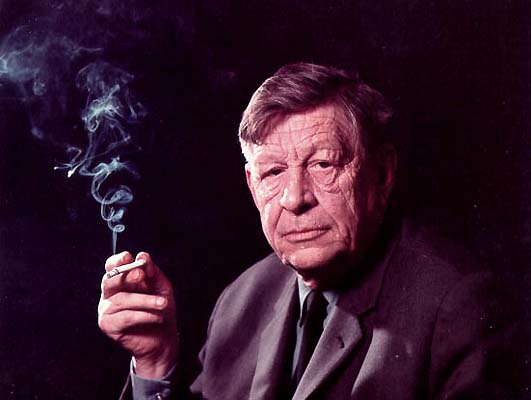
“My face looks like a wedding cake left out in the rain,” quipped W.H. Auden. Indeed, by the age of 60, Auden’s face looked like the most-read library book in the most popular library; it exhausted any adjectives thrown at it—it was its own adjective. His friend Hannah Arendt said he looked “as if life itself had delineated a kind of face-scape to make manifest the ‘heart’s invisible furies.'”

According to one biographer, Auden suffered from something called Touraine-Solente-Gole syndrome,

in which the skin of the forehead, face, scalp, hands and feet becomes thick and furrowed and peripheral periostitis in the bones reduces the patient’s capacity for activity. There [is] no therapy for the syndrome, which does not affect either life expectancy or mental status, but which account[s] for Auden’s striking appearance of grave, lined melancholy.— “Auden,” Richard Davenport-Hines

auden2

W.H. Auden

Auden probably had never heard of TSG syndrome so he may not have known that his rapid aging was the result of anything other than how he was living his life. It was a life lived in a cloud of cigarette smoke and almost continuous writing. Fueled by amphetamines, which he believed made him more productive, he certainly was productive: four hundred poems (many very long), almost the same number of essays and book reviews, several verse plays, and all written between the mid-1920s and his death in September 1973. At night, to bring that constantly working mind to some static place, he took sleeping pills and drank.

Towards the end, in May 1973, he wrote what may be his last loved poem, “Thank You, Fog.” He had lived in New York for decades and “Grown used to New York weather” and was “all too familiar with Smog.” Fog is unnamed until the end, the final word of the last line, but her name is knowable: Fog is smog’s “unsullied sister,” and years away had allowed the poet to forget “what/You bring to British winters.”

Auden in winter is a poet of few, but precious, loves: company and coziness. Fog brings both as he is kept in, with friends, for a week at Christmas. No birds outside, no outside, just friends doing crosswords and paying no mind to worldly concerns. The outside world, where one “minds one’s p’s and q’s,” only interrupts the proceedings in the form of the “Daily Papers,/vomiting in slip-shod prose/the facts of filth and violence/that we’re too dumb to present:/our earth’s a sorry spot.”

Warm by the fire, warmed by the company of friends, cozy. Aware that the earth’s a sorry spot, but unmoved by this for the moment, as coziness and comfort can sometimes trump it all. It is a cat dozing by a fireplace of a poem, and like a cat, it has claws: Who is the poet thanking? “No summer sun will ever/dismantle the global gloom.” (Ever? Ever.) “Thank you, Fog.”

* * * *
It is a rainy, gray November afternoon in upstate New York today, in which the light remains dim from dawn till after dusk; what color there is is colors that were: expired leaves lingering on branches, uncollected rakings shoved into the roads. Autumnal Auden comes to mind.

Thank You, Fog by W.H. Auden
Grown used to New York weather,
all too familiar with Smog,
You, Her unsullied Sister,
I’d quite forgotten and what
You bring to British winters:
now native knowledge returns.

Sworn foe to festination,
daunter of drivers and planes,
volants, of course, will cause You,
but how delighted I am
that You’ve been lured to visit
Wiltshire’s witching countryside
for a whole week at Christmas,
that no one can scurry where
my cosmos is contracted
to an ancient manor-house
and four Selves, joined in friendship,
Jimmy, Tania, Sonia, Me.

Outdoors a shapeless silence,
for even then birds whose blood
is brisk enough to bid them
abide here all the year round,
like the merle and the mavis,
at Your cajoling refrain
their jocund interjections,
no cock considers a scream,
vaguely visible, tree-tops
rustle not but stay there, so
efficiently condensing
Your damp to definite drops.

Indoors specific spaces,
cosy, accommodate to
reminiscence and reading,
crosswords, affinities, fun:
refected by a sapid
supper and regaled by wine,
we sit in a glad circle,
each unaware of our own
nose but alert to the others,
making the most of it, for
how soon we must re-enter,
when lenient days are done,
the world of the work and money
and minding our p’s and q’s.

No summer sun will ever
dismantle the global gloom
cast by the Daily Papers,
vomiting in slip-shod prose
the facts of filth and violence
that we’re too dumb to present:
our earth’s a sorry spot, but
for this special interim,
so restful yet so festive,
Thank You, Thank You, Thank You, Fog

____________________________________________
The WordPress Daily Prompt for November 6 asks, “Someone or something you can’t communicate with through writing (a baby, a pet, an object) can understand every single word you write today, for one day only. What do you tell them?”

* * * *
Please subscribe to The Gad About Town on Facebook: http://www.facebook.com/thegadabouttown

A Streetlight

At once sarcastic and tender, W.H. Auden’s “The More Loving One” offers a night sky empty of stars:

Looking up at the stars, I know quite well
That, for all they care, I can go to hell,
But on earth indifference is the least
We have to dread from man or beast.

How should we like it were stars to burn
With a passion for us we could not return?
If equal affection cannot be,
Let the more loving one be me.

Admirer as I think I am
Of stars that do not give a damn,
I cannot, now I see them, say
I missed one terribly all day.

Were all stars to disappear or die,
I should learn to look at an empty sky
And feel its total dark sublime,
Though this might take me a little time.
—”The More Loving One,” W.H. Auden, 1957

I might very well like a starless sky and call it sublime or subtle in its black-on-black nuance, the poet states, and I do not mourn the sight of a supernova, which is after all the explosive death of a star, and I may not notice the absence of one should it simply blink out, but in all matters, “If equal affection cannot be,/Let the more loving one be me.” In all matters attracting my human attention, be it the night sky or my partner’s dimples, let the more loving one be me.

* * * *
I did not know how much I love color as a perceptual reality until my spinal muscular atrophy (SMA) became symptomatic and walking became something that I had to concentrate on while doing.

At night, I started to experience something called “freezing of gait,” which I would also sometimes experience upon coming to a door. I understand it now, but for a couple of years, I experienced terror, simply because I did not understand what was happening. For most of us, walking is partly an improvisation in which the brain perceives differences in the environment—the room on the other side of the doorway, a nearby divot in the field, a slope—and reacts quickly, without thought. The walker changes course, or almost stumbles and pops back up, or stumbles and gets back up. The feet adjust.

The walker with a neuromuscular condition such as an ataxia or a spinal cord injury or SMA has to “think” his or her walking; it is a process of planning a step and executing it and then repeating it, starting with the thought. Each stride has at least two parts to it, and one of them is conscious thought. “Leg: Move.” All of the information the world presents to a “normal” walker with good eyesight is processed silently and rapidly, and the walker walks. When I was first affected by SMA, all of the same information threw me into a freezing of gait response: every doorway to the outdoors presented me with too much information; the world of the outdoors at night was worse with its absence of information. It was a living nightmare and at least now I usually have such nightmares only when asleep.

The night, though. Every so often I still have the freezing moments: at night, with its gift of the absence of color, that huge absence of information. Streetlights cast shadows that appear as chasms, and then my oh-so-ginger step across reveals a half-inch drop. An actual dangerous break in a sidewalk, but a well-illuminated one, may look flat and safe and result in a fall.

It is the nighttime’s lack of color, color which the brain uses to notice spots at which I need to make changes about my next step, that freeze me. I thought I was alone in this, but I am not; “freezing of gait” is not my expression and is a common phrase—when I first read it, I almost cried because I recognized the description and I finally knew I was not alone.

The idea in Auden’s poem probably meant little to me when I first read it years ago. A starless sky? Okay, I can imagine that. But other than the word “Love” in the title, how is this a love poem? “Let me be the more loved,” could have been my personal motto. Give me more presents than I give you and let’s call today good. Love something that can not love me back? I never owned a pet rock. “Let the more loving one be me”? Pshaw.

Blue does not know it is “blue,” and green does not know how many examples and variations it offers. They need perceivers, and that simple fact of perception is Auden’s “love”; for me, I love the varieties of shades and nuances of color, and so do my so-far unbroken legs and arms. I love my girlfriend’s dimples, too.

____________________________________________
The WordPress Daily Prompt for October 26 asks, “Imagine we lived in a world that’s all of a sudden devoid of color, but where you’re given the option to have just one object keep its original hue. Which object (and which color) would that be?”

* * * *
Please subscribe to The Gad About Town on Facebook: http://www.facebook.com/thegadabouttown