Shooting Stars

Every 33 years, Comet 55P/Tempel-Tuttle makes its closest approach to the sun; it is one of a handful of comets that can be seen more than once in a person’s life. Tempel-Tuttle’s most recent visit to the inner solar system was in March 1998.

As each comet approaches the sun, the energy from our star burns off material from the comet, creating the famous bright appearance and cosmically long tail that we see with every comet (these phenomena are on display this week with the approach of Comet ISON). This material, mostly particles the size of grains of sand, is left behind in space. Every time Comet Tempel-Tuttle starts its disintegration, the process happens at around the distance of earth’s orbit, so a cloud of dust is left behind for us to crash through every year. This is the Leonid meteor shower. Every November 18 or so, we cross through a cloud of what had been the comet’s tail in some previous visit.
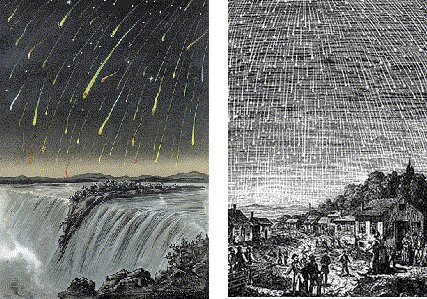
From ‘earthsky.org’

Even better, every third visit or so, Comet Tempel-Tuttle intersects our orbit so closely to where the earth actually is at the time that the cloud of debris is thick enough to make the Leonid meteor shower particularly spectacular. The woodcuts at right depict the 1833 Leonid meteor “storm,” which contemporaries reported produced 100,000 meteors per hour. The comet’s last visit, in 1998, was not one of those close-by visits, and we are now just about midway till our next encounter, so this year’s Leonids will produce maybe 10 to 15 shooting stars per hour, which is still 10 to 15 more per hour than one sees most nights.

This year, this weekend, there are other bright nighttime visitors–a full moon and the aforementioned Comet ISON, which is now bright enough to be seen without aid–but the Leonids are always my meteor shower. This is because November 18 is my birthday. If you see a shooting star this weekend, thanks for noticing something that is coming in third on most lists of things to look for in the night sky–my personal shooting stars.

* * * *

We did not own a telescope when I was a child and I do not remember if either my sister or I ever expressed an interest in possessing one, but my parents considered each occasional celestial phenomena the cause of a family outing. I remember this with great fondness now, which I think was something our mother would tell my sister and me when we were swaddled in the back of our station wagon, wondering why we were outside at this horrible hour just to look at the sky.

“You will remember nights like this,” Mom would say with a smile. “You won’t remember whether you got a full night’s sleep tonight years from now, but you’ll remember seeing” the Perseids or the Leonids or a lunar eclipse, sometimes partial, sometimes total. I think I remember the lunar eclipses particularly well because they are action-packed compared to patiently awaiting a shooting star, and because they end. There is no natural point of departing during a meteor shower, other than when the hot chocolate gets cold. (And then we would return home and I would discover while lying in bed that I already missed being outside in the cold, staring at the sky.)

Our parents did not send us to bed expecting to be awakened a few hours later to drive into the country, so each night-sky outing was its own event and seemed to be sprung on us as a new thing. They are not scientifically-inclined, either, so what we were looking at and for was always mysterious, beautiful, an unexpected gift.

My dad would drive the station wagon to whatever local high point away from the lights that he could find (hard to do in suburban Poughkeepsie). One of our local schools had a parking lot that sufficed, especially for the eclipses.

It was in adulthood that I discovered the appeal of wandering out into a field with a beloved and staring at the deep Ulster County country sky and keeping warm together while the hot chocolate went cold. Especially in November, “for my birthday.”

Last night, my current beloved–who I think will be my current beloved for a very long time–and I walked the Walkway Across the Hudson, which is open at night for every full moon. We looked at the sky, kept each other warm, and because I am not scientifically-inclined, everything was mysterious, beautiful, an unexpected gift.


Red Sox Nation in My Living Room

I am a life-long New York Yankees fan, and I am okay with this. (The first step is admitting powerlessness and that life has become unmanageable.) The eternal American desire to root for an underdog or even a lovable loser–the Cubs, the Brooklyn Dodgers, the Red Sox until 2004–did not pass me by, even as a fan of the Yankees; this is because when I was growing up in the 1970s, the Yankees gave fans two of the team’s extended stretches of losing: in the early 1970s, when the team was owned by CBS, and then again in the late 1980s and early ’90s, when the team’s owner repeatedly fired managers, signed second-rate free agents to two-year contracts only to see them under-perform in both seasons, or traded young talent for older “talent.” 

My team, which I admit had also shown me some success before I was a teenager–three World Series in a row in the ’70s–was not a “lovable loser,” it was a laughingstock by the early ’90s, and I took a perverse pride in this. “Now I know,” I said to no one ever, “What it is like to root for heartbreak.” Of course, seeing multiple World Series trophies held aloft by various pinstriped “heroes” before and after that dark Stump Merrill-Bucky Dent-Dallas Green era puts my rooting for a laughingstock of a team in perspective: the trophies that starting arriving after 1996 were readily, happily seen as a deserved reward for living through those few tough years. But when Don Mattingly is one’s favorite player and he is the one major Yankee in history to have to buy a ticket to see a World Series game, well, let’s just say I was defensively proud of having stood by those sickeningly bad teams. I like knowing what it is like to root for a heartbreaking team (or thinking that I do) and having sympathy for the “lovable loser” teams; it turns out I like rooting for a juggernaut team even more, though.


My dad in a recent photo.

My father is a New Englander, a Vermonter who now lives on Cape Cod, where New England gazes longingly towards old England. He comes by his rooting for the Boston Red Sox (argh and double-argh!) as honestly as he can, and I do not love him the less for it, nor do I think he ever resented me, his only son, for being a Yankee fan. (Maybe all that family role-play therapy that we never really participated in was worth it, after all.)

He is one of those Red Sox fans for whom 2004 was created: born in 1935, he probably listened to the 1946 team’s World Series loss on the radio, and saw the 1967 and 1975 losses on television. All of them legendary, seven-game World Series, but all losses followed by decade-long postseason droughts.

In 1986, I was almost 18, a college freshman living at home, and another legendary Red Sox World Series was unfolding, this time against the other New York team, the Mets. My sole memory of Game 6 and Mookie Wilson’s slow game-ending dribbler through Bill Buckner’s legs is that I was standing behind my dad, who was sitting in his favorite armchair. When the play unfolded, I saw my dad’s shoulders react. A stoic man by nature, my dad simply silently shuddered, like an evil thought had passed through his mind and he had urgently worked to dismiss it; I am glad to this day that I did not see his face. He stood and said something about one more game in a way that exhibited no confidence and then went to bed.

Eighteen years later, in the fall of 2004, my life had taken a dip in fortune and I was once again living at home with my parents, now residing on Cape Cod. The Red Sox had already done the unthinkable and unforgivable in the postseason and defeated my team in the Championship Series. But when the Red Sox won it all that memorable season, I can say that I was proud to be the son who was with his dad when his beloved lovable loser team finally broke through and he was able to enjoy a championship for the first time in his life.

He has now enjoyed two more to my team’s one more, earned in 2009, and I think this is quite enough.

The article I link to here, from The Atlantic (http://www.theatlantic.com/), considers the existential irony that recent Red Sox history presents the world: that young Red Sox fans have known a very successful team, winner or three World Series in a decade, while fans of my father’s generation still carry the spiritual wound (at first, I wrote that as a minor joke, but I realize it’s only half tongue-in-cheek) … still carry the wary style of love learned from rooting for a lovable loser team for 86 years.

A Tale of Two Red Sox Nations