Retailizations

A coffeehouse in France (okay, that right there may be one of the greatest four-word phrases I have ever typed; one almost does not need to continue. Please return from your daydream when you feel up to it) … . A coffeehouse in Nice, France (oh, come on, does this anecdote just keep getting sweeter? The setting may as well be, “A coffeehouse located in Sweet Kisses in Everyone Is Always Smiling Land”) … and, yes, I certainly know that the city’s name is pronounced “neese,’ and not the easy way to a punny joke, but a pun is a pun. 

coffee

Photo from Gawker.com

A coffeehouse in Nice, France, has posted a new price board, seen above and explained in “This Coffeehouse Will Charge You Less if You’re Nice.” If you stride up to the counter and demand a coffee, you will be charged 7€, which is approximately ten bucks and a typographical nightmare. If you say, “Please,” after, you will receive a discount. If you request the coffee and service in the more formal, polite, fashion, you will be charged even less. How great is this?

I worked at several retail jobs spread out over a quarter of a century. (I have also taught college composition, written for newspapers, and written and illustrated technical manuals. Either I have lived an interesting life or a shambling one; these are not mutually exclusive things.) I worked at a bookstore, an electronics retailer, a department store. At each, I desired the power to post a similar sign: a “ten-percent politeness discount on all hardcovers; twenty percent off before 11:00 a.m.,” at the bookstore, say. 

Retail clerks (sales associates, as we are more commonly titled now) occupy a couple different spaces in the average customer’s psyche, it seems. At the bookstore, there were customers who seemed to believe that one of the requirements for employment was that we had read every book in stock, and maybe every copy of each title. Some acted like they saw it as a personal challenge to find out which books I had not read. (At least once, after I had determined that a customer was playing this game, I started to insist that I had not yet read a book–any book–and that I just liked working retail jobs. “I’d like it more if we sold socks,” I told him.)

At the electronics retailer, it was assumed each of us working there was secretly a computer programmer and desktop publisher and ham radio operator who had not yet been discovered and, in our pure-hearted love of working a low-paying retail job as opposed to working as a high-paid consultant, we would/could/should provide professional-level advice for however much we were getting paid. Or for the fee of free.

Both customers are the same, of course, and they have a reasonable desire. Who doesn’t want to discover one’s own personal shopper at every store one walks into? We all want to be insiders. There were many customers at the bookstore with whom I shared great literary conversations and learned to anticipate their next reading needs, and there were many many customers at the electronics retailer.

But if I am your perfect personal shopper, I am probably letting someone else down. (While I was selling furniture at the department store, I had a customer ask me if I thought one couch was more comfortable than another. You know something? Furniture is a surprisingly personal choice. The couch I find comfortable might strike you as high-backed and about as inviting as a bus-station bench.) 

Other customers see the clerks in stores as interchangeable and invisible. Those are the customers the French coffeeshop is addressing. These are the customers who are supremely irked by the fact that a store opens at a certain time and not earlier–when they are there–or in fact has to close at a given hour–again, when they are there. They want to be treated as exceptional and important even as they treat the employees as the equivalent of a store fixture like a shelf or a display. This customer is the only customer who will actually say out loud to a clerk, “The customer is always right.” 

To handle this customer, I learned the “manager trick”: I would anticipate an impending complaint, announce preemptively that I would voluntarily involve the store manager in the conversation, sally forth to the backroom, and conduct the following conversation:

“Hi. Have you heard my chat with so-and-so?”

“Yes. It sounds like you know what to do.”

“I told her (or him) that I would demonstrate sympathy with their side to management, so I am speaking with you now.”

“This is a positive show of solidarity. But you’ll tell them I won’t budge, whatever the conversation is about.”

“Yes. Who are the Yankees playing tonight?”

I would return to the front of the store and repeat what I had been telling the customer all along, but with the added rhetorical support of the manager’s “words.” It usually worked.

It always worked, except once. I stupidly confessed to a friend that I sometimes employed the “manager trick,” and explained what it is, thinking it would amuse him. A few days later, a mutual friend began to negotiate something with me at the store. When I explained that I was going to speak with my manager, he accompanied me step by step to the back of the store. My friend had betrayed my secret.


A Duck About Town: SMA and Me

It is hard to see, but on the top left side of the “The Gad About Town” tab (at least on a Windows browser), to the right of the WordPress logo, there is a little square box that looks like a blob of brown and green. I first placed it there as an inside joke with myself, but the story is worth sharing. The full-size photo is at the bottom of this article.

It is a photo of a duck. 

In 2012, I was diagnosed with a still-undetermined form of spinocerebellar ataxia. (I just noticed that the word “spinocerebellar” now freely flows from my fingers as I type it; I insist on Wikipedia’ing it to check the spelling—to preserve the illusion to myself that this is still new to me—but it is now forever in my vocabulary.) This disease, which I have written about before (“Ataxia“) and will again, is progressive, degenerative, affects my sense of balance, and is robbing me of my physical control of my legs. 

(October 22, 2014 update: in May 2014, a new neurologist was assigned to me and he corrected the first diagnosis to something else, spinal muscular atrophy type IV. Friedreich’s ataxia, the first diagnosis, carries with it a shortened lifespan, a diagnosis that in turn carries with it more than a few nights lying awake and staring into every abyss one thinks is on the other side of any door. Please visit my article about the re-diagnosis, “SCA or SMA?” Everything else in this article, written in December 2013, still reflects my perceptions.)

My symptoms first appeared in 2006, I now realize, when my walking began to slow. I was always a rapid walker, and I felt like I was moving my legs in the same way I had always moved them, but the time it took for me to complete familiar walks was getting ever longer. Even in 2005, while mowing a friend’s lawn, I noticed that it took me longer than it “ought to” have. My legs were tiring easily. Finally, I started to run late for appointments (most hazardously, my job across town) and was perennially underestimating the time it would take me to walk somewhere.

All this was new. I shared what I was experiencing with no one, except to promise when my lateness was noticed that I would “do better” next time.

* * * *

A blue heron, patrolling the shore like a cop on the beat.–Photo by Mark Aldrich

This spring and summer, some friends and I made frequent visits to a pond at a local college campus. A former make-out nook for at least a one of us, this year it became a quiet place to get away from some turmoils in our lives. Several species of waterfowl live on the pond, which is nonetheless quite small. One day a blue heron came by, which is a common but always special sight here in New Paltz. It hung around long enough for me to photograph it walking along the shore.

There are usually a few breeds of duck on the pond, and my friends and I became “expert” in observing the inter-species social behaviors of the different breeds. (In a word, some breeds are just bullies, even to humans who are feeding them breadcrumbs.) We developed story lines about each duck family’s day.

One family of five, a mother duck and her four ducklings, became “my” family. This was because one of her offspring was lame. He or she—I decided he was a he, but I believe it is a she (those who know about such things can tell immediately when looking at the photo below)—appeared to have a broken right leg. Cute and small as they all were, the four of them fuzzy and adorable like they were posing for a children’s book cover, the siblings would push him away from our breadcrumbs, but he always fought hard for his share.

Broken or born that way, he held his leg tucked alongside, which forced him to remain seated on the ground when the others were toddling towards the crumbs. Then, in a flurry of action, he would start to wobbly waddle, but he was perpetually a few steps behind. He was slow in other ways, too: by the time his siblings were free of their baby fuzz and displaying more grown-up plumage, he still had some fuzz.

I saw that, even with his right leg held in a crook, even sitting awkwardly on the ground, once he started walking, after a few unsteady strides he would catch up to his siblings. But he honked just as loudly as they did, each of them telling the others to mind their manners at the top of their voices. In the water, he appeared to swim as quickly as the others.

* * * *

In 2008, the bizarre sensation of being always on the edge of a fall became a part of my life. I could not walk across a parking lot without first looking across it to plan which cars I would use as targets for potential falls. I started walking with a cane.

Faced with the prospect of crossing an empty parking lot (I worked for an electronics retailer that frequently locates its stores in open-air plazas, so that is why I have twice mentioned parking lots), I would look for an abandoned shopping cart (there was a grocery store nearby) and use that as a walker.

As before, I shared what I was experiencing with no one, except sometimes I made jokes about walking with a cane—I named it “Michael,” as in the actor—and I did not have a doctor, because I was 40 and a guy and why bother?

I did not have a doctor, because 40. I was 40 and my legs felt like they were in boots nailed to the ground. I would take a step only to find that neither leg moved.

By 2011, completely foreseeable circumstances had given me the beautiful gift of poverty and thus Medicaid. Now able to afford a few visits to a neurologist, I underwent the series of tests that led to my diagnosis.

* * * *

After that first visit to the duck pond, I did not expect to see “my” duck again. My not-so learned musings about inter-species duck behavior and observations about seeing him clubbed regularly by his siblings led me to my expert prediction. Marlin Perkins in my mind, I lectured one of my ever-patient friends about my sad theory that he probably had been rejected and abandoned “for the greater good of the family.”

On our next visit, two weeks later, he was still there. Of course. He was still missing every first chance at breadcrumbs—even those tossed specifically at him—but fought his siblings to get his crumbs once he started moving. They still pushed him away from their second and third chances at crumbs on the ground, but he was louder than the others and was getting faster, even limping, but doing something like using his lame limb like a cane. He was using his lame leg.

* * * *

I use a method of walking that I devised without knowing what I was doing back at the electronics store: I push off with my right leg, like a right-handed pitcher, and swing my legs under me, using the cane to tap a rhythm. Once I get myself up to speed, I can outpace many of my friends. It is difficult for me to stop suddenly, like when I am jay-walking, so I do not do that. There are days where I do not know what my legs are going to do and we seem to educate each other.

Two friends who walk with me step by step.

Every day, I live with the sensation of being on the edge of a fall all the time, even when I am sitting on a chair that has arms on both sides, and I stand upright by bracing myself with the cane, standing against a wall, or by surprising a friend (often, my beautiful girlfriend) by grabbing their shoulders. In the photo seen here, taken in October 2013, I am with two of my closest friends, but I am holding myself up with a folding chair on each side.

Because I have a diagnosis, I know why I am experiencing these things, and new developments can no longer be as surprising as the discovery in 2008 that it seemed that I could no longer walk. Because I have friends in whom I confide (like you who may be reading this), any new development will not be experienced like running head-first into a wall, which is how it felt for me in 2008.

* * * *

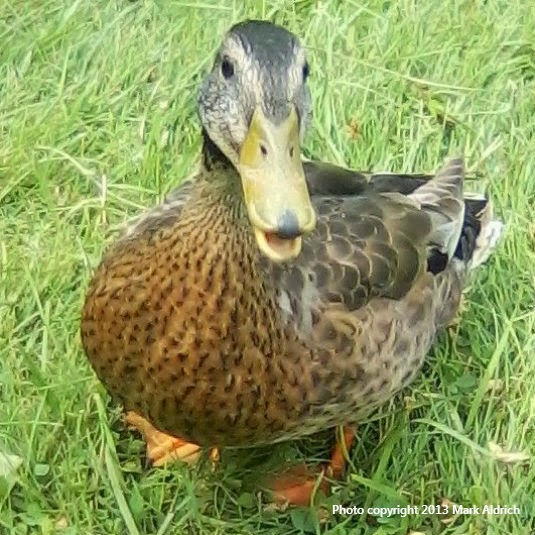
My buddy.–Photo by Mark Aldrich

The photo here is of “my” duck, closer to fully grown in July, waddling up to me. He would take two steps at a time and then pause or plop down, then would take a couple more. First his right foot, then his left, then a stop and reset for another pair of steps. He did not come as close to us breadcrumb tossers as some of the others did that day, but he fought as valiantly as any duck that I would call mine should.

This is the photo that accompanies this blog, next to “The Gad About Town” name. He is my duck about town.

It is now December 2013 and I hope he is still with us, but in the warm south, ornery at his siblings every staggered step of the way. 

A Christmas Tree Story

I am sitting in my girlfriend’s office looking at her office Christmas tree. It is white, snow white, like a snowman in a a Rankin/Bass stop-motion cartoon. (Paul Frees would provide the voice.) We will be trimming it in a few moments.

A white Christmas. Photo by Mark Aldrich


I think that tree trimming was my least favorite trimming when I was young. I still lack the eye necessary for decorating a tree correctly; in fact, I believe that almost every tree I have attempted to decorate has been quietly fixed upon my leaving.

(Two things transpired within moments of me writing the above: my girlfriend credited me with expanding her notions of tree decoration–“You’re the first person I’ve seen who does not put all the decorations on the ends of the branches,” which is true, I sometimes place them on the middle or even closer to the trunk; and we found that I had overloaded one section with the same color ornament and we needed to correct it.)One winter, a friend enlisted me in a project to cut down a real live Christmas tree from a Christmas tree farm so her son could experience a Christmas like the one she and I had never ever had. (The sum total of my experience with freshly cut Christmas trees was buying one in a parking lot from a seller who was asked by the police to pick up his trees and move it along just after we made an offer. We did not get a discount.)

Neither my friend, her seven-year-old son, nor I knew what cutting a live, six-foot-tall or smaller tree would take, so we brought the one saw she had (I believe it was one her uncle had rejected 45 years before for one that was actually sharp; now it also had some rust) and drove to a tree farm in Dutchess County, New York. I have chopped wood plenty of times, and I have helped take dead trees down; none of these experiences served me this day. 

The first task in cutting down a fresh Christmas tree for oneself is finding something to occupy the seven-year-old son of your friend–letting the child select the winning tree to preserve your friendship with his mom is advisable. Next up is failing in negotiations with him to pick a tree that is not on a slope.

Many will ask the question, “Should I cut two notches to make a V or cut straight across?” I know I did, just not out loud or in the presence of someone who could tell me the answer. With my tiny, rusty saw and no one holding the other side of the saw, I started notching one side of a V. The blade sliced some bark off and did not penetrate the green wood underneath. The snow had already penetrated my boots, though. The trunk was no thicker than two inches wide, if that–I’m no tree-ologist!–but it was quickly apparent that I was going to need help. 

With that in mind, I drove away my companion and her son with my grumpy “attitude.”

An hour alone, my inner debate over cutting straight through versus cutting a V had produced several partial starts–some up, some down–all the way around the tree. Instead of a V, I had notched a lowercase w, partway to the center of the tree. My friend returned and we commenced cutting straight across, because it was taking me too long, when we discovered that there is nothing quite as unsatisfying as the sound of a tree not coming down no matter how far one has cut through it until it is ready to come down. 

It eventually came down. I accompanied it down the slope … okay, I rode it down the hill like Slim Pickens in “Dr. Strangelove.” I had not reminded her to bring rope to tie it to the roof of her car, so we drove home with it sticking out one of the backseat windows. 

* * * *

My family had one plastic tree for twenty or more Christmases. It was a well-constructed one, actually, a bare metal trunk with a two or three hoops to hook in each individual branch around the tree. It actually had an instruction manual. Our Christmas tree and boxes of ornaments occupied several boxes in the basement; the annual production of “putting up the tree” was my introduction to grown-ups not being able to remember from one year to the next the locations of things they put away in the same box in the same place every year. And now I am that grown-up.

I am sure that my mother and father found it necessary to re-position my ornaments; I swear that something happens to me when I approach a tree, ornament in hand. I have hooked ornaments into shirt buttonholes when I swear I was aiming for the tree. Just as I wanted to cut my one live tree down in one graceful and strong sawing motion, I always want this ornament here and now to be the first, last, and only one needed to make this year’s tree complete and perfect. Christmas brings out the perfectionist in all his mistake-prone grumpiness in me. 

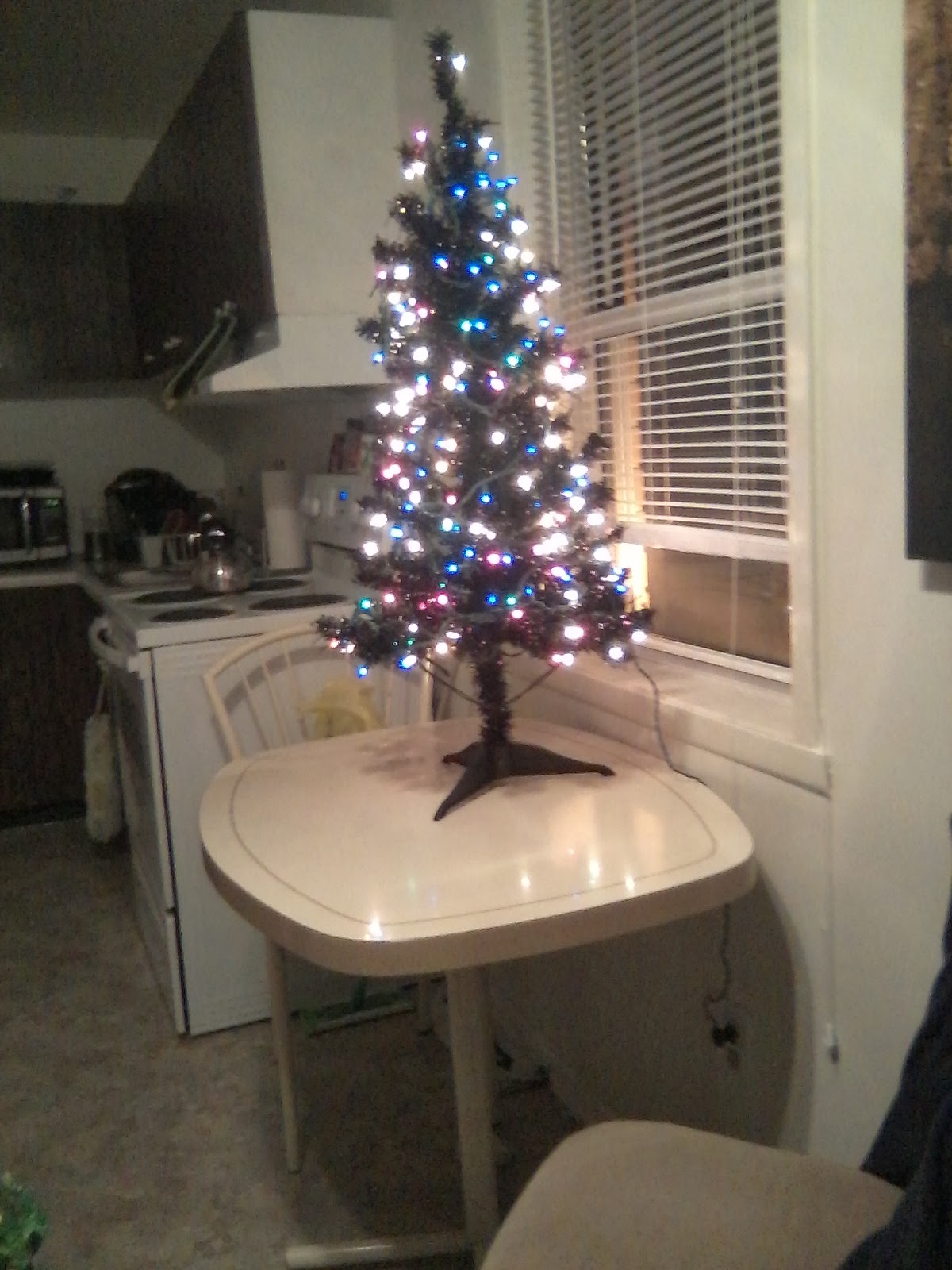
An addition to my kitchen. Photo by Mark Aldrich

Thus, the only part of decorating that I relax and enjoy is either throwing tinsel everywhere or putting the angel on top. (That is an unsung rite of passage, growing tall enough to top the tree with a star or angel.) We had an angel, a cardboard seraph with glued-on glitter and thin, stringy blonde hair. Its halo was glued-on, as well. But it was our angel, and when nicer ones found their way into our house, they were always relegated to lower branches. My family’s underdog mentality extended to angels.

The tree in my girlfriend’s office replaced one she had had for several years. That one now sits in my kitchen, and is the first Christmas tree I have had for my own Christmas in many many years. I do not think I have told her that, yet. Here it sits:

I did not know that trees came pre-lighted. This discovery is revolutionizing my outlook on Christmas. However, I will be leaving the decorating to my housemate, for fear of hooking a ball to my shirt.