Daily Prompt: First Instincts Versus Second Opinions

The WordPress Daily Prompt for August 10 asks, “What are some (or one) of the things about which you usually don’t trust your own judgment, and need someone’s else’s confirmation?”
__________________________________

My first instinct, which is that my first instinct can not be trusted, is usually wrong. This often puts me in any number of conundra.

The paragraph immediately above gives a clear example: My typing fingers wanted to write “conundrum,” then wanted the plural form. But what is the plural of conundrum? My all-too clever brain thought: “conundra. That’s funny. It’ll get a smile from someone.” The someone who smiled was me, which was enough to make it so, and I typed “conundra” for “conundrums.” But I go look it up and learn—thanks, World of Information!—that since conundrum does not come from a Latin root, but sounds like it might have, the proper plural is “conundrums.” Further, the word “conundra” has existed for a long, long while as a humorous, mock-educated plural form for plural problems. “Mock-educated.” That’s me, so it remains “conundra.”

But if that agonized convolution of almost-thought is a real tracing of how I decide most things, and it is, it is a wonder that I find enough food each day to survive.

Thus I need help deciding things more often than not, but have made a life’s habit of refusing help or of going in the opposite direction.

The one best example of going against my first instinct of ignoring my first instinct came when I first met my girlfriend, my partner, my love. (All one person.) The very moment I saw her, a thought crossed my mind (always a dangerous thing) just on other side of being articulate; words were not there, but the thought, if it can be captured, was: “She is going to be important to me.” Not possessing foresight, I did not know what that might mean (the joy is that I am still learning)—I needed five bucks that night, and maybe she was going to lend it to me. Or maybe she was going to join me for this ride we have been on for these last couple-plus years.

Knowing myself all-too not very well, I knew that I should not reach out to her, not try to get to know her, ask her out on a date or 300. My pre-instinct said, “You want to know her.” My first instinct replied (of course, my first instinct feels like a reply already): “No you don’t. Fear rejection. Fear acceptance. We don’t have any food in the fridge.”

I did something I have no history doing and asked friends. “I think I like our new friend.” (My questions end with periods instead of question marks.)

“Yeah?”

“I think I’m going to ask her out.” (Now, this was the challenge: One of the first sentences we had heard from her was that she was beginning a year-long moratorium on dating, starting that week. Easy excuse for me to throw in a towel that I did not even know the color of.)

“You haven’t yet? I thought you had.” That semi-clinched it: My friends knew me less well than I thought they did. That was enough second opinion for me.

My first instinct, to always doubt my first instinct, led me to do the opposite of what I was telling myself to do and ask her on a date. I ignored my instinct to ignore my instinct and trust that someone special was in front of me. At the time: I was unemployed; had not yet had necessary eye surgery, so my glasses were unbelievably thick and unattractive; had not yet been diagnosed, so I was not collecting my Social Security. Thus my life situation was that special kind which does not include income. So my asking her out on a date at all was audacious, and I am not an audacious human.

For once I was, and it made all the difference. I am grateful for her inspiring this audacious behavior from me, and happy she was just as audacious in return.

Daily Prompt: Born at the Right Time

The WordPress Daily Prompt for August 9 asks, “When life gives you lemons … make something else. Tell us about a time you used an object or resolved a tricky situation in an unorthodox way.”
__________________________________

“Life has taken you down a different road, and your GPS is broken.”

One of my myths I believed about myself, deep into grown-up-hood, was that I had incredibly good timing. When it was time to make a life decision, even if that decision was to not make a decision at all, I made it (or did not make it), decisively and without looking back. As said above, this is actually a myth.

The reality was that when in one of life’s corners, I took what was available, crumbs or cake, and kept it moving. “Consequences” was a four-syllable word for “things I will probably ignore.” For the most part, my life was spent chasing employment, trying to find something akin to permanence, only to flub it after three or four years.

I am starting to understand a sentence: “Shall not regret the past nor wish to shut the door on it.” Perhaps I made a lot of errors, but no mistakes. I am not certain about that, but I continue making my amends. If I am here (check) and all is fundamentally well (check), then the road that I followed that brought me here brought me to a good place. There is nothing wrong with this road. I am a signpost on it for others.

I do not have many specific “MacGyver”-type incidents of situational brilliance in my life, not yet anyway. More often than not, my mouth has talked me into increased trouble instead of save me, like that time when I talked a New York State Trooper into giving me a ticket. (He did not, because paperwork. And to annoy me. I am grateful—now.) And I am not a physically resourceful person. My relationship with the natural word of objects and things is that of a reluctant participant, one who breaks unbreakable things and walks into street signs.

When my body started to change in my late 30s, when the symptoms of adult spinal muscular atrophy first showed, it came with a jolt. Only recently have I learned that this is a common experience among people with neuromuscular diseases. When walking becomes difficult—in my case because the nerves that had been sending (ever dimmer) signals to my legs (which had started to atrophy from receiving ever dimmer signals)—the end of normal walking comes as if everything had been just fine one day and the next day as if one’s shoes had been nailed to the ground or one’s co-workers had painted the floor with superglue. It is sudden and scary when the progression of deterioration is undetected and undetectable until the day it is not.

The strange thing is my behavior regarding this: I attempted to MacGyver my response. Rather, I attempted to manufacture a cliche of a MacGyver response. Very little was done consciously on my part other than to buy a cane and start to use the local cab service for any journey longer than my front door to my room, some of whose drivers actually carried me from their car to my front door—stone sober (I emphasize this because my history could imply otherwise)—because my legs had had enough for that day. I developed a mode of walking, a stiff waddle that I hoped would not attract attention. It did.

I attempted to “strong and silent” my way through it as if I was confident that there was a something better on another side of a tunnel that saw me traveling through it in secret terror.

What would MacGyver really do? Probably what I ultimately did: visit a damn doctor. See a neurologist. I have learned to ask for help and even to (and this is a tricky thing) accept it. I still walk with a waddle but I am no longer counting down the minutes to a lesser and lesser able self, which is what I was doing before I knew what the heck was changing in my body. Accepting reality and using all the tools at my disposal, changing into the person who tries to do those things, that is making lemonade, I guess. That’s how I get to play MacGyver in my life. My GPS is finished re-calculating a route.

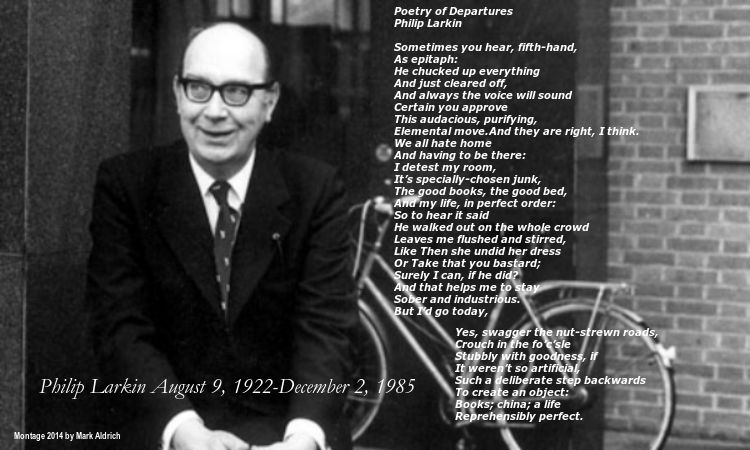
Philip Larkin, August 9, 1922–December 2, 1985

Philip-Larkin montage