Time and Dr. Johnson

Samuel Johnson wrote, “He that hopes to look back hereafter with satisfaction upon past years must learn to know the present value of single minutes, and endeavor to let no particle of time fall useless to the ground.”—Rambler 108, March 30, 1751

Dr. Johnson was 41 in March of 1751 and several years into his work on his most lasting project, his Dictionary. Unlike most of the dictionaries developed for any language, and all dictionaries in English, Johnson’s “A Dictionary of the English Language” was written by one man. An entire dictionary, with more than 40,000 word entries and over 100,000 literary quotations to back up and explain Johnson’s definitions and create an etymology (the study of the origin of words). It took Johnson nine years to complete it; 75 years later, Noah Webster published his own dictionary, which had 70,000 entries, took 25 years to complete, and cites Johnson throughout. The first completed edition of the Oxford English Dictionary took 75 years and dozens of scholars to compile its first edition, published in 1928.

Johnson’s Dictionary is not the best one written for or in the English language—the dictionary that sits forgotten on your shelf is probably named Webster and not Johnson, and the website that you use instead of a book is also not named “Johnson.com” or something like that. Johnson’s definitions are often complete sentences and are sometimes essays on the topic inspired by the word under consideration. His treatment of the word “time,” for instance, offers fourteen different meanings for the word: “1. The measure of duration. 2. Space of time. 3. Interval. 4. Season; proper time. 5. A considerable space of duration; continuance; process of time. 6. Age; particular part of time. 7. Past time. 8. Early time. 9. Time considered as affording opportunity. 10. Particular quality of the present. 11. Particular time. 12. Hour of childbirth. 13. Repetition of any thing, or mention with reference to repetition. 14. Musical measure.” (“Time,” Johnson’s Dictionary)

Johnson offers a quote from English literature, usually the King James Bible, Shakespeare, Milton, Swift, or Dryden, as a pertinent example for each particular definition. Sometimes he offers as many as seven quotes. For his fourteen definitions of “Time,” he uses forty-six quotes.
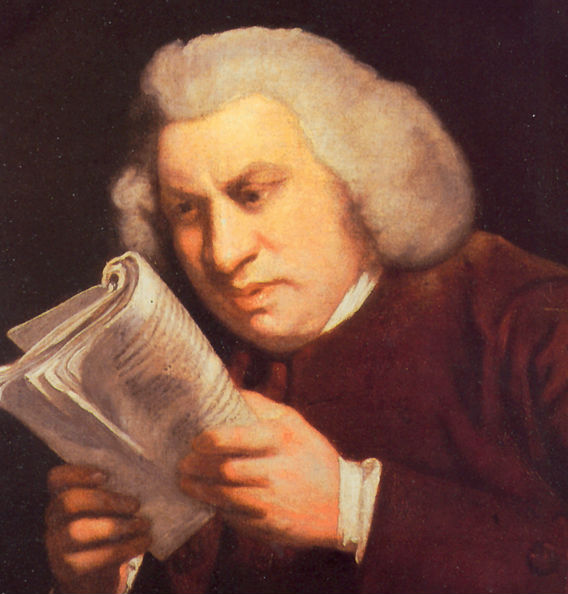
Samuel_Johnson

Samuel Johnson by Joshua Reynolds

This project would be difficult enough to produce in our era of desktop publishing (is there an app for dictionary creation?); Johnson put together his Dictionary in his house, with workmen appearing every so often to assemble a printing press and run off some pages. He paid them out of his own pocket. His personal library, large but not comprehensive, was supplemented by books borrowed from friends. The books were so covered with his markings that they were not worth being returned, the friends remembered.

It took him nine years to complete the Dictionary, yet he had promised it in three. For the rest of his career, Johnson was ridiculed as a slow worker; he proposed to work up an edition of Shakespeare’s plays (the first ever single source, authoritative edition that would be created) in 1756 and started attracting subscribers, but by 1762 another writer took a public jibe at him: “He for subscribers baits his hook/and takes your cash, but where’s the book?” His Shakespeare was published in 1765.

While working on his Dictionary, he published a self-written, twice-weekly periodical, The Rambler, to earn a living. (In other words, he wrote a blog while working on his big project.) Then, while working on his edition of Shakespeare, he published a weekly blog, um, magazine, called The Idler.

Samuel Johnson visited the topic of time over a dozen times in those two journals, and perhaps for understandable reasons: For someone so productive and yet considered a slow worker (The Idler was so named as a joke about his avoiding the long slow work on his Shakespeare), it is likely that few writers had considered time in so many facets. Any waking hour not spent earning a living was indeed “a particle of time (dropped) useless to the ground.”

Johnson had many health issues, ranging from regular bouts with a bleak depression, which he was the first to name the “black dog”; nearsightedness that glasses did not aid (or vanity made him avoid them); a disfiguring skin condition; and Tourette syndrome, a condition that did not have a name until the late 1800s and was not considered a medical condition in Johnson’s lifetime. The tics made him seem an odd character, and he felt he had to win people over with his wit. (Asked once why he made noises, he said it was a bad habit.) His many tics and violent gesticulations are described in every contemporary account about him written by his friends, so the posthumous diagnosis seems a trustworthy one.

A year and a half before his death, he described time and its slowness in old age thus:

The black dog I hope always to resist, and in time to drive, though I am deprived of almost all those that used to help me. … When I rise my breakfast is solitary, the black dog waits to share it, from breakfast to dinner he continues barking, […] After dinner, what remains but to count the clock, and hope for that sleep which I can scarce expect. Night comes at last, and some hours of restlessness and confusion bring me again to a day of solitude. What shall exclude the black dog from an habitation like this?

____________________________________________
The WordPress Daily Prompt for February 25 asks, “If you could slow down an action that usually zooms by, or speed up an event that normally drags on, which would you choose, and why?”

The WordPress Daily Prompt for November 1 asks, “If you could slow down an action that usually zooms by, or speed up an event that normally drags on, which would you choose, and why?”

* * * *
Please subscribe to The Gad About Town on Facebook: http://www.facebook.com/thegadabouttown
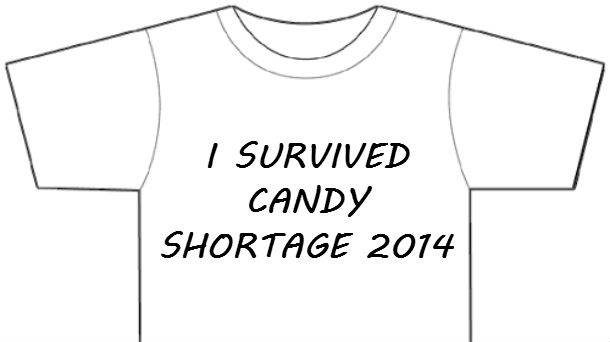
Candy Crisis 2014

As the 2014 candy shortage spread from city to city and finally house to house, the hoarders were found out. The police records from that autumn show a system overwhelmed by the sugar-starved criminal element. Pages upon pages detailing baroque crimes of candy hunger give way to long lists of numbers with no further details and then to blank pages, which speak volumes in their emptiness.

The shortage was blamed by politicians of one party on politicians of the other party. Banks blamed insurers and insurers blamed a system built to only anticipate the anticipatable. Leaders were few.

The more headline-devoted media outlets dubbed it the Candy Apocalypse but they were unready for the sudden absence of advertising revenue. The criminal element sent spokesmen to express shame that it was now connected to such bizarre crimes of hunger that even hardened criminals were abashed.

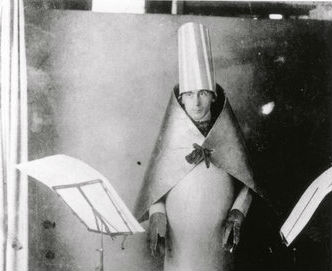
The Dadaists saved me. Surrealism only put off the candy-seeking hordes for a moment, long enough to shoo my family into a far room, but not long enough to protect my property. I dimly remembered a phrase, that drastic times called for something. It seemed that these were drastic times. “Drastic times call for … drastic leisure?” That did not ring a bell. “Drastic pleasure?” “Drastic times call for something really big,” I declared.

The doorbell rang that fitful Halloween night and I was prepared with my drastic big things to meet the drastic times; I prayed that confusion was my only chance to at bringing any sense to these fructose-enslaved zombies.

I was dressed as a sort of sorcerer, put a rug on my head to indicate fortune telling and oven mitts on my hands for claws. I spoke as slowly and as quickly as I could:

jolifanto bambla o falli bambla
großiga m’pfa habla horem
egiga goramen
higo bloiko russula huju
hollaka hollala
anlogo bung
blago bung blago bung
bosso fataka
ü üü ü
schampa wulla wussa olobo
hej tatta gorem
eschige zunbada
wulubu ssubudu uluwu ssubudu
–umf
kusa gauma
ba–umf

hugo_ball

Hugo_ball_karawane


The stunt was a raging failure and tonight I am writing this on the road, leading the procession to the next neighborhood, hunting, forever hunting in a soul-less search for more candy, candy that will never more be found.

* * * *
A flash fiction for Halloween 2014. We have plenty of candy here. Boo.

____________________________________________
The WordPress Daily Prompt for October 31 asks, “It’s Halloween, and you just ran out of candy. If the neighborhood kids (or anyone else, really) were to truly scare you, what trick would they have to subject you to?”

* * * *
Please subscribe to The Gad About Town on Facebook: http://www.facebook.com/thegadabouttown

A Halloween Memory

The Martin Prosperity Institute has not yet released its annual survey of all things Halloween, because today is not Halloween and impatience will not change this fact.

Their work last year in the field of Halloween enjoyment, a study not seriously undertaken by most people older than eight, but a subject that the Institute has studied for three years in conjunction with the Atlantic Cities, led to many national news articles expressing shock at its conclusion: that the best place for Halloween in the United States of America is Poughkeepsie, New York.

To reiterate and emphasize key points: 1. There are fifty states. 2. All of those fifty states are pretty important in the lives of the people who live in them. 3. There are lots and lots of cities in many of those fifty states. 4. I, however, have only one hometown, and it was voted Halloween Central last year by a major little-known Canadian institute of counting things up and measuring the assessments in extremely professional ways. (Or assessing the measurements. Whichever. It was exciting news. More candy corn?)

The Washington Post expressed its perplexion with a judgmental headline, “Is Poughkeepsie, N.Y., the best place to trick-or-treat tonight?” Okay, it was not all that judgmental. Maybe it was a little sneer-y. A little dumbfounded. Perhaps a little, um, jealous?

How did the MPI come to its conclusion (since we both love my hometown so much, I think I can call the Martin Prosperity Institute by the more informal “MPI” or even “Marty”) that Poughkeepsie does Halloween better than … oh, I could list every city and hamlet in the country here, but I am no Grinch … everybody else?

According to its press release last year, titled “Trick or Treat? The 2013 Halloween Index,” the MPI measured “five variables that are integral to a successful Halloween: candy stores (per 10 thousand), costume rental stores (per 10 thousand), children aged 5-14 (share of metro population), population density, and median income.” Now, while Poughkeepsie does not rank number one in any one of these five categories, it ranked so high across the board that it beat second-place Chicago, Ill., (the 2012 winner).

Jackson, Tenn, was found to have the greatest number of costume stores per capita. Ocean City, NJ, had the most candy stores. But Poughkeepsie’s high average income and large number of costume stores sent it to number one.

See for yourself. Here is a very precise representation:

Poughkeepsie has the biggest pumpkin!

Poughkeepsie has the biggest pumpkin!

According to itself, the Martin Prosperity Institute “is the world’s leading think-tank on the role of location, place and city-regions in global economic prosperity.” “Marty” is based in the Rotman School of Management in Toronto, Canada, which is a lovely city and might be a great Halloween destination for the adventurous Halloween traveler, but Poughkeepsie.

It should come as no surprise for those of us who grew up in Poughkeepsie that our hometown is the fake spookiest or candy-sweetest or the best Halloween town in America.

Any October visitor might notice how many fly-by-night (erm, seasonal) costume stores appear along the Rt. 9 corridor every fall, or the large number of short-lived candy shops, or professionally run haunted houses, or the fact that there is a gigantic freaking (and real) cemetery smack in the middle of the whole darn Rt. 9 corridor. For those visitors—business travelers and ghouls alike—this study makes plenty of sense.

It would have made a lot of sense to my sister and me and our elementary school friends if you’d told us this back in the 1970s. I was never a particularly enthusiastic trick-or-treater. As a less-than-enthusiastic cub scout, tasked with selling items from the most boring scout catalog ever printed (two items that I remember are plastic campground dining gear and peanut brittle that outlasted the plastic dining gear), I already knew my way around the neighborhood and knew which houses were owned by people I did not like seeing in bright daylight, much less at dusk. The plastic masks—Fred Flintstone, Spiderman, Superman—were each identical except for the paint job, did not line up over my eyes, much less my eyeglasses, and were held in place by the flimsiest rubber band yet devised by human ingenuity. I could not breathe in them. Each had a cape—even Fred Flintstone, I am sure, or perhaps that was my mother’s ingenuity to keep me warm—and none earned me much candy. My less than enthusiastic cub scout side always trumped my slightly more enthusiastic begging-for-candy side.

Bordering our neighborhood, on two sides, was “The Woods.” Google Maps will convince you that the wooded area between my neighborhood and the Hudson River was not impressive, was merely undeveloped and undevelopable land left to rodents and deer and pricker bushes and some extraordinarily ordinary maples and oaks. The untrained eye will see, driving along the country road bordered on one side by The Woods, that one can clearly see to the Hudson River and unmistakably hear trains on the Metro-North line a few dozen yards away. I pity my 2014 eyes and ears. Because I knew, just knew, in 1977 that those trains came off their tracks and plunged howling into The Woods at night. And some of those rodents and deer had never before been seen by the eyes of man. They were feral and wild and wildly feral. (Never mind those firepits or the plastic forks or … is that peanut brittle?)

One Halloween Night, in 1979, I was allowed to venture on foot, not accompanied by adults and in costume (hold that thought for a second while I address my parents: What!?!) from my neighborhood to my best friend’s neighborhood, which was connected to mine by Barnegat Rd. The Woods, the scary Woods, borders Barnegat Road. Do I need to repeat this?

The best friend, Doug, loved to tell tall tales. Whenever he hosted me for a sleepover there had been a plane crash in The Woods the night before that no one was investigating (there had been no such incident) or a car had plunged down the embankment into The Woods the other night and exploded and the driver got out on fire (there had been no such accident) or his Polish grandmother had told him that there would be ghosts in 1979 that hadn’t been seen in many many years (he had no Polish grandmother). Doug was five days younger than me and creatively lazy and this made him a respected authority in my eyes. (I hope he is someone’s parent nowadays.)

At just the perfectly wrong moment, while he and I walked from his neighborhood back to mine, loot in our identical plastic pumpkin pails, just as he was committing with his words some luckless fictional airplane pilot to a fiery death earlier that very day a mere few feet from where we were walking, just then, my flashlight went dark. We started to walk at a faster pace. There truly are few streetlights on that road, and even fewer in my memory. I had never seen a night so dark or learned of a death so imaginable. Just then, we heard a sound. A low, rasping scream of an anguished, crying creature—Doug had found his true calling as a storyteller, at least this one night, and both of us bolted from what was obviously the ghost-tortured mortal remains of his burned-up pilot or a ghost of a train engineer come to steal us from Poughkeepsie, which for us was already the best Halloween city in the country.

____________________________________________
The WordPress Daily Prompt for October 30 asks, “Today you can write about anything, in whatever genre or form, but your post must mention a dark night, your fridge, and tears (of joy or sadness; your call). Feel free to switch one ingredient if you have to (or revisit one from previous trio prompts).” I switched one. The fridge became a flashlight.

* * * *
Please subscribe to The Gad About Town on Facebook: http://www.facebook.com/thegadabouttown