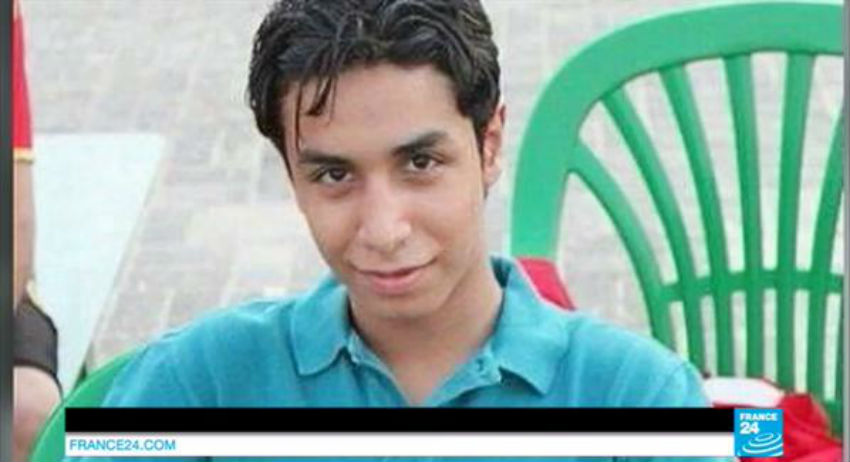
An Imminent Beheading

The United Nations Office of the High Commissioner for Human Rights released a statement Tuesday night urging Saudi Arabia to halt the execution of ‪Ali Mohammed al-Nimr‬ because he was “convicted for a crime reportedly committed as a child.” It is rare that a specific person’s specific case be the subject of such a statement.

The statement reads, “Any judgment imposing the death penalty upon persons who were children at the time of the offence, and their execution, are incompatible with Saudi Arabia’s international obligations.” It reminds Saudi Arabia that it is a party to the UN Convention on the Rights of the Child. Because Ali’s trial was conducted unfairly, the UN OHCHR argues, “International law, accepted as binding by Saudi Arabia, provides that capital punishment may only be imposed following trials that comply with the most stringent requirements of fair trial and due process, or could otherwise be considered an arbitrary execution.” Thus, Ali’s impending execution must be halted and a new trial set up.
Read More

One Who Got Away

More so for Sylvia Plath than many other writers, readers develop protective feelings for her. Many openly express the idea that “only they” get her or are her best reader. Reading biographies of the dead poet, one encounters language akin to a lover describing the one who got away. Plath, a suicide, is a love who got away, for reader after reader.

The other Plath scholars or even her casual readers (if such readers exist) are viewed as rival suitors, as dead wrong for her, as individuals mishandling her bones. Some biographers refer to her by her given name, “Sylvia,” rather by than her personal and professional name, Plath, thus treating her as a familiar. Others are deeply offended by this practice, which does indeed appear to be something reserved for this poet alone. It has the effect of making her the star of a soap opera that she never cast herself in.

(Until her death in July 1995, I was friends with and a student of a Sylvia Plath scholar at SUNY New Paltz, Dr. Carley Bogarad. If ghosts existed, I wish hers was looking over my shoulder today.)
Read More

Crucifixion for Protest

Reports out of In Saudi Arabia about the case of Ali Mohammed al-Nimr tonight, September 23, are grim. We may wake to unbearably sad news tomorrow (it is 10:45 p.m. EST as I type these words).

Reliable sources report that Ali is scheduled to be executed by beheading tomorrow and then his body will be crucified and hoisted up on a pole and displayed to show all who see what can befall a young man unlucky enough to be born in that barbaric nation in this current, sanguinary period in its history. Ali was arrested at a protest in 2012 when he was 17 years of age; he was charged with many crimes, it seems likely he did not commit any.

The holiday of Eid al-Adha is upon us. In Egypt, President Abdul Fattah al-Sisi pardoned two journalists, Mohammed Fahmy, a Canadian, and Baher Mohamed, an Egyptian, along with several dozen other prisoners. Fahmy and Mohamed were released; their colleague, Peter Greste, was deported in February, and he may have been included in the long list of those pardoned today. I wrote about Fahmy’s case last month: https://thegadabouttown.com/2015/08/29/a-farce-in-egypt/.

It is believed that al-Sisi acted in accordance with a tradition of granting pardons on this most solemn of holy days. Eid commemorates Abraham’s willingness to sacrifice his own son, Isaac, out of respect for God’s will; because Isaac was spared thanks to God sending an angel to halt the proceedings out of God’s respect for Abraham’s seriousness of intent, Eid is marked with similar pardons granted by political leaders.

But a willingness to sacrifice a child is sometimes marked by actually murdering the child. That sick possibility is what is perhaps about to befall a young man who walked out on a street on the wrong day to do so in Saudi Arabia.

(Two sources: https://www.movements.org/market/1327 and http://m.france24.com/ar/20150923-%D8%A7%D9%84%D8%B3%D8%B9%D9%88%D8%AF%D9%8A%D8%A9-%D8%A7%D8%B9%D8%AF%D8%A7%D9%85-%D8%B4%D8%A7%D8%A8-%D8%B4%D9%8A%D8%B9%D8%A9-%D9%82%D8%B7%D8%B9-%D8%A7%D9%84%D8%B1%D8%A3%D8%B3-%D8%A7%D8%AD%D8%AA%D8%AC%D8%A7%D8%AC%D8%A7%D8%AA-%D8%AD%D9%82%D9%88%D9%82-%D8%A7%D9%84%D8%A7%D9%86%D8%B3%D8%A7%D9%86-%D8%B9%D9%84%D9%8A-%D8%A7%D9%84%D9%86%D9%85%D8%B1)

Mark Aldrich's avatarThe Gad About Town

No one knows when or where—and it is possible that by the time you read this, the punishment will have been carried out today—but sometime soon, now that it has been learned that an appeal was denied, Ali Mohammed al-Nimr will be beheaded and then his remains will be mounted on two boards and put on display. In his country, this practice is known as “crucifixion.”

It is not a common means of treating a prisoner who has been sentenced to death in his home country. Beheading someone and then displaying the body is reserved only for those who have committed the most heinous of crimes, like show up at a protest.

View original post 772 more words