
Upside Down

For a year I lived with a diagnosis of Friedreich’s ataxia, a genetic, neuromuscular disease whose symptoms are quite close to mine.

My symptoms: Since 2005 I have been aware, at first dimly, of a mobility disorder developing in me; today, in 2015, I walk with a cane or impressive walking stick, stiffly, like I am wearing very tight jeans; I have little sensation in my lower legs and even have moments of “body confusion” in which I think I am moving my right leg but my left leg moves. I sway when I stand and fall/walk into walls and my sense of not knowing where I am in the world contributes moments of comedy to my day. I was in my mid-30s when the symptoms began to attract my attention, which means the symptoms began to appear several years earlier.

Instead, it is very likely that I have a disease called spinal muscular atrophy, but I am grateful for that year in which I thought I had Friedreich’s ataxia. This is because all that I knew upon learning my diagnosis was my diagnosis—Dr. M, my neurologst, did not even hand me a tri-fold pamphlet, “So You Have a Potentially Life-Shortening Condition,” if such an item is even available—but there were online groups ready to embrace someone like me.
Read More
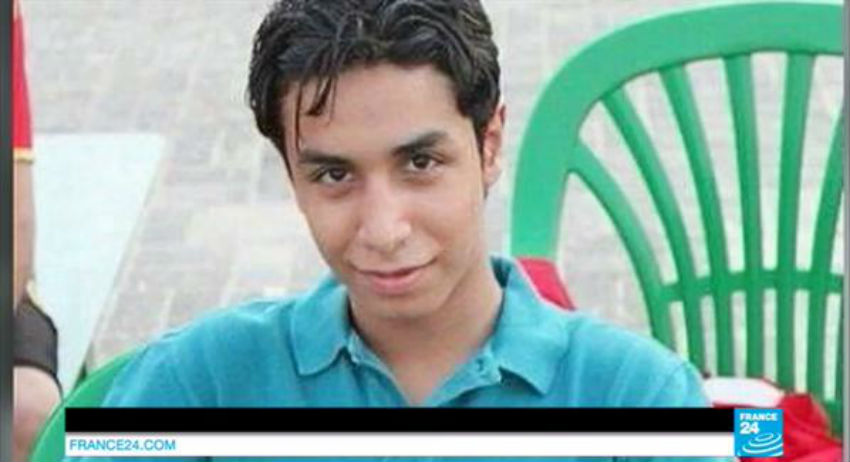
An Imminent Beheading

The United Nations Office of the High Commissioner for Human Rights released a statement Tuesday night urging Saudi Arabia to halt the execution of ‪Ali Mohammed al-Nimr‬ because he was “convicted for a crime reportedly committed as a child.” It is rare that a specific person’s specific case be the subject of such a statement.

The statement reads, “Any judgment imposing the death penalty upon persons who were children at the time of the offence, and their execution, are incompatible with Saudi Arabia’s international obligations.” It reminds Saudi Arabia that it is a party to the UN Convention on the Rights of the Child. Because Ali’s trial was conducted unfairly, the UN OHCHR argues, “International law, accepted as binding by Saudi Arabia, provides that capital punishment may only be imposed following trials that comply with the most stringent requirements of fair trial and due process, or could otherwise be considered an arbitrary execution.” Thus, Ali’s impending execution must be halted and a new trial set up.
Read More

One Who Got Away

More so for Sylvia Plath than many other writers, readers develop protective feelings for her. Many openly express the idea that “only they” get her or are her best reader. Reading biographies of the dead poet, one encounters language akin to a lover describing the one who got away. Plath, a suicide, is a love who got away, for reader after reader.

The other Plath scholars or even her casual readers (if such readers exist) are viewed as rival suitors, as dead wrong for her, as individuals mishandling her bones. Some biographers refer to her by her given name, “Sylvia,” rather by than her personal and professional name, Plath, thus treating her as a familiar. Others are deeply offended by this practice, which does indeed appear to be something reserved for this poet alone. It has the effect of making her the star of a soap opera that she never cast herself in.

(Until her death in July 1995, I was friends with and a student of a Sylvia Plath scholar at SUNY New Paltz, Dr. Carley Bogarad. If ghosts existed, I wish hers was looking over my shoulder today.)
Read More