#OpParis, Day 2

The mainstream media has started to take Anonymous more seriously than it has in the past in the last two days. Part of this is born of the mainstream media’s continuous pursuit of an “Us vs. Them” narrative, and part of this comes from the human need to find someone to cheer for in this dark, bloody time.

Here is The Hill, a daily in Washington, DC: “Anonymous claims it has eliminated 5,500 ISIS Twitter accounts.” Here is Rory Cellan-Jones of the BBC, who landed an interview with “the person behind the #OpParis Twitter account” (@opparisofficial, by the way): “Anonymous takes on IS.” Cellan-Jones’ interview was conducted by email, not on camera, and was not recorded.
Read More
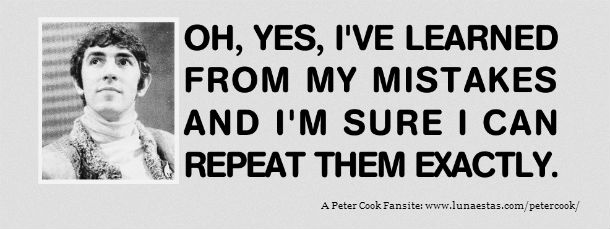
Peter Cook: Goodbye-ee

The great comedian Peter Cook was born on this date in 1937. This essay is a tribute I wrote about him in January 2015. Please enjoy.

Mark Aldrich's avatarThe Gad About Town

John Cleese has said that for him it often took hours of “grinding” work to write several minutes of comedy, but that Peter Cook could write three minutes of top-quality material in just over three minutes. It appeared to come to him that easily early in his career.

But he did work hard. As a writer and performer, Cook worked hard at avoiding politeness for politeness’ sake if a laugh was available instead. When the Prime Minister of England, Harold Macmillan, wanted to attend a performance of the hot new West End show, “Beyond the Fringe,” either no one told him that one part of the show was the performance of a monologue by Peter Cook as Macmillan and that Cook made Macmillan sound like a sluggish dolt, or it was expected that Cook would skip that section of the performance in deference to the nation’s leader. In the monologue…

View original post 1,658 more words

Auden & Bluffing

In the documentary, “Tell Me the Truth About Love,” W.H. Auden’s friend Thekla Clark recounts the story of one of Auden’s lovers complaining to him that he thought Auden would be more “romantic,” being a poet, after all. “But you aren’t romantic,” Clark quotes the lover telling the poet. “You aren’t romantic at all.”

“If you want romance,” Clark quotes Auden replying, “screw a journalist.” (Except the word used is not “screw.”)

Auden was not one to ruin a good line—or a good night—by spending it an explanation of the difference between the romantic and the sentimental.
Read More