Supercentury

“Bacon makes everything better.”—a sign in Susannah Mushatt Jones’s kitchen.

As of today, March 10, 2016, the 19th Century is still alive. Two individuals born in the century before last, Susannah Mushatt Jones of Brooklyn, New York, and Emma Morano of Verbania, Italy, are still with us. Each was born in 1899. Thus, the last breath of that century is nearly here. They are the two oldest people on the planet. The third oldest, a Jamaican woman named Violet Brown, turns 116 today, but she was born in 1900; she is the oldest person alive who was born in the 20th Century.

That said, either one of these two women could yet outlive me. (I started cleaning the back porch two days ago and I am still out of breath. I’m 47 going on a not very robust 88.) Further, although each woman is on the top 20 list of longest lived people of all time, they have several years to catch up to Jeanne Calment of Arles, France, who died in 1997 at the age of 122. No one with the paperwork to prove it has lived longer than Jeanne Calment did.

Miss Mushatt Jones is 116 years and 248 days old today. She was born on July 6, 1899, in Alabama, and one of her grandparents was a slave. When Jeralean Talley died in June, 2015, at the age of 116, Miss Jones became the oldest verified person on Earth. “I’m the oldest person in the world? No I’m not,” she is said to have exclaimed to her relatives.

Miss Morano was born on November 29, 1899, 116 years and 102 days ago.
Read More
Today in History: March 10

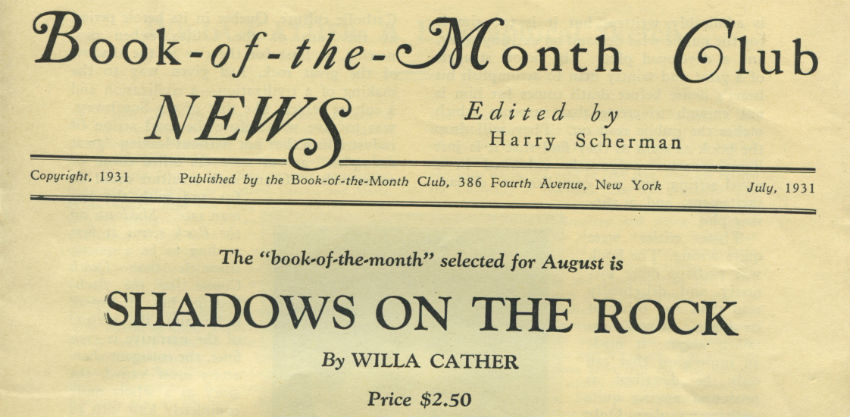
“Lolly Willowes, or The Loving Huntsman,” by Sylvia Townsend Warner was published in 1926, and on this date that year, 90 years ago today, it was the first announced selection of the Book of the Month Club, which exists to this day. The first selection committee featured Christopher Morley, Dorothy Canfield, and Heywood Broun; the current committee includes Craig Ferguson. In the late 1980s, the Club reached its peak membership of 1.5 million subscribers, but that has dwindled in subsequent years.

* * * *
Alexander Graham Bell successfully contacted his assistant, Thomas Watson, 140 years ago today. (It is not true that Watson immediately began work on inventing voicemail.) It was three days after Bell was awarded the patent for his “Improvement in telegraphy,” and it was the first proof that their invention, the telephone, worked. Watson heard his boss’ voice transmitted on the experimental apparatus in a legendary moment: “Mr. Watson—Come here—I want to see you.”

Less than ten years later, on April 15, 1885, Bell recorded his own voice on a wax and cardboard disc. This was never a great medium for recording, but it was one of many that was experimented with as a medium. Flimsy from the moment it was recorded and then dried out with age, the disc had never been played, its contents never transposed to a more permanent medium, until 2013 when audio technicians used optical scanners to recover the recording. Here (below the fold) is Alexander Graham Bell in 1885 introducing himself to us here in the 2010s:
Read More

Coloring

For those with synesthesia, the world seems no more interconnected than they assume it always is for the rest of us, until the person with the condition casually mentions how lively and bright blue the letter K always is to a playmate, who then reacts in a baffled way.

It is a condition that an unknown number of people have, but it is a condition to which the modifier “suffers” can not be added, because it does not often have negative effects on an individual’s life. (For some, it must have negative effects, just as any condition might.) It is not known how many people have or might have some form of synesthesia because not many people take the time or are offered the opportunity to describe the way they perceive how they perceive the things they perceive.
Read More