
Today in History: March 26

This message to all ARPANET users announces the availability on ARPANET of the Coral 66 compiler provided by the GEC 4080 computer at the Royal Signals and Radar Establishment, Malvern, England. Coral 66 is the standard real-time high level language adopted by the Ministry of Defence.—the first email sent by a head of state, Queen Elizabeth II, on March 26, 1976

Queen Elizabeth II was visiting the Royal Signals and Radar Establishment, a telecommunications research center in Malvern, England, to officially christen, like a new ship, the ARPANET connection that was about to be switched on. ARPANET stood for Advanced Research Projects Agency Network, and it is what eventually became our Internet. A technician named Peter Kirstein, later inducted into the Internet Hall of Fame but not for this moment in history, composed the first royal email and stationed the Queen at the workstation seen in the photo above. All she had to do was hit a few keys and there it was: the first email sent by a head of state, 40 years ago today.
Read More
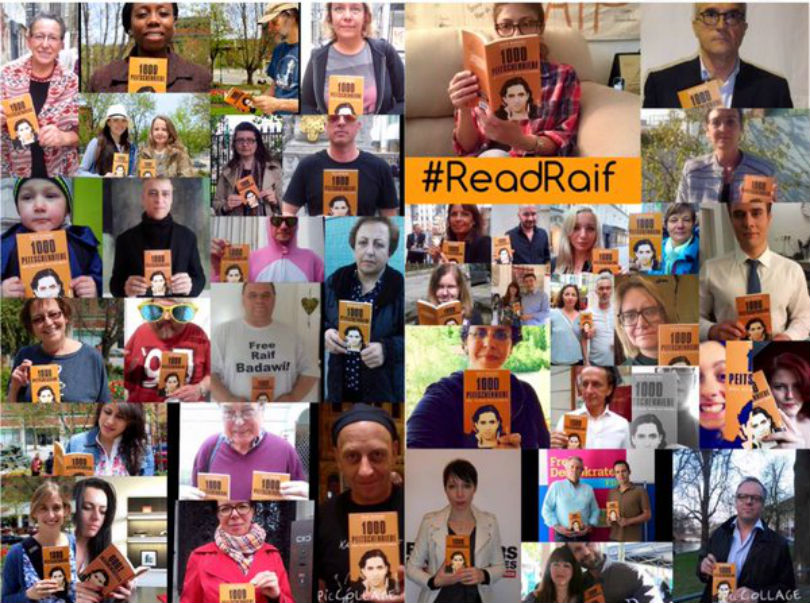
#ReadRaif: Now More than Ever

Freedom of speech is the air that any thinker breathes; it’s the fuel that ignites the fire of an intellectual’s thoughts.
 
Many human rights organizations believe that freedom of speech is a basic human right, and they call upon the Arab regimes to reform their policies when it comes to freedom of speech. As a human being, you have the right to express yourself. You have the right to journey wherever your mind wanders and to express the thoughts you come up with along the way. You have the right to believe, and to atone, the same way you have the right to love or to hate. You have the right to be a liberal or to be an Islamist.Raif Badawi, “1000 Lashes Because I Say What I Think

If you believe freedom of speech is a precious commodity, “the air” we need to breathe, the most dangerous and assertive act you can perform in the name of that freedom is to keep using it, to keep at it. To keep writing.
Read More

Dear Amnesty: Stop Crying Wolf

Is the human rights organization’s fundraising placing lives in danger? An article by Mark Aldrich and Raymond Johansen

* * * *
“They aren’t your money train. They are human beings.” Raymond Johansen, an activist and Anon who has been fighting for freedom for human rights prisoners around the world for years, has spent the last two weeks trying to protect three young prisoners in Saudi Arabia from Amnesty International’s clumsy embrace.

Two weeks ago, this headline appeared on Amnesty International’s website and its many Facebook and Twitter accounts: “Families Fear Their Sons Will Be Executed Within 24 Hours.” The three sons in question—Ali Mohammed al-Nimr, Dawood al-Marhoon, and Abdullah al-Zaher—are also featured on Reprieve’s “Urgent” death penalty cases page. Interviews with Ali al-Nimr’s family will be featured in a PBS Frontline documentary, “Saudi Arabia Uncovered,” that will be broadcast on March 29.

Indeed, the three officially remain on death row in Saudi Arabia, so their lives are in the hands of that nation’s judiciary. The world is watching. However, in October 2015, that nation assured Phillip Hammond, the British Foreign Minister, that Ali will not be executed, and Mr. Hammond did the unprecedented and announced this in bold and clear language: “I do not expect Mr al-Nimr to be executed.”

Might Saudi Arabia renege on this promise? It might. Had Amnesty International, Reprieve, or the families of the three youths learned something new two weeks ago? They had not. And yet that phrase, “Families fear their sons will be executed within 24 hours,” has propagated on Twitter and Facebook, usually with a link to an Amnesty action page (signature and donations welcome).
Read More