
False. Evidence. Appears. Real.

Hatred is its only reality. Racism is a part of nothing larger than itself. The simple word “Fear” yields many acronyms to reflect what fear is in its essence: “False Evidence Appearing Real” is a famous one. So is “Eff Everything And Run” or “Eff Everything And Retaliate.”

America. July 2016. The bitter angels of our nation’s nature seem to have won. Lately, part of me wants to declare victory for F.E.A.R and its glorious absence of nuance or shades of gray, its loving embrace of nothing except its own bright-red lust for violence for its own sake. “Hate Wins” would be the headline. “‘Just Hate Everyone,’ Experts Suggest” would be the sub-head.

Murder is murder. It is not an idea. It is a vacuum, and vacuums are totalitarian in their lack of purpose. I used to think that ideas can fill the vacuum, the murderous vacuum, but that is wrong. Ideas are ephemeral. No one kills for an idea. Many murderers will tell themselves that they are killing for a reason, for an idea; there is no human thought more corrosive, more dangerous, than self-justification.
Read More
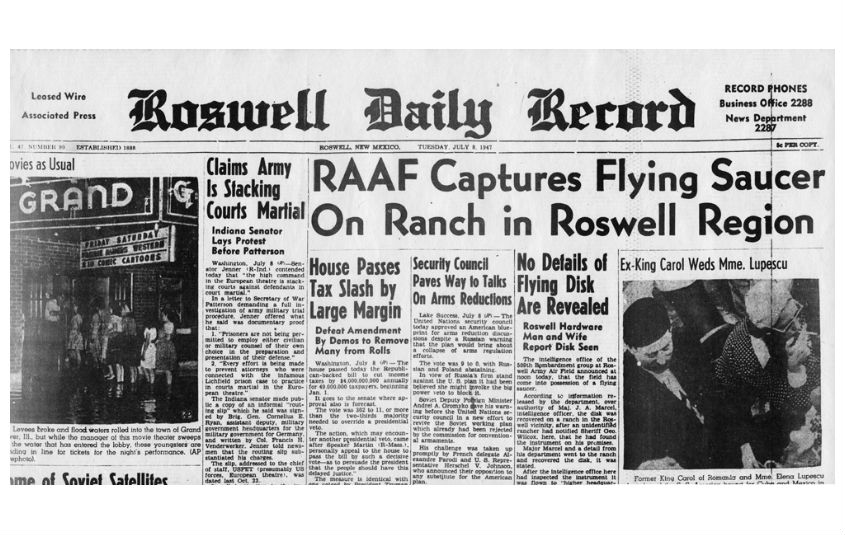
Today in History: July 8

The cover-up is usually worse than whatever it is covering up, and, sometimes, the initial attempt at a cover-up is also minor, but the attempts to cover-up the first cover-up? Those are what breed suspicions. On this date in 1947, the Roswell (New Mexico) Daily Record published this front-page headline: “RAAF Captures Flying Saucer on Ranch in Roswell Region.” The “RAAF” in the headline is “Roswell Area Air Force.”

Since a few weeks before, the entire country had been “flying saucer” crazy, so this was just one of many similar headlines from the spring and summer of 1947. But this headline, this story, involved the military, which simultaneously supplied the public with two mutually exclusive thoughts: 1. a sense that authorities are in charge and are telling us the truth, and 2. the feeling that authorities are hiding something and deciding for us what truths we can handle.
Read More

Hello Darkness, My Good Buddy

At once sarcastic and tender, W.H. Auden’s “The More Loving One” asks us to imagine a night sky empty of stars:

Looking up at the stars, I know quite well
That, for all they care, I can go to hell,
But on earth indifference is the least
We have to dread from man or beast.

 
How should we like it were stars to burn
With a passion for us we could not return?
If equal affection cannot be,
Let the more loving one be me.

 
Admirer as I think I am
Of stars that do not give a damn,
I cannot, now I see them, say
I missed one terribly all day.

 
Were all stars to disappear or die,
I should learn to look at an empty sky
And feel its total dark sublime,
Though this might take me a little time.
— “The More Loving One,” W.H. Auden, 1957

I might very well like a starless sky and call it sublime or subtle in its black-on-black nuance, the poet declares, and not mourn the sight of a supernova, which is after all the explosive death of a star, and I may not notice the absence of one should it simply blink out, but in all matters, “If equal affection cannot be,/Let the more loving one be me.”

In all matters attracting my human attention, be it the night sky or my beloved’s face, let the more loving one be me.
Read More