A Day (Un)Like Any Other

No other word will do. For that’s what it was.

Gravy.

Gravy, these past ten years.

Alive, sober, working, loving, and

being loved by a good woman. Eleven years

ago he was told he had six months to live

at the rate he was going. And he was going

nowhere but down. So he changed his ways

somehow. He quit drinking! And the rest?

After that it was all gravy, every minute

of it, up to and including when he was told about,

well, some things that were breaking down and

building up inside his head. “Don’t weep for me,”

he said to his friends. “I’m a lucky man.

I’ve had ten years longer than I or anyone

expected. Pure Gravy. And don’t forget it.”
—Raymond Carver, “Gravy”

“Gravy” was not published until after Raymond Carver’s death in August 1988. It appeared in The New Yorker that month and it is on his tombstone in Ocean View Cemetery in Port Angeles, Washington, along with one other poem that is given the title, “Late Fragment.” Either Carver himself or his wife Tess Gallagher—who was also his literary executor—treated his tombstone as a final publication, which, at its plainest, a tombstone indeed is.

And did you get what
you wanted from this life, even so?
I did.
And what did you want?
To call myself beloved, to feel myself
beloved on the earth.
—Raymond Carver, “Late Fragment”

Read More

Sentimental Journeys

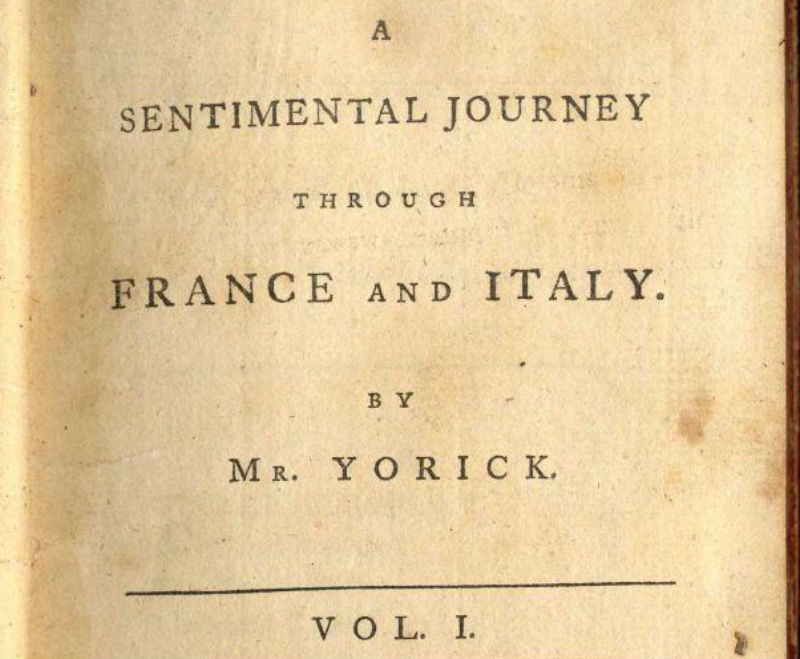
Laurence Sterne was dying of consumption, the polite yet dramatic term that people used to employ for pulmonary diseases, especially tuberculosis. He had contracted it by 1740, when he was still in his 20s, and he fought for his every breath for his remaining three decades of life.

In 1765, he left England in search of better breathing, and he traveled abroad to France and Italy. He was a surprise best-selling author by this point, a clergyman who had decided on a whim to start telling the life story of a character but by not telling it in a straightforward manner, to comically digress his way through The Life and Opinions of Tristram Shandy, Gentleman. One of the earliest novels in English or any language, “Shandy” was an instant success when its first two volumes started appearing in 1759.

The genre we call “travel writing” was not as common in the 1760s as it is now, and most works in that genre at that time were quite unsentimental: verbal pictures of natural phenomena and wonders of the man-made world and warnings-slash-complaints about the foreignness of foreigners on their strange home turf. In his 1765 journey, Sterne encountered fellow novelist Tobias Smollett, and the stern, dry Smollett left such an impression on the always amused Sterne that in his book, A Sentimental Journey Through France and Italy, he based a character named “Smelfungus” on Smollett. Nice revenge.
Read More

Today in History: July 13

Five years have past; five summers, with the length
Of five long winters! and again I hear
These waters, rolling from their mountain-springs
With a soft inland murmur.—Once again
Do I behold these steep and lofty cliffs,
That on a wild secluded scene impress
Thoughts of more deep seclusion; and connect
The landscape with the quiet of the sky. […]
—The opening of “Tintern Abbey” by William Wordsworth

The full title of William Wordsworth’s poem is “Lines Written a Few Miles above Tintern Abbey, on Revisiting the Banks of the Wye during a Tour, July 13, 1798.” The Romantic Movement in English poetry can be dated to July 13, 1798, when Wordsworth and his sister walked near the ruined Cistercian abbey in Wales. (Photo above.)
Read More