Today in History: August 18

Until August 18, 1920, a woman’s right to vote was a states’ rights issue in America, determined by each individual state. In New York State and in most but not all of the states west of the Mississippi, women could vote on any issue presented on a ballot. In many states, women could only vote for president, but in some other states, women could only vote on local issues. Most of the states along the east coast completely denied women the right to vote.

In 1870, the 15th Amendment to the U.S. Constitution gave the vote to freed male slaves. It reads: “The right of citizens of the United States to vote shall not be denied or abridged by the United States or by any State on account of race, color, or previous condition of servitude.”
Read More

The Ghostly Writer

The French writer Guy de Maupassant was famous for approximately two things: one, his brief yet incredibly prolific writing career; and two, his claim that one of his many stories just happened to have been dictated to him by his ghost-double, his doppelganger.

M. de Maupassant was dying of syphilis for the last several years of his life (perhaps we have three things he was famous for), and insanity is one symptom of that terrible disease. In “The Horla,” which he published in 1887, a few years before his death, the narrator is tormented by a demon he can not see, can not prove exists, but who comes to him every night and drinks the water off his night table and makes him ransack his own house, to the consternation of his servants. (I might write a parody of this and call it, “The Santa.”)
Read More

One Year Ago: A Public Torture

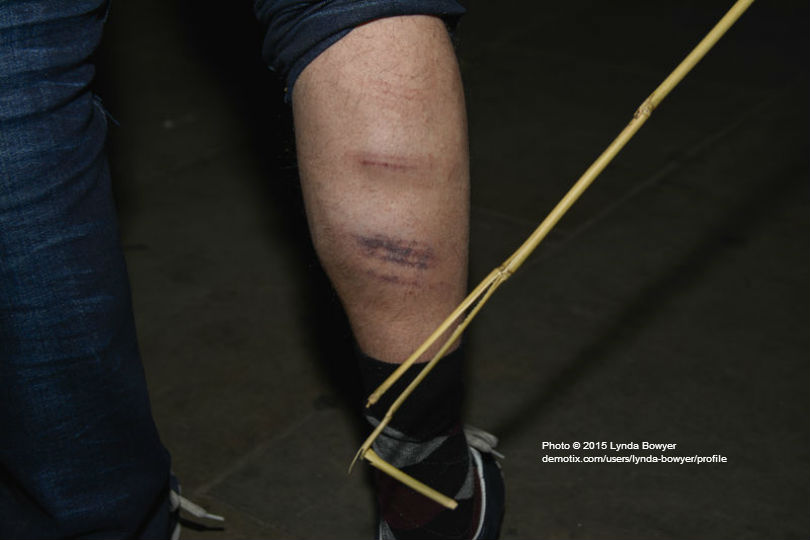
Raymond Johansen allowed himself to be tortured one year ago today, August 16, 2015, in solidarity with Saudi writer Raif Badawi.

Johansen was hit 50 times by a friend, Tony Clenaghan, with a thin cane, a switch, in Trafalgar Square, where corporal punishments once upon a time were held in public and frequently, but not since the 1830s. Johansen had difficulty walking afterward and even expressed confusion as to where he was upon speaking with a reporter. (Video below.)

When a caning is administered it sometimes does not look as severe as one thinks a beating would look; even one of the words we employ minimizes the severity: “lashes.” In writing about the Saudi Arabian writer Raif Badawi, who was sentenced by Saudi Arabia in 2014 to 1000 lashes and 10 years in prison, I have run into the shallow poverty of available analogies. All language is analogy, metaphor, and I have wanted the words to be sufficient to convey the pain of judicial corporal punishment, but they do not. They can not. Raymond Johansen’s action last year pumped life into the analogies, however.
Read More