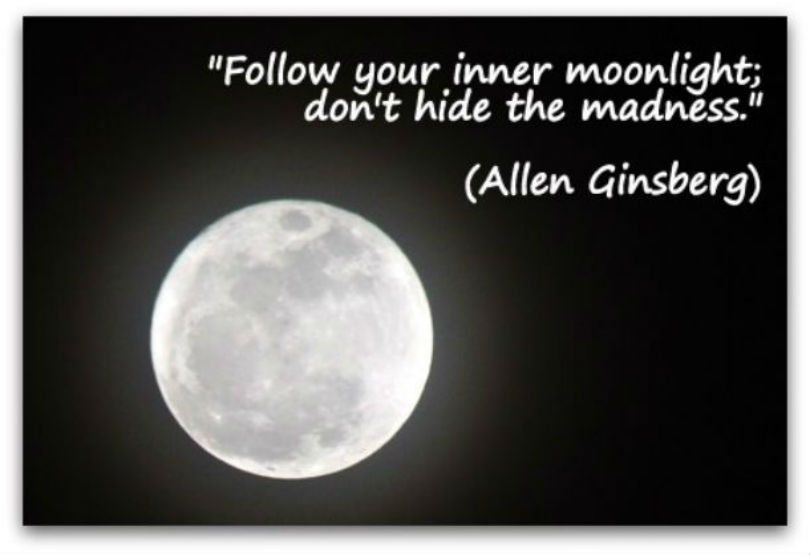
Moonlight Madness: A Non-Quote

In his published works, Allen Ginsberg wrote not one single thing about moonlight and madness, yet there is a popular Internet meme—an Internet poster—usually seen with a handsome photo of our moon and the rousing declaration credited to him that you should “Follow your inner moonlight; don’t hide the madness.” (See above.)

It is a Bizarro World version of a speech given by a football coach at halftime. “Follow your inner moonlight, boys, and let’s win one for State! Don’t hide the madness!” (The team huddles together and starts to chant, quietly and slowly at first, but then they build it to a hypnotic intensity: “Don’t. Hide. The. Madness. Don’t. Hide. The. Madness.”)
Read More

Today in History: August 18

Until August 18, 1920, a woman’s right to vote was a states’ rights issue in America, determined by each individual state. In New York State and in most but not all of the states west of the Mississippi, women could vote on any issue presented on a ballot. In many states, women could only vote for president, but in some other states, women could only vote on local issues. Most of the states along the east coast completely denied women the right to vote.

In 1870, the 15th Amendment to the U.S. Constitution gave the vote to freed male slaves. It reads: “The right of citizens of the United States to vote shall not be denied or abridged by the United States or by any State on account of race, color, or previous condition of servitude.”
Read More

The Ghostly Writer

The French writer Guy de Maupassant was famous for approximately two things: one, his brief yet incredibly prolific writing career; and two, his claim that one of his many stories just happened to have been dictated to him by his ghost-double, his doppelganger.

M. de Maupassant was dying of syphilis for the last several years of his life (perhaps we have three things he was famous for), and insanity is one symptom of that terrible disease. In “The Horla,” which he published in 1887, a few years before his death, the narrator is tormented by a demon he can not see, can not prove exists, but who comes to him every night and drinks the water off his night table and makes him ransack his own house, to the consternation of his servants. (I might write a parody of this and call it, “The Santa.”)
Read More