Today in History: September 22

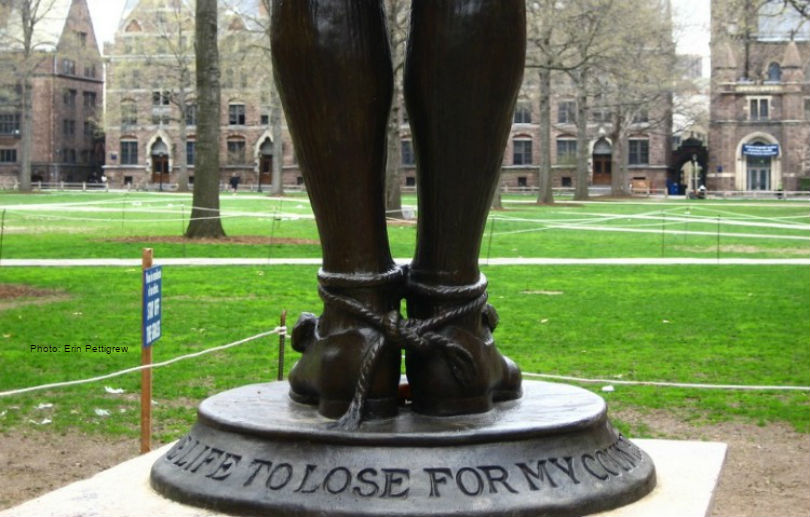
He was an unlikely spy. Perhaps the best spies are supposed to be “unlikely,” unsuspectable, but Nathan Hale probably was too honest to be a spy. Sent by the Continental Army to Lower Manhattan to track and report on British Army movements, he was caught within days of his arrival. Arrested on September 21, 1776, he was executed by hanging the next day.

Not one contemporary account has an exact description of the scene on the gallows, because the hanging, which did not follow a trial, was not a public event. All of the contemporary accounts, all written by the British, describe the calm composure of the 21-year-old spy as he faced death, however. What he said was close enough to, “I only regret that I have but one life to lose for my country,” that that may indeed have been what he said 240 years ago today. (Some millennials have offered this as America’s first-ever mic drop.)
Read More

The Stylish Stylist

In 1926, Henry Watson Fowler published A Dictionary of Modern English Usage, a book that has remained in print ever since. (The first edition and the second edition use Fowler’s sentences; the third edition, which was published in 1996, is a substantial rewriting of the classic and uses the Fowler name as a form of brand.) Fowler’s book is not a dictionary of definitions, like Johnson’s or Webster’s, it is a usage dictionary, an instructional manual for better using this beautiful tool we have devised called the English language.

Its entries give instructions on pronunciation, offer the pros and cons of employing a variety of idiomatic expressions, and argue again and again for simplicity in expression. Many style guides have followed—the MLA, the AP, the Chicago Manual—and each one is more useful in answering day-to-day questions about one’s writing than Fowler’s guide is, but none is as entertaining as his. His fight was a fight against cliché, obfuscation, and empty rhetoric. He fought for style, for clarity.

He fought against pointless rules. One might think from the description of his work that he is the reason for the commonplace rule against ending a sentence with a preposition. The opposite is true. In a two-page essay on the topic (two pages!), titled, “Preposition at end,” he writes:
Read More

Today in History: ‘Yes, Virginia, There Is A Santa Claus’

I am 8 years old. Some of my little friends say there is no Santa Claus. Papa says, ‘If you see it in The Sun it’s so.’ Please tell me the truth; is there a Santa Claus?—Virginia O’Hanlon, a question published in the New York Sun on September 21, 1897

Virginia O’Hanlon, an eight-year-old girl, asked her father one day in the summer of 1897 whether Santa Claus is real.

He suggested she write to the city newspaper, the New York Sun, so she did. Virginia wrote: “I am 8 years old. Some of my little friends say there is no Santa Claus. Papa says, ‘If you see it in The Sun it’s so.’ Please tell me the truth; is there a Santa Claus?”

Francis Pharcellus Church, a 58-year-old editor who had been a Civil War reporter and had not married and was not a father, was tasked with composing a reply to Virginia.

On this date in 1897, Church’s unsigned reply, “Yes, Virginia, There Is A Santa Claus,” was published in the Sun. It remains the most widely reprinted newspaper editorial in history. It is perhaps the only one that has been set to music. He wrote:
Read More