Today in History: Oct. 7

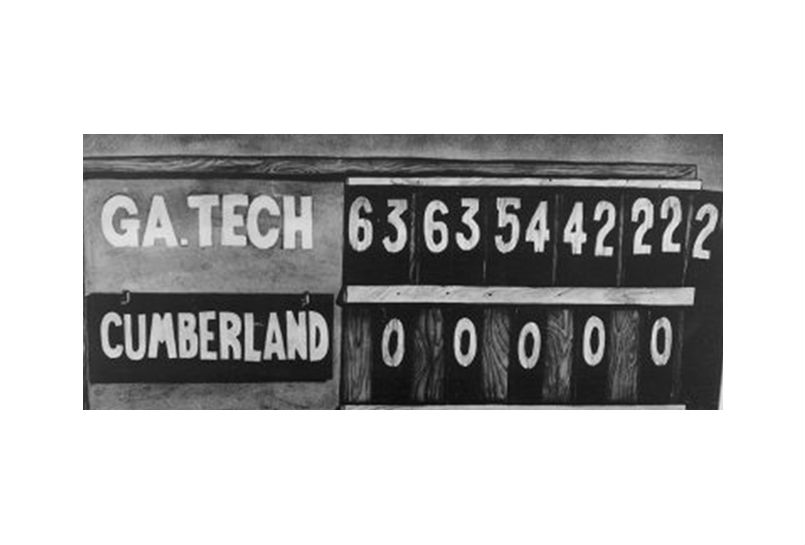
Georgia Tech’s football team, coached by the legendary John Heisman, beat an outmatched Cumberland College squad 222–0 on this date 100 years ago. It remains the most lopsided score in the history of college football, mostly because teams do not usually continue to try to score when the mathematical possibility of the losing team turning things around is passed. (Above is a photo of the scoreboard at the end of the game.)

Cumberland College did not have a football team, had cancelled its football program before the season opened, but Coach Heisman would not let the school cancel its game against his Georgia Tech team. Earlier that year, Cumberland’s baseball team had beaten Georgia Tech’s baseball team by the unruly score of 22–0. Heisman was Georgia Tech’s baseball coach as well as its football coach, so he had no sympathy for Cumberland’s plights in any other athletic endeavor. (Further, rumors abounded that Cumberland’s baseball players were not students at the school and were in fact professional baseball players employed to run up Cumberland’s baseball scores.)
Read More

Today in History: Oct. 6

“You are going to lose this World Series and you are never going to win another World Series again. You are never going to win a World Series again because you insulted my goat.”—Billy Sianis

Bar owner Billy Sianis of Chicago was asked to leave Game 4 of the World Series between the Chicago Cubs and the Detroit Tigers at Wrigley Field on this date in 1945 because fans were complaining about the smell of his companion beside him: his goat.

Now, Mr. Sianis’ bar was called the Billy Goat Tavern, so he had been his own advertisement for years: He cultivated a goat-like goatee and he frequently brought a goat with him wherever he traveled in Chicago.

He always paid for two seats at any game he attended, one for himself and one for the goat. Before Game 4, he was allowed to parade on the field with the goat, who wore a sign that read, “We got Detroit’s goat.” (Seen above. Mr. Sianis is wearing a topcoat and goatee.)
Read More

The Forest and the Trees

A heavy rain drowns each raindrop; a light rain, like the kind I saw in the woods out behind my house when I was a child, a light rain striking the leaves and branches of trees, further slowing their impact, that rain produces the strongest petrichor of all, the one that renders me into an seven-year-old noticing the world for the first time.
 
The lightest of rain after the driest of spells leads to the most argillaceous petrichor, which is the kind that humans smell as relief, the thought that things will start growing again.—”Petrichor,” Jan. 26, 2015

We called it “The Woods.” Well, I did. Sometimes, I referred to it as a “forest,” which it most certainly was not. Our backyard ended at a line of trees and dross beneath them; the lightly manicured, suburban lawn did not grow beyond that line, despite my teen-aged lawn mowing efforts to expand the lawn by clearing the dead leaves and branches away. That tight boundary made The Woods appear all the more elemental and foreign.
Read More