
Today in History: Election Day

In the United States of America, today is Election Day. The next inhabitants of the offices of President and Vice President are to be filled by voters along with one-third of the seats in the United States Senate, the entire population of the House of Representatives, and many local elections (mostly, state legislatures).

Today’s presidential election is the 58th quadrennial presidential election in the nation’s history. The system as it has evolved is neither a truly popular vote nor a truly national one: today’s election is more a collection of entwined local votes that will add up to some statewide and national results. There are so many polling places across the nation that a census is not feasible: some states leave it up to the counties to make polling places available, so one must look for polling station information in those states by contacting county election officials.

If you are registered to vote, with or without a political party, but you do not know where your polling place is, there are many resources. Facebook has offered itself as a polling place locator and ballot information resource, for instance. Here is one other website: Vote411.org.
Read More
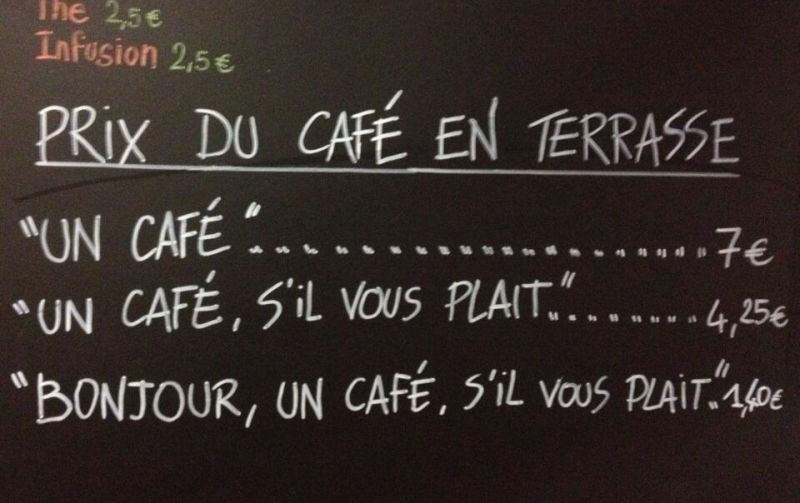
Retailizations, Part Deux: Be Nice

A coffeehouse in France (okay, that right there may be one of the greatest four-word phrases I have ever typed; one almost does not need to continue. Please return from your daydream when you feel up to it) …

A coffeehouse in Nice, France (oh, come on, does this anecdote just keep getting sweeter? The setting may as well be, “A coffeehouse located in Sweet Kisses in Everyone Is Always Smiling Land”) … and, yes, I certainly know that the city’s name is pronounced “neese,’ and not the easy way to a punny joke, but a pun is a pun. 

Three years ago, a coffeehouse in Nice, France, posted a new price board, seen above and explained in “This Coffeehouse Will Charge You Less if You’re Nice.”
Read More

Today in History: Nov. 7

The first Tacoma Narrows Bridge collapsed on this date in 1940. The bridge was opened to traffic in July of that year, and it was the third-longest suspension bridge in the world up until the day it collapsed, but it moved vertically in the wind, sometimes violently so, sometimes like a piece of clothing hung out to dry. (The bridge is seen bending, twisting in the photo at top.)

The bridge was built too narrow and constructed with shallow girders, which is why it waved in the breeze. Thus, even while it was under construction, the workers who were building it nicknamed it “Galloping Gertie” for its lack of stability. Engineers at the University of Washington were hired to find a solution to the oscillations, and they completed their first studies on November 2, 1940.
Read More