Good Old Days Ahead, Right Behind You

Henry Watson Fowler (March 10, 1858 – December 26, 1933)

Mark Aldrich's avatarThe Gad About Town

In 1926, Henry Watson Fowler published “A Dictionary of Modern English Usage,” a book that has remained in print ever since. (The first edition and the second edition use Fowler’s sentences; the third edition, which was published in 1996, is a substantial rewriting of the classic and uses the Fowler name as a form of brand.) Fowler’s book is not a dictionary of definitions, like Johnson’s or Webster’s, it is a usage dictionary, an instructional manual for better using this beautiful tool we have devised called the English language.

Its entries give instructions on pronunciation, offer the pros and cons of employing a variety of idiomatic expressions, and argue again and again for simplicity in expression. Many style guides have followed—the MLA, the AP, the Chicago Manual—and each one is more useful in answering day-to-day questions about one’s writing than is Fowler but none is as entertaining as…

View original post 824 more words
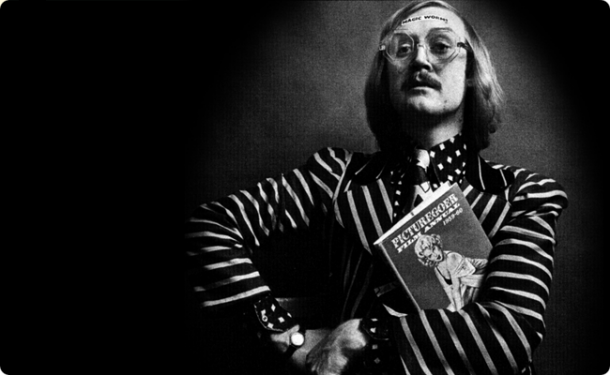
Vivian Stanshall: Not an Eccentric

Twenty years ago yesterday, Vivian Stanshall died. Among his many creations are the stories of the Rawlinson family, especially Sir Henry Rawlinson. There was a real Sir Henry and he died March 5, 1895, 100 years to the day of Stanshall’s sad and accidental end.

Mark Aldrich's avatarThe Gad About Town

The Bonzo Dog Doo-Dah Band played the role of jester in the court of the Beatles in the late 1960s, and Vivian Stanshall was the charismatic, curious leader of the leaderless and leader-resistant Bonzos. The missing link between the Beatles and Monty Python (if one was needed), in 1967 the Bonzos appeared in both “Magical Mystery Tour” (partially entertaining the Beatles with a performance of “Death Cab for Cutie”) and in the pre-Python but mostly Python-staffed afternoon television show, “Do Not Adjust Your Set.”

Here, Michael Palin of the Pythons introduces the Bonzos and Stanshall does his best worst Elvis in “Death Cab for Cutie.”

Stanshall, a writer for whom no declarative statement could be too perplexing (“I’ve never met a man I didn’t mutilate”), was paired up with Neil Innes, a songwriter whose Beatles-esque melodies led not only to to the Bonzos being produced by Paul McCartney (the minor…

View original post 1,167 more words

‘Thank You, Fog’

W.H. Auden was born 108 years ago today.

Mark Aldrich's avatarThe Gad About Town

“My face looks like a wedding cake left out in the rain,” quipped W.H. Auden. Indeed, by the age of 60, Auden’s face looked like the most-read library book in the most popular library; it exhausted any adjectives thrown at it—it was its own adjective. His friend Hannah Arendt said he looked “as if life itself had delineated a kind of face-scape to make manifest the ‘heart’s invisible furies.'”

According to one biographer, Auden suffered from something called Touraine-Solente-Gole syndrome,

in which the skin of the forehead, face, scalp, hands and feet becomes thick and furrowed and peripheral periostitis in the bones reduces the patient’s capacity for activity. There [is] no therapy for the syndrome, which does not affect either life expectancy or mental status, but which account[s] for Auden’s striking appearance of grave, lined melancholy.— “Auden,” Richard Davenport-Hines

auden2 W.H. Auden

Auden probably had never heard of TSG syndrome…

View original post 705 more words