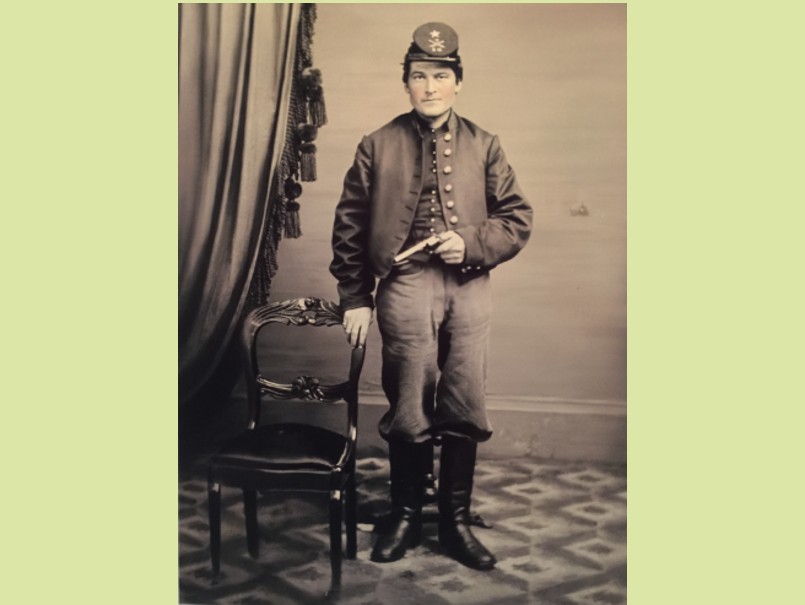
‘Mystic chords of memory …’

On this particular Veterans Day, in this particular time and place and moment, I think more of my Civil War ancestors, and what it meant to be a part of the Union. I do not know what it meant for them; I know what they mean to me.

* * * *
I do not know what my great-great-grandfather James Metcalf (above) saw at the Battle of Gettysburg. He and his father, Amos, my great-great-great-grandfather, were both there with the 6th Battery, 1st Battalion, Maine Light Artillery.

The list of locations (from the National Park Service) at which the 6th Battery saw action while my Metcalf ancestors served from November 15, 1861, till the war’s end includes the names of some of the bloodiest battles in Civil War history: Antietam, the Wilderness Campaign, the months-long Siege of Petersburg, and Gettysburg. James was a private and his father was a hospital cook, so perhaps their experiences were different ones. However, both died years after the war of diseases contracted in service: Amos was disabled with rheumatism and died in 1883, and James died of malaria in 1905. Amos was in his forties during the war, and James turned twenty in 1863.
Read More

Today in History: November 1

“I pray Heaven to bestow the best of Blessings on this House and all that shall hereafter inhabit it. May none but honest and wise Men ever rule under this roof.”—President John Adams

On this date in 1800, President John Adams moved into the newly built, but still unfinished, White House. The rooms were damp and drafty. He arrived unannounced with two aides to see the building.

The historian David McCullough describes The White House in 1800: “The immense house was still unfinished. It reeked of wet plaster and wet paint. Fires had to be kept blazing in every fireplace on the main floor to speed up the drying process. Only a twisting back stair had been built between floors. Doors were missing. … Later, supper finished, Adams climbed the backstairs candle in hand and retired for the night.”

During his second day in his new reidence, he wrote a letter to his wife, Abigail, which included the above words, which were cut into the mantlepiece of the State Dining Room during the administration of Franklin Roosevelt, and remain there.
Read More

Today in History: October 1

Years after the event, Babe Ruth recounted his “called shot” of October 1, 1932, as something planned almost from the start of the at-bat, the game, his life.

What certainly took place is this: with the New York Yankees tied with the Chicago Cubs 4-4 in Game 3 of the World Series, Ruth came to the plate in the fifth inning, and after two strikes, he held up his hand and pointed … somewhere.

At the pitcher? At the Cubs dugout? Towards center field?
Read More