January 7 in History

The typewriter is one of those devices whose need had been obvious for decades, even a century before a practical one was produced. On this date in 1714, one Henry Mill of England was awarded patent number 395 for a device whose description sounds like nothing less than a typewriter, even though that particular word had not yet been coined. The 1714 English patent reads in part:

He hath by his great study and paines & expence invented and brought to perfection an artificial machine or method for impressing or transcribing of letters, one after another, as in writing, whereby all writing whatsoever may be engrossed in paper or parchment so neat and exact as not to be distinguished from print; that the said machine or method may be of great use in settlements and publick records, the impression being deeper and more lasting than any other writing, and not to be erased or counterfeited without manifest discovery. (Emphasis mine.)
Read More

January 6 in History

Today is the Feast of the Epiphany in Christianity. According to various traditions, it is the twelfth day of Christmas, the day the Magi (the Three Wise Men) came to the baby Jesus bearing gifts of adoration. In Eastern Christian traditions, the date marks the baptism of Jesus in the Jordan River.

* * * *
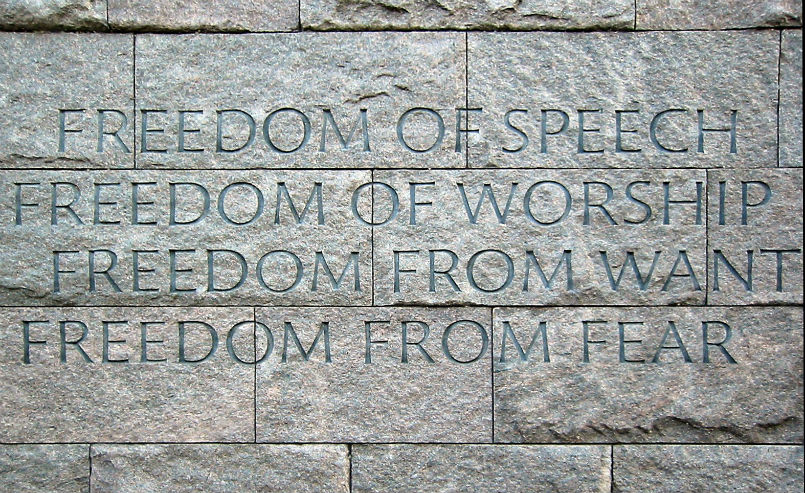
In his 1941 State of the Union speech, delivered on this date in 1941, President Franklin D. Roosevelt listed four freedoms that every human is entitled to: the freedom of speech and expression, the freedom to worship God in his own way, freedom from want and freedom from fear.

Film from 1941 (after the jump):
Read More

January 5 in History

I don’t know who Godot is. I don’t even know (above all don’t know) if he exists. And I don’t know if they believe in him or not—those two who are waiting for him. The other two who pass by towards the end of each of the two acts, that must be to break up the monotony. All I knew I showed. It’s not much, but it’s enough for me, by a wide margin. I’ll even say that I would have been satisfied with less.—Samuel Beckett, 1952

En attendant Godot, a new play by Samuel Beckett, received its first official performance on this date in 1953 at the Théâtre de Babylone in Paris. The play had received a staged reading on French radio in 1952, for which Beckett supplied an introduction; part of the note is quoted above.

Beckett had promised he would attend the radio performance, but he did not. (He was Godot that night.) The text of the play was published at the end of 1952, then on January 4, 1953, a single preview was staged for reviewers before opening night. Most were positive.
Read More