Thank You, Charlie B.

Two years ago today, a friend of mine passed. Charles F. Brennan, III—my friend Charlie (November 2, 1960 ‒ April 7, 2014)—was my sponsor for a time.

His funeral mass card carried a quote from Emerson: “To laugh often and much; to win the respect of intelligent people and the affection of children; to earn the appreciation of honest critics and endure the betrayal of false friends; to appreciate beauty; to find the best in others; to leave the world a bit better whether by a healthy child, a garden patch, or a redeemed social condition; to know even one life has breathed easier because you have lived. This is to have succeeded.”

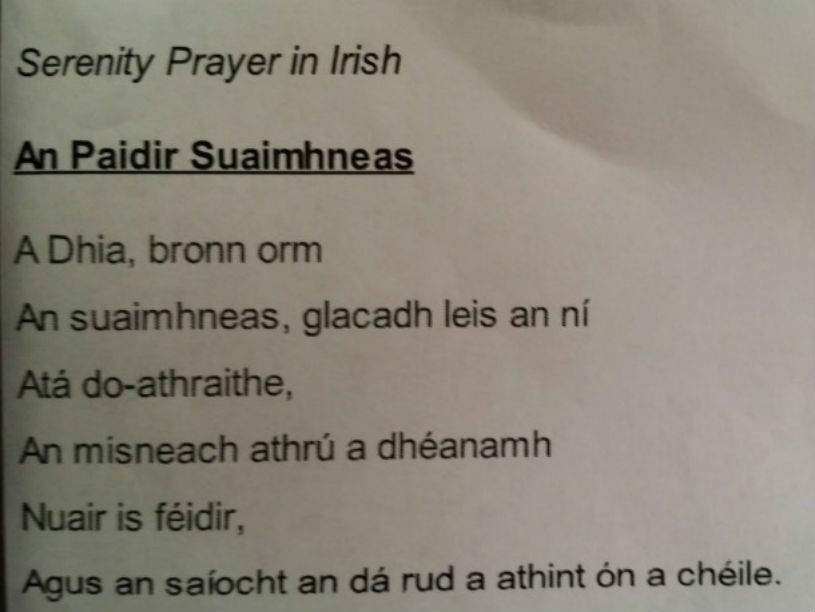
At the top is a copy of The Serenity Prayer in Irish, whoch we found in his apartment:

An Phaidir Suaimhneas
A Dhia,
deonaigh dom an suaimhneas
chun glacadh le rudaí
nach féidir liom a athrú,
misneach chun rudaí a athrú nuair is féidir,
agus gaois
chun an difríocht a aithint.

What follows was first published two years ago. Thank you for reading it:
Read More

A Moment of Clarity

A personal reflection sparked by Olivia Laing’s excellent 2013 book The Trip to Echo Spring.

* * * *
Every alcoholic in recovery has a collection of anecdotes that can be simultaneously heartbreaking, outrageous, and hilarious. Perhaps they are hilarious only to fellow alcoholics; perhaps they can not even be listened to by outsiders. For an outsider, most alcoholic anecdotes may as well conclude with the same dark punchline, an interchangeable rubber-stamped ending: “And then I got away with it again.” Or, “I didn’t die that time, either.” And then comes the next hair-raising—or eyebrow-raising—tale.

Every alcoholic in recovery is living a story with a weird ending, if they remain in recovery. It is that two-word pair there, “in recovery,” that provides the surprise, the weirdness, a period of life as surprising to behold as some of the antics, the many bizarre actions and activities and inactions and inactivities that were surprising for outsiders to watch unfold in the previous life.
Read More

2000 Days

No other word will do. For that’s what it was.
Gravy.
Gravy, these past ten years.
Alive, sober, working, loving, and
being loved by a good woman. Eleven years
ago he was told he had six months to live
at the rate he was going. And he was going
nowhere but down. So he changed his ways
somehow. He quit drinking! And the rest?
After that it was all gravy, every minute
of it, up to and including when he was told about,
well, some things that were breaking down and
building up inside his head. “Don’t weep for me,”
he said to his friends. “I’m a lucky man.
I’ve had ten years longer than I or anyone
expected. Pure Gravy. And don’t forget it.”
—Raymond Carver, “Gravy”

The plainspoken poem “Gravy” was not published until after Raymond Carver’s death in August 1988. It appeared in The New Yorker that month and it is on his tombstone in Ocean View Cemetery in Port Angeles, Washington, along with one other poem that is given the title, “Late Fragment.” Either Carver himself or his wife Tess Gallagher—who was also his literary executor—treated his tombstone as a final publication, which, at its plainest, every tombstone indeed is.

And did you get what
you wanted from this life, even so?
I did.
And what did you want?
To call myself beloved, to feel myself
beloved on the earth.
—Raymond Carver, “Late Fragment”

Read More