Grade School Avant Garde

Art that is odd for the sake of the odd is often neither. Sometimes it is both. Meet the Lettrists.

Greil Marcus, in his essential history book, “Lipstick Traces,” describes a particular type of artist:

There is a figure who appears in this book again and again. His instincts are basically cruel; his manner is intransigent. He trades in hysteria but is immune to it. He is beyond temptation, because despite his utopian rhetoric satisfaction is the last thing on his mind. He is unutterably seductive, yet he trails bitter comrades behind him like Hansel his breadcrumbs … He is a moralist and a rationalist, but he presents himself as a sociopath … No matter how violent his mark on history, he is doomed to obscurity, which he cultivates as a sign of profundity.

Marcus’ book places the punk rock movement of the late ’70s in a “secret history” of western culture beginning in the 17th Century but he finds his greatest excitement in recounting the stories of the Dadaists, the Lettrists, and the Situationist International.

Often, it is the same story, though: Revolutionary thinker(s) who create art via revolutionary thought that (sometimes angrily or destructively) confronts the norms of the era are largely ignored by the culture at large except by a few who incorporate the new art in more popular forms. Something that was created with great energy, occupied 100% of its creator’s brain, becomes a tiny part, sometimes less than 1%, of a larger movement and a footnote in history.

The Lettrists are an example. Some of them are still going, 70 years after Isidore Isou came up with the idea. What was the idea? That the alphabet is a random bit of socially acceptable ordering of language, yet we make many more sounds than are indicated by our 26 letters. Sneezes should have a place in an alphabet, because, well, they communicate.

Here is Orson Welles interviewing Maurice Lemaître and Isou, who is the poet in the center who can not seem to stop grinning:

The dedication to the fantasy of a new language is powerful to witness, but I am not a fan of other people’s fantasies. There is little different between Tolkien and Isou in that they both invented unique alphabets; for me, Isou’s attempts at expanding our way of describing life here on earth is more interesting. But interesting is all that it is. It is seductive in its lack of seductiveness.

Give me Lettrism over “Lord of the Rings” and give me the Sex Pistols over either.

Further, the so-called “flash mobs” that have been invading retail spaces over the last decade or so are the offspring of the Situationists of the late 1960s, except the Situationists wrote long manifestos and conducted public debates about things like the idea of society, and flash mob participants consider the fact of a group making a group statement to be the statement, period. And now flash mobs are a part of any media campaign’s advertising budget.

Yes, I am a cranky “get off my lawn” old man in my punk tastes. This is because I am a cranky old man, deep down, deeper than any punk can reach. (Or this makes me very punk, but no one can declare themselves that.) In the late ’70s one of my schoolmates was an import from London named Dan, and he already had terrible teeth (we were 10 or 11), a gaudy accent, and wore torn t-shirts and played music whose major point was its loudness. (Or so it seemed to my ears.) I wish I could write that in 1978-’79 I was friends with a London kid who introduced me to the Sex Pistols and The Clash, but I can not. I detested the noise. I was also introduced to rap music around then or even earlier: another elementary school classmate was rapping like Gil Scott-Heron in 1976, but we were 8 and what little rap that I remember was about his birthday party.

In the 1990s, I fell in love with what was by then ancient punk rock and started to absorb it; around this same time Johnny Rotten/John Lydon started to become a beloved cultural figure in Great Britain, which he remains.

The energy of anger, the cultural energy of anger, the dedication to anarchy (which brooks no dedication), rarely appealed to me and more frequently scared me. Any anarchists in my circle brought out my inner parent, which is probably why I hated them all the more. (Hate? Wait a second. I do not hate …)

The violence of change indicates a world of absolutes, of either-ors; a world that includes shades of gray and a third way presents yet another either-or, however: Either we live in a universe of absolutes or we do not. The revolutionaries live in the hyphen between the either and the or and like the hyphen, life there is brief. Every culture has an avant garde, and every culture defeats it by ignoring and then absorbing it.

* * * *
Image at the top found at: Ideological Art.

____________________________________________
The WordPress Daily Prompt for October 15 asks, “From your musical tastes to your political views, were you ever way ahead of the rest of us, adopting the new and the emerging before everyone else?”

* * * *
Please subscribe to The Gad About Town on Facebook: http://www.facebook.com/thegadabouttown

Sick Transit, Gloria, on a Monday

One could define Hell as the experience of the sensation of wanting to be any place other than where one is at that moment. In the proper wrong circumstances, your bed could be rendered almost as uncomfortable as an MRI tube.

If I convince myself that the seat next to mine presents a better view of the movie screen and I can not slide into it because you are there, ask me in a couple hours what the film was about or who was in it.

Walk through any strip mall shopping plaza on a Sunday afternoon: not only is the place bereft of customers, not one single employee wants to be there, even for the money. Or a Walmart after midnight. Every employee is elsewhere, Walter Mitty’ing their way through life, perturbed to be where they are. Perturbed to be. That is a variety of Hell.

Sic transit gloria mundi, there goes the beauty of the world, in four-hour half-shifts working at a job one does not hate exactly—because hate is a strong enough emotion to inspire actions towards real change—but dislikes, detests, disdains. I detested myself when I disdained my jobs.

* * * *
One could also define Hell as the Albany, New York, Greyhound bus station. No one appears happy to be in a bus station, neither the transiting passengers nor the employees. An extended stay in a bus station is the experience of boredom minus information.

Airports present a vast panoply of human experiences, from the fear of permanent change to the excitement of temporary reunions. I have experienced emotions that I have not encountered elsewhere in my life in airports. I realized that I had fallen in love with someone 60 seconds too late in an airport once upon a time. (More correctly, I think that I thought I ought to have gotten a phone number.) I almost missed my next flight in indecisively wandering around O’Hare while debating whether I should run “just like in a movie” to what I thought was the terminal my desired companion had told me her flight was leaving from. If you did not know, O’Hare is too large an airport to be indecisive in.

A wait in a train station is boredom plus information, as the trains are usually on time and people willingly, even happily, strike up conversations. Grand Central Station or Penn Station in New York, South Station in Boston—look at this photo:

South_Station_Terminal_Inside

Boston’s South Station: Filled with sunlight and advertising and well-stocked newsstands. Look at that happy place. (Photo from Wikipedia.)

In memory, this is truly what South Station looks like: full of light. In truth, I remember once sitting beside the late journalist David Halberstam as he waited next to the Martin’s News Shop (see above) for the Acela train to whisk him off to New York City and the two of us watched a man throw up on himself on a bench not eight feet away. I was rendered mute by both seeing someone I idolized and that sight. The great writer was spared an embarrassing “I’m a big fan” speech from me, but maybe I missed making the scene into a conversation-opener. (Mr. Halberstam has since passed away, something that was perhaps hastened by the incident.)

In America, there are only a couple reasons one is in a bus station for an extended period—overnight, say—and two are the side effects of unhappy circumstances, like not knowing anyone in town. A typical long distance bus journey includes a couple changeovers and long breaks between legs in the trip. A traveler has to stay somewhere and if one is the only person one knows in Cleveland, Ohio, (for example) one might spend eight hours walking around the neighborhood, which looks a lot like this photo that I did not take one overnight stay in Cleveland in June 2000:

But the Albany Greyhound Station? No one wants to be there. No traveler or bus driver wants to spend more than 27 seconds there (I have never seen a driver enter the facility; they remain beside the bus even after passengers have collected all bags and boxes, as if afraid the vehicle will be stolen), and no one in a position to change things in that great city wants it to be there, either. For almost 30 years it has sat atop both Greyhound’s list of buildings that need to be replaced or rebuilt and Albany’s. Each wants to see what the other will do before acting. The building’s continued existence is the picture of a stand-off, as no one will invest time, money, or care in the place if it is always about to be razed and rebuilt by the other entity. Greyhound wants to see what Albany will do, and vice-versa. (Here is a recent article.)

Photo by Michael P. Farrell/Times Union. From www.timesunion.com/local/article/Churchill-Albany-s-Greyhound-station-is-a-5320974

Any photo will make the Albany bus station appear benign. Do not be fooled. (Photo by Michael P. Farrell/Times Union. From http://www.timesunion.com/local/article/Churchill-Albany-s-Greyhound-station-is-a-5320974.php)

Yet there it stands, dingy and apart. It is a reminder that life ends, but bus stations are not supposed to be memento mori.

(Photo by Michael P. Farrell/Times Union. From http://www.timesunion.com/local/article/Churchill-Albany-s-Greyhound-station-is-a-5320974.php)

Hell’s waiting room, the Albany bus station. (Photo by Michael P. Farrell/Times Union. From http://www.timesunion.com/local/article/Churchill-Albany-s-Greyhound-station-is-a-5320974.php)


____________________________________________

The WordPress Daily Prompt for October 6 asks, “Train stations, airport terminals, subway stops: soulless spaces full of distracted, stressed zombies, or magical sets for fleeting, interlocking human stories?”

Your Inner Bliss Moonlight and Madness: Follow It

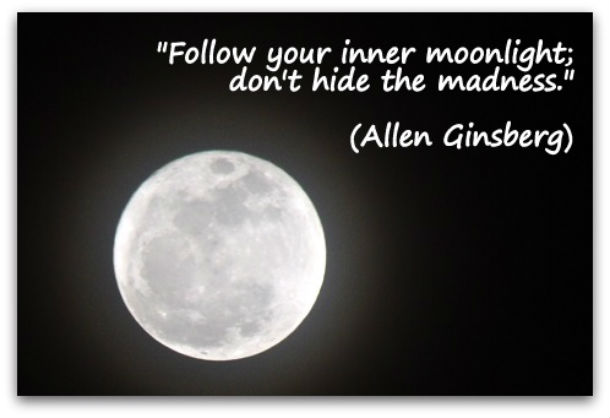
In his published works, Allen Ginsberg wrote not one single thing about moonlight and madness, yet there is a popular Internet meme—an Internet poster—usually seen with a handsome photo of our moon and the rousing declaration credited to him that you should “Follow your inner moonlight; don’t hide the madness.” (See above.)

It is a Bizarro World version of a speech given by a football coach at halftime. “Follow your inner moonlight, boys, and let’s win one for State! Don’t hide the madness!” (The team huddles together and starts to chant, quietly and slowly at first, but then they build it to a hypnotic intensity: “Don’t. Hide. The. Madness. Don’t. Hide. The. Madness.”)

But did Ginsberg, the bard of the Beats, ever write or say such a thing? Yes, no, and yes. According a post in the blog The Allen Ginsberg Project, exactly 25 years ago Ginsberg’s biographer Michael Schumacher interviewed Ginsberg about writing and inspiration and submitted the answer to a Writer’s Digest publication, “On Being a Writer,” which was a book that read more like a calendar of daily inspirations than a book. The writer at The Allen Ginsberg Project did the footwork and even wrote to Schumacher in the search for an answer, so credit must be given to that blog. The full piece is here: “The Mystery of the Inner Moonlight.”

What Ginsberg wrote to Schumacher was:

“It’s more important to concentrate on what you want to say to yourself and your friends. Follow your inner moonlight; don’t hide the madness. Take [William Carlos] Williams: until he was 50 or 60, he was a local nut from Paterson, New Jersey, as far as the literary world was concerned. He went half a century without real recognition except among his friends and peers.
“You say what you want to say when you don’t care who’s listening. If you’re grasping to get your own voice, you’re making a strained attempt to talk, so it’s a matter of just listening to yourself as you sound when you’re talking about something that’s intensely important to you.”

Long before, he had used one half of the declaration and wrote “Don’t hide the madness” in a poem in 1954. While he was editing William S. Burroughs’ novel “Naked Lunch” with Jack Kerouac, Ginsberg wrote “On Burroughs’ Work”:

On Burroughs’ Work
The method must be purest meat
and no symbolic dressing,
actual visions & actual prisons
as seen then and now.

Prisons and visions presented
with rare descriptions
corresponding exactly to those
of Alcatraz and Rose.

A naked lunch is natural to us,
we eat reality sandwiches.
But allegories are so much lettuce.
Don’t hide the madness.

For a writer who found his voice in compound nouns and lists of the super-specific details of his humdrum day (some graduate student must have tallied up the many grocery and other kinds of bills that he so frequently includes in his work; perhaps they won an assistantship), the minutiae of his existence, “reality sandwiches” was a great turn of phrase, so good it appears to have surprised the poet. He brings the work to its swift conclusion right there, lest he pile on some allegorical lettuce and bury the meat.

But moonlight? “Inner moonlight,” no less? That was a new one. In 1955, he had already written his best known, best regarded, poem, the long “Howl,” which was published the next year. Its opening line, “I saw the best minds of my generation destroyed by madness,” seems to tell of a hard-earned caution about the lunacy of following any moonlight, inner or not. But the madness in “Howl” is the pain of those “best minds” attempting to fit in with repressed and repressive society and finding their outlet in self-inflicted agony, trying to find a fix.

By 1989, Ginsberg knew that a phrase like “inner moonlight” voiced a sentiment akin to the similar—and similarly purposefully over-simplified— “follow your bliss” of Joseph Campbell. Both are inscribed in the long history of mal-understood phrases used by people to excuse bad, or self-centered, behavior. Neither one deserves that fate; neither phrase deserves many of the people who declare them as personal credos. (I am happy to report that every post I read in response to this question was an example of a writer genuinely not declaring anything, not anything at all. Writers follow their bliss and do not need to tell the world that they are doing so.)

A writer’s life is not often a conventional one and a writer’s wisdom is often a hard-earned one. Any writing that declares its “wisdom” as “hard-earned” or to be the product of following an inner blissful moonlight is usually missing its own point, and is thus conventional enough to be put on an Internet poster. But the “crazy wisdom” that Ginsberg and Corso and many of the Beats did manage to sometimes touch upon and stare directly at and give to their readers, that is always worth encountering for the first time over and over again.

* * * *
What did Allen Ginsberg’s voice sound like, his poet’s voice? Here is a recording, with music said to be by Tom Waits underneath.

____________________________________________
The WordPress Daily Prompt for October 3 asks, “‘Follow your inner moonlight; don’t hide the madness.’—Allen Ginsberg. Do you follow Ginsberg’s advice—in your writing and/or in your everyday life?”