Tag! I’m Not It …
Now seems as good a time as any to let you all know something, something very important. Come closer …
Read More
Now seems as good a time as any to let you all know something, something very important. Come closer …
Read More

The greatest newspaper—ever!—is and was the Weekly World News. Its presence next to every grocery store checkout lane is thoroughly missed by every non-Bat Boy walking among us.
Most American boys who grew up in the 1970s and ’80s, and by most, I mean me, made this progression in our reading: from Cracked magazine, which quickly revealed itself to be a weak imitation of Mad magazine, to Mad magazine, which was brilliant but I (we) stopped looking at it around age 14, through a wasteland of our teen years and the New York Times and homework—heck, the Times and all newspapers everywhere just feel like permanent homework, don’t they? AmIRight?—to the discovery that the Weekly World News existed.
It is a three-word title and only one of those three words is correct: Weekly. Is this terrible? No. That is a .333 average and a career batting average like that would result in the hitter being elected to the Hall of Fame. So, weekly, yes. World? A printing press in central Florida certainly is on the globe. But “world” is an exaggeration. News? Well, upon finishing every article I would say out loud, “It’s news to me.”
An alien named P’lod regularly visited the White House and advised presidents Clinton and Bush? News to me. Where is CNN? Someone call somebody. There’s a boy abused by his own shadow? That’s a heartbreaking slice of life story. (An admission: When I was young, my own shadow was faster than me, too. It was only when lights were behind me, but still.) Bat Boy? You can’t make this stuff up … because why would anyone? That is why everything the WWN reported had to be true … ish … or, okay, not at all.
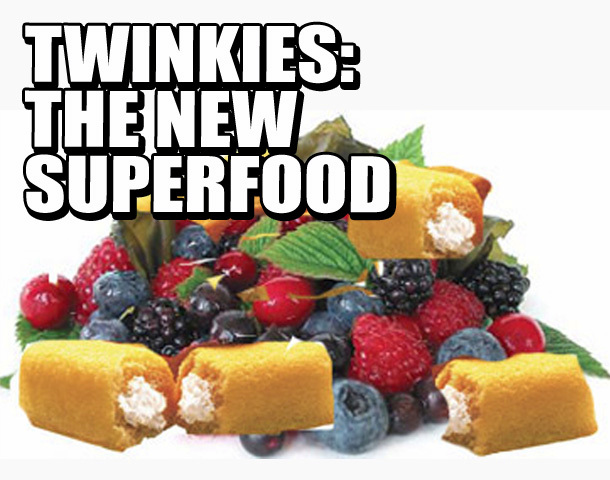 Twinkies are a superfood? In my life, on occasion, ‘deed they were. (I have now been sober for almost five years.) I love this article, TWINKIES: THE NEW SUPERFOOD!, by the way; look at that photo. How small a staff works there now? How small is the budget? Once upon a time, the reported paid circulation was a quarter-million readers, and of course, all of the Men in Black. The staff could not afford the minutes to leave the office and spend two dollars on some real fruit and berries and real Twinkies, so they had to copy-and-paste a clip-art photo of a broken Twinkie over a photo of some fruit? Even in the name of truth or comedy? You can see the white border around the middle Twinkie.
I would like to think that someone spent extra time to make this photomontage look this sloppy, in the same way that I like to think, for approximately six seconds, that every word in the newspaper is true.
The newspaper—and yes, only half of that term is correct, in that the publication was in fact printed on paper—the paper ran into hard times and only exists online now. It is there that you will find a few, a precious few, examples of the paper’s opinion writer, Ed Anger, who appeared in its pages from 1979 till around a few years ago. The title of his book, “Let’s Pave the Stupid Rainforests & Give School Teachers Stun Guns: And Other Ways to Save America,” gives a taste of his typical opinion.
Ed Anger was a creation of a staff writer named Rafe Klinger and then was the pet project of the editor, a man named Eddie Clontz. After Clontz died, several writers have revealed that they took turns editorializing as Ed Anger in the years since. Klinger sued the WWN, arguing that the paper could not continue to run the angry Anger editorials, but he lost. Thus, there was some real anger animating Ed Anger’s anger.
Ed Anger hates everything and everyone, especially Democrats, foreigners, religions other than his, wild animals that somehow need protection even though they have claws, complicated foods, and most television programming. Each editorial begins with, “I’m madder than a” and then promptly becomes less funny over the subsequent four hundred words or so.
Ed Anger amused me because I remembered a real Ed Anger in my hometown when I was growing up. I do not remember the gentleman’s name, but people in Dutchess County, New York, may remember in the 1970s a self-published newspaper—a blog, but on paper—by a writer who devoted pages to convincing his readers that all people of color were bad, that all Democrats were Communists, that the local Democrats were Satanists, that his new tin-foil hat was protecting him. Now, anyone can think anything they like and hate anything they want to, can write inspiringly dull sentences outlining their many hatreds, can self-publish those sentences in a newspaper or blog, can spend money getting copies printed and distributed, but this man, the real-life Ed Anger of my youth, he had advertising in his local production! His racist and anti-semitic, single-note, single-theme weekly newspaper, which was basically an eight-page run-on sentence interrupted by headlines, had ads in it. There were local businesses whose owners maybe did not want to rile people up by publicizing their political leanings, but they paid for ads in this one man’s hate-filled quirk.
As Ed Anger might have written: “You know what I think of that?” It is not printable in a family blog.
____________________________________________
The WordPress Daily Prompt for January 11 asks, “Pick a contentious issue about which you care deeply—it could be the same-sex marriage debate, or just a disagreement you’re having with a friend. Write a post defending the opposite position, and then reflect on what it was like to do that.”
* * * *
Please subscribe to The Gad About Town on Facebook: http://www.facebook.com/thegadabouttown

Blame former Vice President Al Gore. In his bestselling book, “Earth in the Balance” (1992), Gore recounts the story of watching his six-year-old son be hit by a car, and the months he and his wife spent bringing the boy back to health.
He writes that “something changed in a fundamental way” for him that year, 1989: he turned 40, watched his son almost die, and lost the 1988 Presidential election. (He came in a distant “don’t remember him running that year” in the primaries to Michael Dukakis.)
On the same page as that list, page 14 in the revised edition, he writes that,
This life change has caused me to become increasingly impatient with the status quo, with conventional wisdom, with the lazy assumption that we can always muddle through. Such complacency has allowed many kinds of difficult problems to breed and grow, but now, facing a rapid deteriorating global environment, it threatens absolute disaster. No one can now afford to assume that the world will somehow solve its problems. We must all become partners in a bold effort to change the very foundation of our civilization.
(Gore does a far better job connecting the personal with the political than I did for him just now, above; reading the long quote on its own, as I shared it, reminds me of a tire-screeching/pulling-the-stereo-needle-across-the-record sound effect. “One minute, he was talking about turning 40, and then? This is connected to climate change how?” Okay. He spends the first dozen pages laying out his political credentials as a leader trying to avert the environmental catastrophe that we are now 20-plus years closer to than when he was writing. Then he reveals something that few politicians like to admit: vulnerability and teachability.) (My own Al Gore cred: the first vote I ever cast for president was for him, in 1988, in the New York State Democratic primary, which Dukakis won. I voted for Clinton/Gore twice and Gore in 2000. Nine years after its release, I have yet to view “An Inconvenient Truth,” however.)
In the next paragraph, he brings in Mahatma Gandhi, and bumper stickers have not been the same since.
I believe deeply that true change is possible only when it begins inside the person who is advocating it. Mahatma Gandhi said it well: ‘We must be the change we wish to see in the world.’ And a story about Gandhi—recounted by Craig Schindler and Gary Lapid—provides a good illustration of how hard it is to ‘be the change.’ Gandhi, we are told, was approached one day by a woman who was deeply concerned that her son was eating too much sugar. ‘I am worried about his health,’ she said. ‘He respects you very much. Would you be willing to tell him about its harmful effects and suggest he stop eating it?’ After reflecting on the request, Gandhi told the woman that he would do as she requested, but asked that she bring her son back in two weeks, no sooner.
As Gore tells it, or Schindler-Lapid tell it, the mother and son visit Gandhi two weeks later and he delivers his health message to the boy. The mother thanks him but asks why he had requested a two-week wait. “Because I needed the two weeks to stop eating sugar myself,” he is said to have replied.
And we all, without prompting, cast Sir Ben Kingsley as “cuddly Gandhi” in our movie version of this anecdote in our minds. In 12-step fellowship meetings, I promise you will hear someone re-tell this anecdote as if it appeared in the great movie biography, or in any biography of the great man.
No version of the story appears in any biography of Mahatma Gandhi. Nor does the “be the change” quote. According to a spiritual writer named Keith Akers, the bumper-sticker-perfect expression, “We must be the change we wish to see in the world,” can not be traced anywhere in the world until the 1970s at the earliest. He spent a couple of years trying to find the statement in Gandhi’s published and recorded works. His article, “Did Gandhi Really Say ‘Be the Change,’” concludes that it is a legend. Not that there is anything wrong with the notion—it is certainly a viable suggestion to make in any debate—but someone wanted to add some historical-philosophical oomph to the thought and attributed it to Mahatma Gandhi.
Akers also shares the amazingly ironic fact that several years ago, the National Cattleman’s Beef Association used the phrase in a pamphlet it released aimed at educating school boards about making sure beef was a part of their school districts’ nutrition and wellness plans for the coming school year. It is not attributed to Gandhi, but there it is, uncited and without quotes, in a document dated September 2005. About beef and its positive role in a youngster’s school nutrition.
In 2011, a writer named Brian Morton published in the New York Times an essay titled “Falser Words Were Never Spoken.” Akers also cites it. Morton expounds on several bogus quotations, including the “be the change” thought, and authoritatively quotes this from Gandhi: “If we could change ourselves, the tendencies in the world would also change. As a man changes his own nature, so does the attitude of the world change towards him. … We need not wait to see what others do.”
He calls it the “closest verifiable remark” from Gandhi on the idea, but he does not offer a source so that anyone else can verify its closeness or its anything-ness. A Google search yields articles on spiritual websites that recount the mother and son and sugar story (some quite vividly, making it sound like an adventure tale), and the trek to the spiritual leader, and his request that they check back with him some time later (in some versions it is two weeks, in others, three days). And then the long version of the quote, the Morton quote, is offered in these stories, which were found today in a simple Google search, as Gandhi’s wise words to the mother.
There is no documented evidence he ever even said the Morton quote. Gandhi was an activist, so yes, putting his money where his mouth was would have counted for something. But he was not merely a spokesman for his ideals, telling people how to live. He knew that personal discipline in one person can not change anything, certainly not a government, but that a lot of people of discipline, working together and pushing each other, can. Those who like to vocalize the “be the change” quote are rarely heard speaking about changing unjust political systems or sparking revolutions; usually they use the quote to remind each other to smile more and be more sunny and thus make the world a smilier, sunnier place. And anyone who doesn’t smile back? It’s their fault.
If you want to write a best-selling bumper sticker, water a big thought down to a weak and insipid one, make it sound altruistic but really be about self-congratulation, and attribute it to someone long dead who really was a deep thinker but who would not have thought or even uttered what you are crediting them with saying.
____________________________________________
The WordPress Daily Prompt for January 2 asks, “What change, big or small, would you like your blog to make in the world?”
* * * *
Please subscribe to The Gad About Town on Facebook: http://www.facebook.com/thegadabouttown
Celebrate Silent Film
stories, anecdotes, poetry, essays, and general magic
The blogging challenge keep you motivated and start the new year on the "write" track!
The Dangerous Blog of Mamie Van Doren
Daddy issues are for beta bitches
Poetry and the rumblings of my synaptic snap.
Poetry BLOG By Edge of Humanity Magazine
-- A Modern SuperWoman Life
Shortness of Breadth
because the story must be told
Award-winning historical murder mysteries inspired by classic 19th-century novels
My thoughts, sentiments, and scribbles on womanhood
Perfectly Imperfect Human
Discovering the joy of art
open your mind to a growth mindset and new perspectives
Truth of life
 The Gad About Town