Guilty of White

The lottery that I won at 6:37 p.m. on November 18, 1968, was not the product of any hard work on my part. It was not a reward for playing fairly or for especially clean living, nor was it awarded to me for playing by the rules and earning my way.

It was a scratch-off ticket, generated at random, and someone else could have gotten it just as easily as I did. Like the service at a lottery counter in a gas station, life is a first-come, first-served proposition. It was a scratch-off, and, my gosh, did I win a nice jackpot.

If reincarnation existed, one could say that someone else may have deserved this life more than I did or do, and one could certainly argue that someone else might have done a better job with it than I have so far, but it is mine. It is the golden ticket.

The lottery that I won paid off immediately: I am white in a country that treats this minor genetic condition like it is something one diligently worked for and earned. And I am male. I am heterosexual. This world and this country rewards the bearers of those accidental tickets pretty generously, too. When I was a child, my family was middle class in income if not status in a country and at a time when being in the middle of middle-class life in America meant one was living more comfortably than three-fifths of the residents of the rest of the world. And citizens in this country treat that privilege like a victory over immediate enemies rather than the several-generation accumulation of incidents that it is.

Education? Paid for through high school by virtue of being born where I was. By which I do not mean the Spackenkill school district. Nor Poughkeepsie. Not even New York State. Being born in America in 1968 meant an education. (The states were not yet privatizing education or dictating their own local test-versions of education, so I benefited from learning when the dinosaurs existed and the one main reason for the Civil War.) Thanks to my parents, my mom especially, I do not remember the experience of learning how to read or count, because I was taught before my earliest memory (age two and a half) is time-stamped.

Perhaps it is a bit of speculative science fiction to offer the idea that none of these matters are in and of themselves good, righteous, holy, or even earned things. I could have been born in a country that does not privilege the pink pigment of white skin. Or I could have been born in this country but not white. We could have lived in a country where money did not provide some piece of status and “our type” might have been punished at random moments. My mother was born and raised in America, but she had cousins in “the old country” (near Minsk) who were exterminated. They had money.

So I know that I am racist, sexist, whatever-ist. By virtue of being born white, male, and middle class in America in the late 1960s, how could I not be? The day that I walk through (every damn day) is a different day than any woman, black person, gay person—any member of a minority group randomly pre-selected according to these criteria by society—walks through. And the sad, simple fact is that it is a luxury for me to even type that sentence or play with that thought. I do not need to consider what life is like for me, what my day is like, because no power group makes me aware of it.

Oh, sure, it’s society’s rules and some people seem to know how to play by them. “If you don’t commit any crimes, what do you have to worry about?” And that is the thing: I don’t. Simply because I am guilty of white, guilty as charged of male. I am a born member of the power elite, me with my $11,000 annual disability income.

Why does anyone march? Or protest? Or agitate? Or riot, finally? Because if you told me that I had “earned” the genetic anomaly that is taking my legs away, which I did not, not any more than I earned being white or heterosexual, I would attack you with my cane, with every fiber of my being.

* * * *
The Gad About Town is on Facebook! Subscribe today. Daily facts (well, trivia) about literature and history plus links to other writers.

____________________________________________
The WordPress Daily Prompt for December 7 asks us to reflect on the word “Protest.”

The WordPress Daily Prompt for March 2, 2016, asks us to reflect on the word “divide.”

The WordPress Daily Prompt for April 4, 2015, asks, “Link to an item in the news you’ve been thinking about lately, and write the op-ed you’d like to see published on the topic.” Today is the 47th anniversary of the death of Dr. Martin Luther King, Jr.

The WordPress Daily Prompt for December 2, 2014, asks, “‘It was the best of times, it was the worst of times.’—Charles Dickens, A Tale of Two Cities. When was the last time that sentence accurately described your life?”

Visit “Occupy Daily Prompt,” the DP Alternative.

News v. ‘News’

The president signed a bill into law today, which is news in and of itself since not much new legislation has made it to his desk in these last two Congresses, but it was the VA bill, a pretty important piece of “gotta fix this now” business. Most news outlets covered the event live, and a live stream even showed up in my Facebook and Twitter feeds (no, not from the White House or the Democrats. From a news organization) so I was aware it was taking place at the moment it was taking place.

It was not so for viewers of one national news channel; that operation had an nearly elderly rock star (Gene Simmons is 64 and is still leading KISS) speaking about global politics, war zones, and the controversial name of an NFL team. I believe “general interest” is what news producers call such a chat, rather than “specific news,” which is what was happening at Fort Belvoir while the president was signing the VA bill there. Simmons was probably on Fox News to plug some book, TV show, or thing, because a Gene Simmons without something to sell is a Gene Simmons we do not see on TV.

And now I have gone and further publicized this by including it in my little blog.

Most news shows tonight will not air the boring footage of a president signing a piece of paper but will instead feature Gene Simmons because he made his points about the name of the Washington Professional Football Team by using some colorful terms, giving us all a “Ha Ha!” moment or a “Shame on Gene Simmons! How old is he nowadays? What color is his hair?” moment. Perhaps someone should get a quote from President Obama about it, in order to keep him in the news.

The Life Cycle of a Retail Idea

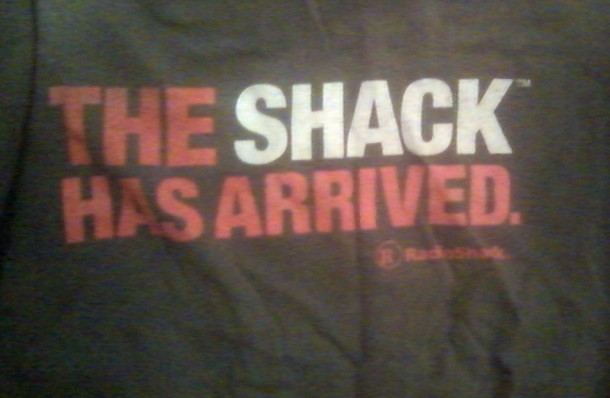
The annual corporate image overhaul was usually followed by a frenzy of inaction, no changes outlined or implemented at all. One year, “corporate” decided that its most valuable property was the company’s image as a solution center, the place customers visited to get answers, like spiritual seekers traveling to commune with a lama on a mountaintop. The decades-old reputation of sales associates possessing a broad and deep knowledge base was the asset that was advertised, but the advertising was backed up with no internal education initiatives or local emphasis on, well, anything.

To be a bit nicer about it, I did get a pretty reliable t-shirt that I still wear sometimes, as seen in the photo above.

The latest news from RadioShack—that it is closing about 20% of its stores, that declining sales resulted in a net loss of $400 million in 2013—resulted in a statement that I overheard more than once last week: “Yeah, RadioShack went out of business. They closed yesterday.” It isn’t going out of business, not yet, and not yesterday, but how often do you hear RadioShack’s name come up in water cooler conversation anymore? And if and when you do, for the last several years, the next part of the sentence usually has been “… is going out of business.”

It is difficult to manage news properly when you have spent the last decade attempting to manage expectations.

Like many people, the first personal computer I ever used was a TRS-80 (Tandy Radio Shack-80), on which I learned the BASIC programming language and which we used in some now forgotten way to produce the very first newspaper I wrote, for my junior high school. (We also used a hand-cranked “ditto” machine.) From 1980 till 2005, I did not set foot in a Radio Shack, or give a thought to its stores or its brand. My association with the company was that it was for hobbyists and that I am not one. I bought my first computer from an Apple retailer, my phone from a department store, batteries from the local convenience store. The first and last time that I soldered something, it was not fun and I was a Cub Scout.

Running parallel to my various professional career employments has been my back-up: retail sales associate. In the 1980s, I partly paid for college by working at a Montgomery Ward (now out of business). Through the 1990s, I worked for an independent family-owned bookseller (now out of business). Starting in 2005, I worked at two RadioShacks in two locations, for two very talented managers. I became very fond of RadioShack and its long retail history, and I left the company in 2010. So yes, the only thing these various stores have in common is my employment with them and … well, at least RadioShack is still in business. As of today.

But for how long? In 1986, the Montgomery Ward in which I worked not only sold a lot of everything, but it also had its own cafeteria, so that shoppers, weary of their morning spent spending and ordering and redecorating, did not even have to leave the premises to eat. They could continue shopping after chowing down on a burger. Department store visits were destination shopping experiences, and customers could brand their entire home as Sears or Wards residences; a century ago, one could even buy a house, design plans and material and tools, from those companies’ catalogs. But one could also dash in and pick something up in an emergency—a roll of film or a pack of batteries or light bulbs or a necktie to replace the one with a fresh coffee stain. (I’m just spit-balling ideas here; that never happened to me.)

The malls replaced the department stores as destinations in themselves, plus they threw in a movie theater. Most of the major department stores have closed, except Sears and Kmart, and Sears is considered troubled by analysts and Kmart is continuously restructuring.

For a while, bookstores grew into destination experiences in the way they combined music sections with huge periodical collections and more than a few books. But by the mid-1990s, online retailers were beginning to attract attention—well, Amazon was—as well as a piece of the retail dollar. Many online retailers retain one’s entire purchase history; Amazon shows that my first purchase with it was made in 1998. At around that time, I first heard a customer reply to the information that a book was not in stock with this sentence: “I’ll drive over to Amazon and get it there.” When my colleagues and I would politely offer the information that no such thing as “an Amazon store” existed, they would correct us in return and say that they had been there the night before.

“Amazon” had come to mean “the big Barnes & Noble in the next town” for our customers, and Barnes & Noble was in trouble because of this association, too. Amazon has never had a physical store, and each retail operation that earns all 100 cents of its sales dollar from sales completed in real stores on real streets with real employees and real customers has been flummoxed for 15 years by this fact. Almost every bookstore tried to establish a dot.com enterprise only to discover—shortly after their customers discovered this first—that fulfillment meant getting the book that had been ordered into the store for the customer to pick up. And if the customers were going to visit the store for the privilege of paying shipping for a book that, if only you had stocked it there would have been no shipping charge, well, customers were going to find an alternative, like paying for shipping to their doorstep and not visiting your store.

The speed with which the book selling sector collapsed—Waldenbooks, Borders, hundreds if not thousands of independent booksellers—has only recently been rivaled. By the electronics sector.

And again, it is a combination of what was revolutionary about Amazon (and Walmart) combined with some baffling decisions and perplexing identity crises by electronics stores. The numbers are staggering, as pointed out in this Atlantic Monthly article:

RadioShack’s long slide coincides [with] the steep ascendance of Amazon as America’s great brick-and-mortar destroyer. In 2003, Amazon and RadioShack each had about $5 billion in sales, as WSJ business editor Dennis Berman pointed out. Last year, Amazon had $75 billion to RadioShack’s $3.5 billion.

Some further comparison is illuminating: At the end of 2013, RadioShack had 5,000 brick-and-mortar stores with 27,500 employees and $3.5 billion in sales, which is $127,000 in sales per employee. Its website is the 1,066th most popular in the world. At the end of 2013, Amazon had zero brick-and-mortar stores with 117,300 employees (full- and part-time) and $75 billion in sales, which is $640,000 in sales per employee.

Once upon a time, a decade ago, RadioShack and Amazon were the same size. But RadioShack has had six logos and changed its name twice since the late 1990s. Its annual Christmas advertising blitz has included gimmicks like casting Shaquille O’Neal as a spokesman, promoting itself as the public’s wireless destination, installing Amazon.com “fulfillment lockers” in stores (so Amazon customers who did not want things shipped to their homes could have them shipped to their local RadioShack (!) just to bring customers into the stores), and, it is worth repeating, decisively changing its name to “The Shack” and then decisively back. More than one writer has pointed out that “RadioShack.com” is an oxymoron and is also the history of technology in one mouthful. This year, during the most-watched Super Bowl in history, viewers saw the company make fun of itself in a way that won the company a lot of affection but probably not one single new customer.

https://www.youtube.com/watch?v=eq3rieHG_J0

In fact, according to the Wall Street Journal’s online publication, MarketWatch, “On March 4, RadioShack’s ‘consumer perception’ among American adults who made a purchase in the store within the previous 90 days was just 8%, according to an analysis carried out for MarketWatch by YouGov BrandIndex.” In English, of those people who recently spent real money in a real RadioShack, only 8% were aware of RadioShack as an anything. For comparison, Best Buy gets a 22% customer perception rating. So the amusing ad did nothing except declare that, yes, we know you know we think we are out-of-touch, but, um, we won’t be like that anymore. “Come see what’s possible when we do things together,” is the new slogan. Are you asking me or telling me? Um, “things?”

What do all the recent headlines generated by the news of RadioShack’s imminent imminence mean, really? What are we telling ourselves about what we think we are (maybe) going to miss, if 92% of RadioShack’s actual money-spending customers were not even aware they spent that money in a RadioShack? Most of the business analyst articles are not about the changing face of retail in the face of a hundred-year-old company’s demise but head-shaking premature obituaries, neither musings about ways forward for the company nor attempts to explain how RadioShack has managed to stay alive after so many previous obits.

RadioShack is the company whose image for more than a decade has been “the store that thinks you need to be reminded of its image.” Sometimes the R is sans serif and sometimes it is serif, sometimes we are “The Shack” and sometimes … when a company does not know why it is in business, just that it wants to remain in business, it closes, sometimes quickly, sometimes slowly.

It will always de-materialize if you don’t work for it.