
A Duck About Town: SMA and Me
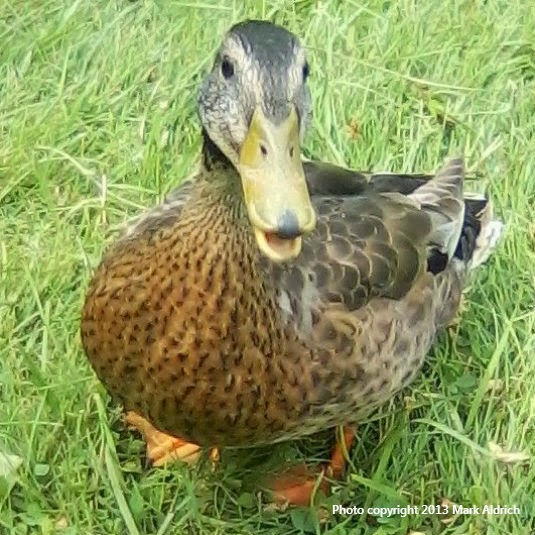
It is hard to see, but on the top left side of the “The Gad About Town” tab (at least on a Windows browser), to the right of the WordPress logo, there is a little square box that looks like a blob of brown and green. I first placed it there as an inside joke with myself, but the story is worth sharing. The full-size photo is at the bottom of this article.
It is a photo of a duck.
In 2012, I was diagnosed with a still-undetermined form of spinocerebellar ataxia. (I just noticed that the word “spinocerebellar” now freely flows from my fingers as I type it; I insist on Wikipedia’ing it to check the spelling—to preserve the illusion to myself that this is still new to me—but it is now forever in my vocabulary.) This disease, which I have written about before (“Ataxia“) and will again, is progressive, degenerative, affects my sense of balance, and is robbing me of my physical control of my legs.
(October 22, 2014 update: in May 2014, a new neurologist was assigned to me and he corrected the first diagnosis to something else, spinal muscular atrophy type IV. Friedreich’s ataxia, the first diagnosis, carries with it a shortened lifespan, a diagnosis that in turn carries with it more than a few nights lying awake and staring into every abyss one thinks is on the other side of any door. Please visit my article about the re-diagnosis, “SCA or SMA?” Everything else in this article, written in December 2013, still reflects my perceptions.)
My symptoms first appeared in 2006, I now realize, when my walking began to slow. I was always a rapid walker, and I felt like I was moving my legs in the same way I had always moved them, but the time it took for me to complete familiar walks was getting ever longer. Even in 2005, while mowing a friend’s lawn, I noticed that it took me longer than it “ought to” have. My legs were tiring easily. Finally, I started to run late for appointments (most hazardously, my job across town) and was perennially underestimating the time it would take me to walk somewhere.
All this was new. I shared what I was experiencing with no one, except to promise when my lateness was noticed that I would “do better” next time.
* * * *
 |
| A blue heron, patrolling the shore like a cop on the beat.–Photo by Mark Aldrich |
This spring and summer, some friends and I made frequent visits to a pond at a local college campus. A former make-out nook for at least a one of us, this year it became a quiet place to get away from some turmoils in our lives. Several species of waterfowl live on the pond, which is nonetheless quite small. One day a blue heron came by, which is a common but always special sight here in New Paltz. It hung around long enough for me to photograph it walking along the shore.
There are usually a few breeds of duck on the pond, and my friends and I became “expert” in observing the inter-species social behaviors of the different breeds. (In a word, some breeds are just bullies, even to humans who are feeding them breadcrumbs.) We developed story lines about each duck family’s day.
One family of five, a mother duck and her four ducklings, became “my” family. This was because one of her offspring was lame. He or she—I decided he was a he, but I believe it is a she (those who know about such things can tell immediately when looking at the photo below)—appeared to have a broken right leg. Cute and small as they all were, the four of them fuzzy and adorable like they were posing for a children’s book cover, the siblings would push him away from our breadcrumbs, but he always fought hard for his share.
Broken or born that way, he held his leg tucked alongside, which forced him to remain seated on the ground when the others were toddling towards the crumbs. Then, in a flurry of action, he would start to wobbly waddle, but he was perpetually a few steps behind. He was slow in other ways, too: by the time his siblings were free of their baby fuzz and displaying more grown-up plumage, he still had some fuzz.
I saw that, even with his right leg held in a crook, even sitting awkwardly on the ground, once he started walking, after a few unsteady strides he would catch up to his siblings. But he honked just as loudly as they did, each of them telling the others to mind their manners at the top of their voices. In the water, he appeared to swim as quickly as the others.
* * * *
In 2008, the bizarre sensation of being always on the edge of a fall became a part of my life. I could not walk across a parking lot without first looking across it to plan which cars I would use as targets for potential falls. I started walking with a cane.
Faced with the prospect of crossing an empty parking lot (I worked for an electronics retailer that frequently locates its stores in open-air plazas, so that is why I have twice mentioned parking lots), I would look for an abandoned shopping cart (there was a grocery store nearby) and use that as a walker.
As before, I shared what I was experiencing with no one, except sometimes I made jokes about walking with a cane—I named it “Michael,” as in the actor—and I did not have a doctor, because I was 40 and a guy and why bother?
I did not have a doctor, because 40. I was 40 and my legs felt like they were in boots nailed to the ground. I would take a step only to find that neither leg moved.
By 2011, completely foreseeable circumstances had given me the beautiful gift of poverty and thus Medicaid. Now able to afford a few visits to a neurologist, I underwent the series of tests that led to my diagnosis.
* * * *
After that first visit to the duck pond, I did not expect to see “my” duck again. My not-so learned musings about inter-species duck behavior and observations about seeing him clubbed regularly by his siblings led me to my expert prediction. Marlin Perkins in my mind, I lectured one of my ever-patient friends about my sad theory that he probably had been rejected and abandoned “for the greater good of the family.”
On our next visit, two weeks later, he was still there. Of course. He was still missing every first chance at breadcrumbs—even those tossed specifically at him—but fought his siblings to get his crumbs once he started moving. They still pushed him away from their second and third chances at crumbs on the ground, but he was louder than the others and was getting faster, even limping, but doing something like using his lame limb like a cane. He was using his lame leg.
* * * *
I use a method of walking that I devised without knowing what I was doing back at the electronics store: I push off with my right leg, like a right-handed pitcher, and swing my legs under me, using the cane to tap a rhythm. Once I get myself up to speed, I can outpace many of my friends. It is difficult for me to stop suddenly, like when I am jay-walking, so I do not do that. There are days where I do not know what my legs are going to do and we seem to educate each other.
 |
| Two friends who walk with me step by step. |
Every day, I live with the sensation of being on the edge of a fall all the time, even when I am sitting on a chair that has arms on both sides, and I stand upright by bracing myself with the cane, standing against a wall, or by surprising a friend (often, my beautiful girlfriend) by grabbing their shoulders. In the photo seen here, taken in October 2013, I am with two of my closest friends, but I am holding myself up with a folding chair on each side.
Because I have a diagnosis, I know why I am experiencing these things, and new developments can no longer be as surprising as the discovery in 2008 that it seemed that I could no longer walk. Because I have friends in whom I confide (like you who may be reading this), any new development will not be experienced like running head-first into a wall, which is how it felt for me in 2008.
* * * *
 |
| My buddy.–Photo by Mark Aldrich |
The photo here is of “my” duck, closer to fully grown in July, waddling up to me. He would take two steps at a time and then pause or plop down, then would take a couple more. First his right foot, then his left, then a stop and reset for another pair of steps. He did not come as close to us breadcrumb tossers as some of the others did that day, but he fought as valiantly as any duck that I would call mine should.
This is the photo that accompanies this blog, next to “The Gad About Town” name. He is my duck about town.
It is now December 2013 and I hope he is still with us, but in the warm south, ornery at his siblings every staggered step of the way.

 The Gad About Town