Daily Prompt: First Instincts Versus Second Opinions

The WordPress Daily Prompt for August 10 asks, “What are some (or one) of the things about which you usually don’t trust your own judgment, and need someone’s else’s confirmation?”
__________________________________

My first instinct, which is that my first instinct can not be trusted, is usually wrong. This often puts me in any number of conundra.

The paragraph immediately above gives a clear example: My typing fingers wanted to write “conundrum,” then wanted the plural form. But what is the plural of conundrum? My all-too clever brain thought: “conundra. That’s funny. It’ll get a smile from someone.” The someone who smiled was me, which was enough to make it so, and I typed “conundra” for “conundrums.” But I go look it up and learn—thanks, World of Information!—that since conundrum does not come from a Latin root, but sounds like it might have, the proper plural is “conundrums.” Further, the word “conundra” has existed for a long, long while as a humorous, mock-educated plural form for plural problems. “Mock-educated.” That’s me, so it remains “conundra.”

But if that agonized convolution of almost-thought is a real tracing of how I decide most things, and it is, it is a wonder that I find enough food each day to survive.

Thus I need help deciding things more often than not, but have made a life’s habit of refusing help or of going in the opposite direction.

The one best example of going against my first instinct of ignoring my first instinct came when I first met my girlfriend, my partner, my love. (All one person.) The very moment I saw her, a thought crossed my mind (always a dangerous thing) just on other side of being articulate; words were not there, but the thought, if it can be captured, was: “She is going to be important to me.” Not possessing foresight, I did not know what that might mean (the joy is that I am still learning)—I needed five bucks that night, and maybe she was going to lend it to me. Or maybe she was going to join me for this ride we have been on for these last couple-plus years.

Knowing myself all-too not very well, I knew that I should not reach out to her, not try to get to know her, ask her out on a date or 300. My pre-instinct said, “You want to know her.” My first instinct replied (of course, my first instinct feels like a reply already): “No you don’t. Fear rejection. Fear acceptance. We don’t have any food in the fridge.”

I did something I have no history doing and asked friends. “I think I like our new friend.” (My questions end with periods instead of question marks.)

“Yeah?”

“I think I’m going to ask her out.” (Now, this was the challenge: One of the first sentences we had heard from her was that she was beginning a year-long moratorium on dating, starting that week. Easy excuse for me to throw in a towel that I did not even know the color of.)

“You haven’t yet? I thought you had.” That semi-clinched it: My friends knew me less well than I thought they did. That was enough second opinion for me.

My first instinct, to always doubt my first instinct, led me to do the opposite of what I was telling myself to do and ask her on a date. I ignored my instinct to ignore my instinct and trust that someone special was in front of me. At the time: I was unemployed; had not yet had necessary eye surgery, so my glasses were unbelievably thick and unattractive; had not yet been diagnosed, so I was not collecting my Social Security. Thus my life situation was that special kind which does not include income. So my asking her out on a date at all was audacious, and I am not an audacious human.

For once I was, and it made all the difference. I am grateful for her inspiring this audacious behavior from me, and happy she was just as audacious in return.
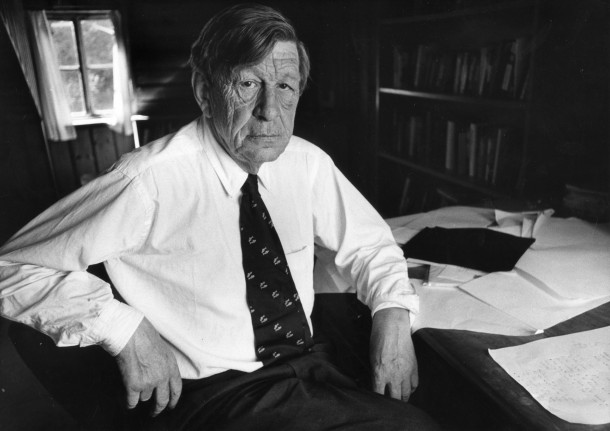
Auden’s Decency

In the documentary, “Tell Me the Truth About Love,” W.H. Auden’s friend Thekla Clark recounts the story of one of Auden’s lovers complaining to him that he thought Auden would be more “romantic,” being a poet, after all. “But you aren’t romantic,” Clark quotes the lover telling the poet. “You aren’t romantic at all.”

“If you want romance,” Clark quotes Auden replying, “screw a journalist.” (Except she does not say “screw.”)

Auden was not one for ruining a good line—or a good night—by spending it explaining the difference between romance and sentimentality.

Auden’s poetry, often about love, derived from an almost clinical study of his own personal history and emotions. A professional poetic detachment yielded a poetry that was undisturbed by sentimentality. Yet Auden is also the least cynical and one of the most humane of the great poets.

One can not declare oneself humble. Humility and decency do not allow for advertising. The moment one discusses one’s virtues, one yields them. In the same documentary, “Tell Me the Truth About Love,” Auden tells the talk-show host Michael Parkinson that “a writer is a maker, not a man of action” so everything he writes is an autobiography, is his history of his experience transformed in his senses, and that, no, he would not be writing his memoirs. The autobiography of a man of action—a politician or general or activist—may be necessary to understand them.

(The clip starts around minute three. The documentary, which first aired on the BBC in 2000, is full of interviews with Auden and his circle. Once upon a time, talk shows featured literary figures; Michael Parkinson was the Johnny Carson or Dick Cavett of Britain, minus the jokes. Actually, Dick Cavett was the Parkinson of America.)

Auden learned the difference between a man of action and a maker early on, and he learned how tempting it could be to confuse the two. In the 1930s, while a young writer, he was made into a hero of the British left, and moved to America to reacquire his privacy. Edward Mendelson quotes Auden in “The Secret Auden,” in the current issue of the New York Review of Books: “I suddenly found I could really do it, that I could make a fighting demagogic speech and have the audience roaring … . It is so exciting but so absolutely degrading; I felt just covered with dirt afterwards.”

By the 1960s, both his politics (left) and his religion (he returned to the Anglican Church of his youth in 1940) were publicly known, but he was no longer a speech maker and never was a proselytizer. From Mendelson’s article:

When he felt obliged to stand on principle on some literary or moral issue, he did so without calling attention to himself, and he was impatient with writers like Robert Lowell whose political protests seemed to him more egocentric than effective. When he won the National Medal for Literature in 1967, he was unwilling either to accept it in Lyndon Johnson’s White House during the Vietnam War or “to make a Cal Lowell gesture by a public refusal,” so he arranged for the ceremony to be held at the Smithsonian, where he gave an acceptance speech about the corruption of language by politics and propaganda.”—The Secret Auden,”

To accept an award from one’s adopted country and relocate the ceremony from the heart of power to the nation’s museum, and then to turn the ceremony into a lecture about corruption is, when available, a different sort of bravery than an attempt to make one’s absence into a loud presence.

Edward Mendelson is Auden’s literary executor, and in the New York Review article, he reveals that he is still learning of some of Auden’s acts of decency, 40 years after the poet’s death. Charities he quietly funded, a manuscript donated for a sale to pay for a friend’s surgery, a prisoner who wrote him once and began a lifelong correspondence course in literature. Even the story of a woman from his congregation in Manhattan who “was suffering night terrors, so he took a blanket and slept in the hallway outside her apartment until she felt safe again.”

There is even this story, revealed last year in a letter to the Times of London:

Sixty years ago my English teacher brought me to London from my provincial grammar school for a literary conference. Understandably, she abandoned me for her friends when we arrived, and I was left to flounder. I was gauche and inept and had no idea what to do with myself. Auden must have sensed this because he approached me and said, “Everyone here is just as nervous as you are, but they are bluffing, and you must learn to bluff too.”

Auden knew, Mendelson writes, that good and evil exist, but that human beings fall on a spectrum between the two. Most are not evil people attempting to be saintly but good people striving to become better. There “are those who, like Auden, sense the furies hidden in themselves, evils they hope never to unleash, but which, they sometimes perceive, add force to their ordinary angers and resentments, especially those angers they prefer to think are righteous. On the other side are those who can say of themselves without irony, ‘I am a good person,’ who perceive great evils only in other, evil people whose motives and actions are entirely different from their own. This view has dangerous consequences when a party or nation, having assured itself of its inherent goodness, assumes its actions are therefore justified, even when, in the eyes of everyone else, they seem murderous and oppressive.” When one’s nation declares itself a force for good in the world, maybe one should make sure the passport is up-to-date. Auden once wrote, “Many a sore bottom finds/A sorer one to kick.”

We do not practice what we thoroughly possess. We say we “practice” kindness because we do not possess it, not to the degree that makes us kind. We practice love because we are not loving but can always be more so. The humble acts of decency and kindness may not change the universe, but they may change an individual’s universe. In the often misquoted line from his amused and amusing 1957 poem, “The More Loving One,” Auden says, “If equal affection cannot be,/Let the more loving one be me.”

* * * *
Mendelson mentions Thekla Clark in his New York Review article, in one more anecdote about Auden’s quiet defense of doing the right thing, and adds that he learned of this “in a documentary film, ‘Wystan: The Life, Love and Death of a Poet,’ by Michael Buergermeister, which had its premiere in Oxford last year.” It is the only mention I have found of this documentary. On Buergermeister’s own website, only this trailer for the film appears:

It is tantalizing.

Love: A Valentine, Pt. 1

[This was originally posted in November 2013.]

Today at a car dealer I saw the sharpest and softest demonstration of love.

My friend and I were waiting for her car to be serviced, so we sat in the waiting room to discuss the things good friends discuss in waiting rooms.

An elderly woman, still wearing her winter coat indoors, was sitting alone across from us, barking inarticulate sounds to herself. Sometimes, when she would hear laughter, she would rock forward, and, with a smile on her face, direct some louder sounds in the direction of the others, as if she was participating in the joking and merriment. Then she would slump back and the stream of non-language would continue, sometimes in a sing-song, sometimes with a note of fear and anger. Was she alone here? Had she wandered in off the street? That was not possible, as the street was Route 9.

The sing-song was almost alphabetical, “Baa-baa-bah! Daa-da. Ha-ha-hah! Mmm-maa-maa, nnnn-naaa-naa?” There would be minutes of this, and then, on hearing more laughter from the customers, she would sit forward again and direct another non-sentence at us. No one was paying her any mind, but no one was paying any attention, either.

I took an improvisation class once and one exercise was to “converse” with another classmate in gibberish. (Like the late Sid Caesar.) I was very bad at it, or so I thought, because my gibberish sounded too close to actual language. Portraying a traffic cop, my gibberish sounded like, “No nhy NI nulled nou nover?” It seemed to me, a non-doctor, that this woman had suffered a stroke at some time and maybe was suffering dementia, too, since her gibberish retained the sound of a basic sentence structure, but minus any content or context.

Her husband returned from the parts and service counter. “They are almost done, sweets,” I heard him say while standing in front of her. She took his hands, swung them a bit, happy to see him again. He sat with her. She appeared to be telling him about her day. Her voice grew louder, took on an angry tone: “Why are we still here?” was my interpretation of what she was saying, but we were in a car dealership, after all, so maybe that was what I wanted to say to my friend.

The husband rested his head in his hand for a minute. This was a half-hour of my day, but this is his entire life right now. Both the wife and husband appeared to be in their 70s.

He left again to check on the progress of their car. She continued talking in her sing-song. When he returned, he informed her that it was time to leave, urged her to her feet, and she grew seemingly angry—at being asked to leave the only home she had ever known, even if she had been there for a total of 45 minutes or so. She used a declarative tone—”Bye-bye-bye-my-my-my-die-die-die”—and even stamped a foot, but then she leaned around him to announce, “Bye-bye-bye-hi-hi-hi” to each of us in the room. And then she started to take her coat off. He re-closed it and gently pulled her hood up.

The word “patience” is overused by 40-somethings like my friend and me when we are lucky enough to witness proceedings such as the above. “Such patience,” some would say.

It took the elderly husband three dance maneuvers to get his wife to face the door and walk through it; twice, she walked up to it and then turned back around into the room. He smiled at the room several times; he neither tried to engage any of us nor shrug away his wife’s loudness.

“Patience” does not describe what every waking moment and probably a few sleeping ones are like for this gentleman. There is a better word to describe it.

When they left, my friend uttered that word: “That is lovely.” I agreed, “That’s love.”