My Thinking Makes It So

In Act 2, Scene 2, of Hamlet, the doomed Rosencrantz and Guildenstern are chatting with the prince. They are old college buddies of Hamlet’s, and King Claudius (Hamlet’s step-father) and Queen Gertrude (his mother) have sent for them to learn what is bothering the young man, who has been acting with an “antic disposition” and saying strange things, half to himself and half to no one can tell who.

Hamlet greets them and speaks in the same riddling manner that he has been using with the rest:

HAMLET: Let me question more in particular, my good friends, what you have done to deserve such fortune, that she sends you to prison hither?
GUILDENSTERN: Prison, my lord?
HAMLET: Denmark’s a prison.
ROSENCRANTZ: Then the world is one.
HAMLET: A goodly one; in which there are many confines, wards, and dungeons, Denmark being one o’ the worst.
ROSENCRANTZ: We don’t think so, my lord.
HAMLET: Why, then ’tis none to you; for there is nothing either good or bad but thinking makes it so. To me it is a prison.

Hamlet quickly determines that they are not merely dropping in to talk about sports and the weather but are spies. Ultimately, he manages to have them both killed.

Shakespeare’s quip about how one’s thinking determines a thing’s relative goodness or badness has lived on through the centuries, but in most peoples’ recitations it carries about the same weight now as a Twittering teenager’s hashtagging of “YOLO.” Perhaps this is because it is delivered by a character who is speaking in riddles and jests and pretending to be mad. (“What are you reading?” “Words, words, words.”)

Four hundred years after Hamlet was first performed, “Nothing (is) either good or bad but thinking makes it so” is spoken as a longer, more profound-sounding, version of, “Don’t sweat the small stuff.” “The rain is uncomfortable for you but it’s good news for the farmers,” says the profound thinker who apparently wants me to punch him. (I once replied to this with a “Do you know any farmers? We live in the suburbs. If you do, see if they’re carrying umbrellas, too.” The person walked away, which of course was the only proper reply to my being a jerk.) (We are still friends. I have my good points.)
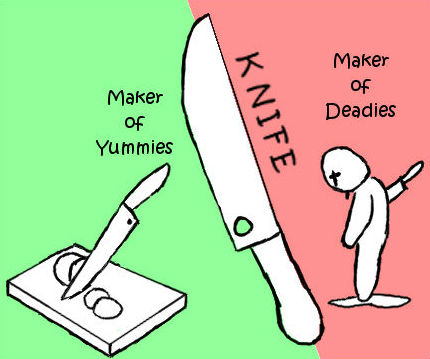
knifeconstrastMany people resist strongly and vocally when it is suggested that, taken existentially, Shakespeare and/or Hamlet is right. Our perception is all that defines good from bad. A happy event, in and of itself, is not inherently a good thing. A tragic happening is not by definition evil. There is a deep commitment to the idea that there is evil in the universe as well as good; that good inheres in things we like and love and that evil is a containable reality. This is because most of us combine and conflate the notions of sad with bad and happy with good.

Some of the saddest things that I have seen have had positive things follow them, possibly as a result of reactions to the sad thing. (I am disabled and that sucks, and I would not wish the experience on people I dislike, but being disabled gives me an income, a teeny-tiny one, which gives me time to write; a small example, that, but reality resides on a spectrum and not in an either-or zero-sum playhouse.) And some of the best things that I think I have done may turn out to have terrible consequences. Sadness exists. Tragedy is a reality. So is happiness.

Are there people who do wrong in this world? People who introduce sadness into peoples’ lives or who work for their own personal gain to the detriment of others around them? Of course. Hamlet was no murderer but he had Rosencrantz and Guildenstern killed. (Fictional characters, of course.) Hitler existed. If evil is inexplicable, well, then, so is good. We want all matters to be explicable, however, so we deploy terms like “good” and “evil” as if they are tools that explicate.

Further, our minds want there to be someone to credit or something to blame behind the good or the evil thing. There must be an explanation, goes the thinking. Thus, there must be a find-able motivation animating even the explicably good thing or evil person. The great journalist Ron Rosenbaum explores this in his famous book, “Explaining Hitler,” which confronts the book buyer from the start, the front cover. Hitler’s baby picture sits there. Historians have searched for decades for the clues to pinpoint the moment baby Adolf became Hitler. What was the cause? The explanation? It seems that it is not okay if there is not one. But “here there is no why,” as Martin Amis writes of Auschwitz.

Rosenbaum interviewed Alan Bullock, one of Hitler’s biographers. “‘Some days, I ask God,’ Bullock told me, his voice dropping to an impassioned whisper, ‘If You were there, why didn’t You stop it?’ And then he added the sad lesson of a lifetime spent attempting to explain Hitler: ‘Never believe God is omnipotent.'”

Boom! Is the Holocaust, or a holocaust, a man-made political rampage, something so far outside human imagination when it is always and only the product of human imagination?

Yehuda Bauer, a Holocaust Studies scholar, replies to Rosenbaum’s question, “Will there ever be a why?” “Bauer told me that he believes it is theoretically possible. ‘But the fact that something is explicable doesn’t say that we have explained it.'”

Terrible acts and tragedies are the horrible outliers of most human experiences. The beautiful thing is that love, great love and small love, is not. And it is just as inexplicable … until I gaze in my beloved’s eyes.

____________________________________________
The WordPress Daily Prompt for December 3 asks, “What’s the best piece of advice you’ve ever received that you wouldn’t give to anyone else? Why don’t you think it would apply to others?”

* * * *
Please subscribe to The Gad About Town on Facebook: http://www.facebook.com/thegadabouttown

Perfect Day?

“You’re going to reap just what you sow.”

“Excuse me?”

And he repeats it four more times.

After deftly sketching some snapshots of a perfect day—a walk in the park, a moment in a zoo, me and you—the speaker/monotone voice in Lou Reed’s song of that same name leaves us with that pushy, inexplicable, and echoing last line.

On its surface—and like many good songs, it has more than one level—on its surface “Perfect Day” describes just that: The small moments of togetherness that make a perfect day. Heck, I would like this to be a song at my wedding, if I have one, except for that last line.

It was the B-side to Reed’s one top-40 hit, “Walk on the Wild Side,” so “Perfect Day” has been a radio regular for over four decades. Of the two songs, “Walk on the Wild Side” is the less complicated lyric, being a list and description of the personalities populating Andy Warhol’s Factory in the late-’60s–early-’70s.

“Perfect Day” starts out as a verbal picture postcard:

Just a perfect day
drink Sangria in the park
And then later
when it gets dark, we go home

Just a perfect day
feed animals in the zoo
Then later
a movie, too, and then home

“Just” is a heartbreaking word. The singer does not say it was a “merely,” “only,” or “simply” perfect day. Those modifiers look down at the word they are assisting. “Just” indicates completeness. A day spent doing whatever one planned on doing, visiting the zoo or not visiting a zoo, is perfect, complete unto itself. Further, “perfect” is not a step above good or excellent and has nothing to do with the quality of the day. It is not a “good” day or a “bad” day; it is a perfect day. A complete one, a full one. If all your ambitions for the day are small and are met, yes, that is just a perfect day.

And it sounds like it was a fine day, too. The activities are unimportant in the way that the mundane details of lives other than our own are not all that important. When we hear details about a friend’s date, we nod, smile emptily, and say that it sounds like it was “nice.” When our friend tells us he went to the movies with his new girlfriend, we don’t ask about the ticket price or how dirty the theater appeared to be, even though those are details that might be interesting, more interesting than “later a movie, too, and then home.” “Perfect Day” sounds like it is about a “nice” date, which is part of why the song is loved: We all (I hope) have experienced a nice date. It makes the song seem universal.

But then something happens:

Oh, it’s such a perfect day
I’m glad I spend it with you
Oh, such a perfect day
You just keep me hanging on

“Such” is not “just.” This is how tautly the song is composed, that a minor shift in the language betrays a change. “Such” is emphatic. Now, “perfect” seems to be statement about the quality of the day, and it is almost pushy, demanding agreement. “It’s a PERFECT DAY!” your scary friend declares when he has had a few too many. In performance, this is where most singers, Lou Reed included, start to sing. Here is where the music shifts, too. Up till now, it has been the singer’s voice and a piano, at least in most recordings. From the very first recording of the song, it is at this moment that strings appear and the voice gets double-tracked, bringing out the sweetness of the melody. In one famous performance, Luciano Pavarotti sings/bellows the “Oh, such a perfect day” line.

In 1966, The Supremes had a number one hit called “You Keep Me Hanging On.” Its opening verse

Set me free, why don’t cha, baby
Get out my life, why don’t cha, baby
‘Cause you don’t really love me
You just keep me hangin’ on

is not something that would be sung or spoken by someone having a “just” anything sort of day, much less a perfect one. It is one of The Supremes’ biggest hits, it is one of Motown’s most loved songs, and a songwriter can not quote it without invoking all the upset that that song contains and the declaration of independence that it presents. In Lou Reed’s song, the perfect day now is less of a nice postcard and just got interesting.

But he returns to the narrating of the day/evening/date, and now problems are acknowledged:

Just a perfect day
problems all left alone
Weekenders on our own
it’s such fun

Just a perfect day
you made me forget myself
I thought I was
someone else, someone good

That is a compliment that anyone in a good relationship would like to pay to their beloved. I would love to say this to my girlfriend, except the “someone good” phrase. Someone who says that you make them think they are someone good is either fishing for a compliment (“Honey, you ARE someone good”) or thinks that he or she is not good.

In 1997, the BBC created an ad to promote itself and came up with a clever idea: have over thirty performers sing one line each of a classic song. The song was “Perfect Day,” and Reed not only gave his blessing, he performed on the single. His is the first voice heard, thus giving the single (it raised money for charity) his imprimatur. It was a huge hit and went to number one in the United Kingdom, Reed’s only number one there.

Depending on the singer, the final line, “You’re going to reap just what you sow” can sound demanding, creepy, a declaration of independence, or the promise of a treat. Because now we have a distinct you versus me, no longer a we, and the singer is passing judgement. It could be a happy judgement: the object in the song has been sowing love and understanding so the singer could be promising a sweet result. But when sung in the same song as “You keep me hanging on,” something malign is being foretold. “Reap what you sow” is something usually said as a tsk-tsk, at minimum.

The BBC rendition has several participants share duties on the line, and they all seem to emphasize the interpretation of the song that promises a happy future with more perfect days to come. Especially Tom Jones.

I am not a reader or a critic who thinks that the absence of evidence means that whatever is absent from a work is what the work is “about.” There lies madness. Some critics have interpreted the song as a love song to addiction or at least to a substance. This is because Lou Reed was a heroin user, a junkie. Is this a love song or a conflicted love song to the needle? Perhaps, but the needle is not in the song. When Reed wanted to sing about heroin, he did, clearly and emphatically. (“I’m Waiting for the Man.” “Heroin.”) What is in the song, what the song is about, is a not-unconflicted, not-uncomplicated love story, which is every love story, and thus is about one perfect day in that.

Thus, conflicts hinted at and all, it is a nearly perfect song, but that is why it will not be played at my wedding.

____________________________________________
The WordPress Daily Prompt for November 20 asks, “What’s your idea of a perfect day off: one during which you can quietly relax, doing nothing, or one with one fun activity lined up after the other? Tell us how you’d spend your time.”

* * * *
Please subscribe to The Gad About Town on Facebook: http://www.facebook.com/thegadabouttown

Getting Better, One Day at a Time

A friend told me about eating out with her “sarcastic” friend—we all have one—when they saw a toddler, bundled up in winter layers, bounce off a closed glass door and fall because the child had not perceived the door.

The sarcastic friend said, sotto voce, “Get used to that, kid.”

Life is a clear, freshly cleaned, plate glass door that no one notices is a door, even with a shiny metal door handle at every-door-you’ve-ever-seen’s-door-handle-height on it, because we are too busy thinking about life until someone bonks into it. Loudly.

When are we too young to learn that? or too old to be reminded?

I bonked into my own life, repeatedly. Another friend has an analogy: Whenever he lived like he thought he was the “captain of his own ship,” he would run it aground, back it up, direct it in what he thought was a new direction, fire up the engines and re-launch full speed ahead, only to find that it was not a new direction at all and he had re-grounded it in the same spot, but deeper in the muck.

Ten years ago, my SMA symptoms were probably beginning to manifest themselves but I was still walking everywhere, and even if I did notice any changes I was not someone who was going to say anything out loud about them to another human being. I had terrible leg cramps. My right leg would spasm out from under me if I stood still for long, but it had done that for years; my reflexes would catch me and pop me back into place. That happens to everyone, right? I fell in my own apartment, a single-level, one bedroom, hard-to-fall-down-in apartment and twisted that ankle sometime in 2004. SMA? or something else?

It is possible it was my leg misfiring, a neuromuscular something-or-other, as well as something else. In 2004, I was still active in another disease, alcoholism; that stumble that I mentioned is not something that I actually remember as I was in a brownout that night, an ambulatory blackout. I remember awaking in pain and with a foot too swollen to put a shoe on it. Ice and aspirin and I was fine within days or never.

AA_Anniversary_Medallion_Cobalt_BlueHad my alcoholism not gone into remission four and a half years ago through a lot of work, I would not: be writing; know about SMA; know that I was born with SMA; or be walking at all, probably. I would not have the income that I have (Social Security Disability), which is a very small stipend but it is regular; I would not know eighty percent of the people I now call friends; I would not be in the relationship that has outlasted the few relationships I had ever adventured my way into and out of over the years.

I would not be walking because I would not know what was happening, would not have complained to anyone, much less a doctor, and probably would be on a walker by now instead of a cane. I would have silently suffered with a fear that my condition was one I “had drunk myself into,” which would probably frequently be a thought immediately preceding another guilt-riddled binge. (SMA is a genetic disease, and its symptoms would have appeared when they did even if I had been a teetotalling professional athlete.) When I was active, I liked feeling bad, feeling guilty, feeling self-pity, even, because I liked the relief for those feelings that I had in a bottle. I enjoyed feelings, good and bad, only insofar as I could suppress them.

Alcoholism is a disease, a psychological and physical one, in which craving supplants all emotions and that emotion directs all actions. All addictions seem to share that simple self-centered rule and draw vitality from this circular emotional logic. The solution is simple but difficult; for me it involved getting involved with life, doing for others, with others, and noticing that I am not the center of the universe and that you all are not my creations, figments of my imagination. The trick was getting me to want that, to notice that I did not know or had forgotten all this.

About ten years ago, maybe eleven, I tried to contact my future self, the 2014 edition of me with several years of sobriety. I called the A.A. hotline and some nice person listened to me for a bit and then he told me he would get me in the morning and bring me to a meeting. I of course did not go. The first step in recovery is to admit “we were powerless over alcohol—that our lives had become unmanageable.” I knew my life was becoming a wreck already, even with a good job, but … I knew nothing else. Ten years ago I was on Step Zero—I knew that MY life was wrong somehow—but I did not come into recovery until 2010; I do not wish those six years on anyone, even people I detest.

I do not wish SMA on anyone, even people I detest, too. The beautiful thing about bonking into real life is that the best people I know are alcoholics and addicts taking their recovery seriously and people with neuromuscular diseases—like SMA and SCA and Friedreich’s ataxia—people who expand their lives and their possibilities even as their boat changes course on them and coach me to do so, too.

____________________________________________
The WordPress Daily Prompt for November 15 asks, “Present-day you meets 10-years-ago you for coffee. Share with your younger self the most challenging thing, the most rewarding thing, and the most fun thing they have to look forward to.”

* * * *
Please subscribe to The Gad About Town on Facebook: http://www.facebook.com/thegadabouttown