Cave of Stories

The aurochs is an extinct form of cattle that overlapped with humans for tens of thousands of years. It lived in Europe, North Africa, and western Asia; the last one died in 1627. We domesticated it: Our modern-day beef cattle and dairy cows are descended from the aurochs and some of them bear a deep resemblance to the extinct animal. (Picture a bullfight but make the animals taller and more muscular and thus the fight more even.) The reasons for the extinction are the familiar ones and can be summed up as: Humans have enjoyed beef for a very long time.

Early modern humans, homo sapiens, showed up around 100,000 years ago and really started to leave a mark on the landscape around 40,000 years ago. This is deep in our prehistory, and no one knows what our Upper Paleolithic ancestors were thinking. It just appears that thinking is something they were doing.

Awareness is a nice thing to have, and every creature with a nervous system has awareness. Some animals even have a form of memory and the ability to use these memories to their advantage in actions taken in the here and now. Some of us have pets that seem to have better situational awareness than people we deal with every day. Awareness is not thought and the use of awareness is not thinking; they are so close, though.

Consciousness is humanity’s great gift and burden.

By 30,000 years ago—discoveries announced in 2014 are pushing this date further back, to almost 40,000 years ago—our ancestors were painting on the stone walls of their domiciles and meeting places. We do not even know if the spots in what were then and are now caves were homes, temples, some form of market. Stone Age man was not writing things down; writing was many thousands of years in the future. We do not know what early man was communicating or how.

Most of the items found and dated from this period are simple tools—scrapers and blades—but some items have been found that may be tools for making other tools, which is a subtle shift but a huge one. When one is making a tool to make another tool, one is aware of something called “the future.”

The earliest works of art also date back some 35,000 years. Carvings of animals and “Venus” figurines, even a flute made from an antler have been found in different locations. What these represented in early man’s mind is not knowable, but items like these they are not tools for immediate use, like knives or arrows. And then there are the many cave paintings found throughout Europe, Asia, and Africa.

The majority of cave paintings depict animals, animals that were being hunted, like the aurochs, and animals that hunted, like fearsome panthers and bears. The minority of paintings are a sort of declaration of “I am here” that any child would recognize: hand prints.

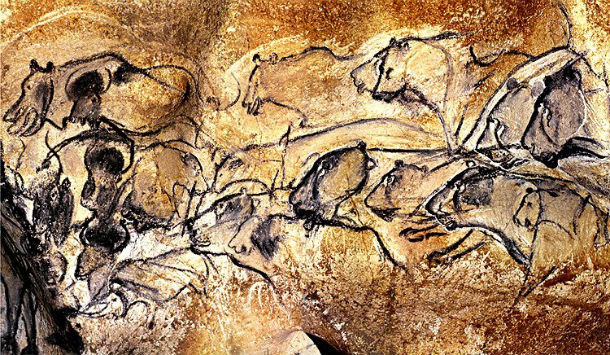
In southern France, the Chauvet Cave is one of the most famous. Rediscovered by modern man in 1994, the many investigations of the many drawings in the cave have narrowed the period in which the works were made to a remarkably specific 30,000–32,000 years ago. (In geologic terms, this is like saying a thing happened in “October” of a certain year.) The picture at top is is of lions hunting aurochs from that cave.

(The cave is the subject of a 2010 documentary, “Cave of Forgotten Dreams,” by Werner Herzog. I believe the film is still available on Netflix, for those with an account. Herzog was given unprecedented access to the inside of the cave, which has never been opened to the public and never will be in order to preserve it. If you are like me and could listen to Werner Herzog read the list of ingredients from a box of breakfast cereal, well, enjoy. It is a great documentary.)

Cave paintings are a snapshot of the birth of human consciousness, and we may be looking at different forms of story on those walls, from journalism to fiction.

The paintings depict animals on the move. Animals they use like horses, animals they hunt, like the aurochs, animals that maybe they avoid, like bears and rhinos.

chauvetfightA fight between two animals is shown. This may be an early form of journalism; the painter or painters saw this happen. The picture at top, of lions on the hunt, demonstrates that the artist or artists had already learned how to effectively use perspective. Some of the lions are in front of other lions, blocking the view of all but the legs of the lions behind them. Their heads are proportionate in size to the perspective used. The cats are not carbon copies of one generic “cat,” but are individual.

“I saw this” is a form of reporting, is awareness. The birth of consciousness came with the idea of a future. Some of the paintings may depict something like, “You can find this many animals over here, I promise you. Next Tuesday.” Some of the paintings are the first stories, fantasies about a successful hunt or accounts of past ones. Some of them are the first lies: Boasts about the number hunted.

That is where the true birth of consciousness resides, in stories.

____________________________________________
The WordPress Daily Prompt for November 23 asks, “What makes a good storyteller, in your opinion? Are your favorite storytellers people you know or writers you admire?”

* * * *
Please subscribe to The Gad About Town on Facebook: http://www.facebook.com/thegadabouttown

Who’s My Great-Great-Great-Great … Grand-Who?

“All happy families are alike; each unhappy family is unhappy in its own way.”—Leo Tolstoy, Anna Karenina

To the best of my knowledge, there are no murderers in the part of the family tree that leads directly to me. I have done my best to maintain this streak of successfully not murdering anyone, but if I am ever accused, I will not be the first person named Mark Aldrich to be charged with murder.

Almost every person with the last name Aldrich in the United States is descended from George Aldrich of Derbyshire, England, a tailor who was born in 1605 and emigrated to America in 1631, a decade after the Pilgrims. He is my great-great-great-great-great-great-great-great-great grandfather and probably the only one whose name I will know. George and his wife Katherine Seald Aldrich settled in Dorchester, Massachusetts, had 10 children (one, a daughter who died in infancy, bore a classic Puritan name, “Experience”) moved to Braintree, and then moved to Mendon, Massachusetts, where his name is inscribed on a monument naming the town’s first settlers.

His second son, Joseph, is the great-great-great-great grandfather of Rhode Island Senator Nelson Aldrich, whose daughter Abby, married John D. Rockefeller II and was the mother of several prominent Rockefellers. One son, Nelson Rockefeller, carried “Aldrich” as his middle name.

Another son, Jacob, had a dozen children, and those from his son, Joseph, were early settlers (in the 1740s) of Mattituck, on the east end of Long Island, and the Tafts, including President Taft.

One of Jacob’s other sons was named Peter, born in 1686, and he is my direct ancestor.

The sheer proliferation of Aldriches in America—when ten children have ten children, the family tree suddenly has a lot of branches on it—makes research a challenge. The genealogies have notes like, “Jacob 2 and Jacob 4 both had sons named Jacob who married wives named Sarah, or they are the same Jacob.” I exaggerated that a little.

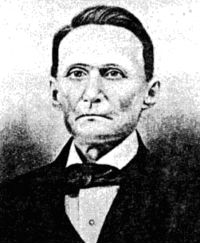
Thus I do not know which line in upstate New York produced Mark Aldrich. The one in 1801. The Mark Aldrich from upstate New York born in 1968, that one is me, last I checked. But in 1801, Mark Aldrich was born near Lake George, New York, son of Artemus Aldrich. He is not my namesake. By the date of his death, September 1873, in Tuscon, Arizona …

Tuscon?

His death notice in the Arizona Citizen fills in some blanks: “Hon. Mark Aldrich died in Tucson, Sunday evening, of old age. … A very large number followed his remains to the grave. The Masonic Brotherhood took charge of his remains and buried him in accordance with the rights of the order.

Mark Aldrich. Not me.

Mark Aldrich. Not the me Mark Aldrich. The other one.

The deceased was seventy-one years of age. He was born in the state of New York, but subsequently settled at Warsaw, Hancock County, Illinois. We know but little of his early history, but are informed that he was three times a member of the Illinois Legislature, and served with Lincoln, Douglass, and other distinguished men who have since written their names high on the roll of fame.He came to California in 1849, and we believe engaged in mercantile pursuits. Of his history while there we are not informed.

He came to Arizona in the latter part of 1855, and has since resided in Tucson. He was the first American merchant in this town, the first postmaster, and the first alcalde.

“Mercantile pursuits” in California in 1849? Whatever might those have been? That was the year the Gold Rush started. The first alcalde of Tucson? “Alcalde” is spanish for “Mayor,” so he was the first American mayor of Tuscon, Arizona.

But the early history that the newspaper writer “knew little of?”

Hancock County, Illinois, in the 1830s was where Joseph Smith had led his followers in the Latter Day Saint Movement. Aldrich tried to sell Smith and his followers some land that he owned but Smith did not purchase. After renting the land, however, Aldrich turned into one of the worst landlords (or best, for Mormon history) and started changing the terms of the lease at whim. Smith and the early Mormons left and settled what became Nauvoo, Illinois; Smith named himself mayor and announced a run for President of the United States. Aldrich went bankrupt.

Nauvoo is in Hancock County, the same county that Aldrich’s land had been on. Now a vocal opponent of the incipient LDS movement, Aldrich was also one of those figures one still sees a lot of in small-town America: he seems to have always been in at least one elected or appointed position wherever he resided. He was a major in the Illinois State Militia, and in June of 1844, Joseph Smith had been arrested and was being held in the Carthage City Jail.

Smith was charged with ordering the destruction of the Nauvoo newspaper facilities because the paper, founded by former associates who turned against him, had printed stories accusing Smith of polygamy. The newspaper was declared a public nuisance and its press was destroyed, but so was its building. When a neighboring town issued a warrant for Smith’s arrest, he declared martial law in Nauvoo, which turned the issue into an Illinois issue and the governor ordered Smith put on trial.

Smith was held with his brother in the Carthage City Jail and on June 27, 1844, a mob of hundreds stormed the jail. The two prisoners were killed. Someone had to have let the mob in. Someone had to have directed the mob. Aldrich, a militia major with men under his command who took part in the mob, was charged with four other men. A trial was conducted and an all-non-Mormon jury acquitted the five. Aldrich ran for sheriff of Hancock County the very next year.

When I lived in Iowa, near Nauvoo, a friend invited me to visit Nauvoo. She did not know this history and I decided against risking matters.

Within a decade, Aldrich was an early settler of Tuscon and its first American mayor. And his body is, to this day, buried under the streets of Tuscon. The cemetery in which he was interred was closed by 1890 as the city grew into city-hood and paved things. Most remains were moved to other locations in subsequent decades but no record exists that states that any Aldrich relative claimed the body of the former mayor and accused-but-acquitted murderer of the founder of the Mormon Church.

____________________________________________
The WordPress Daily Prompt for November 19 asks, “We all have that one eccentric relative who always says and does the strangest things. In your family, who’s that person, and what is it that earned him/her that reputation?”

* * * *
Please subscribe to The Gad About Town on Facebook: http://www.facebook.com/thegadabouttown

Opus 40: An Update

In March I wrote a column about a fundraising campaign to help restore one of my favorite places, Opus 40, in Saugerties, NY. There has been plenty of good news since March.

Built in an abandoned bluestone quarry in upstate New York by one man, Harvey Fite, Opus 40 is a contemporary American version of Stonehenge or the collection of Easter Island moai.
Read More