Queen of the Hudson

One of the unique things that is somehow common to many people (we are all alike in our uniqueness) is a stated belief that our hometown is no place special. We are taught to be humble, so anyplace that our humble selves hail from must be thought of as not all that special, either.

This often masks a fierce inner secret belief that one’s hometown is in fact the best place to be from and (insert name of a higher power one believes in here) please help those who chose to be born somewhere else, especially those unlucky ones born in the nearest next neighboring town. Those people are the unluckiest of all, perhaps because they were born so near to our town’s greatness but were not, which renders all the more dramatic their failure at their life’s first and easiest task: pick the right place to be born.
Read More

You Can Help Opus 40; Here’s How

In November I wrote a column about a fundraising campaign to help restore one of my favorite places, Opus 40, in Saugerties, NY. There is a new fundraising campaign this month—and you can help.

Every year, Ulster Savings Bank, an upstate New York institution (it was my bank for years), holds an online vote to pick a nonprofit organization for a cash award. The top award is $3000, which is not much, but as I have explained in previous articles, every bit helps in the rebuilding of the damaged parts of the sculpture park. You do not need to be a Hudson Valley local to vote.

If you click on this link right here: (Mid-Hudson Heroes), you will find Opus 40 at the top. If you have a Facebook account, you can vote. Further, you can vote every 24 hours between now and March 6. Opus 40 is only one of approximately 150 nonprofit organizations being recognized by the bank, so every vote counts.
Read More

Pareidolia, Good to Know Ya

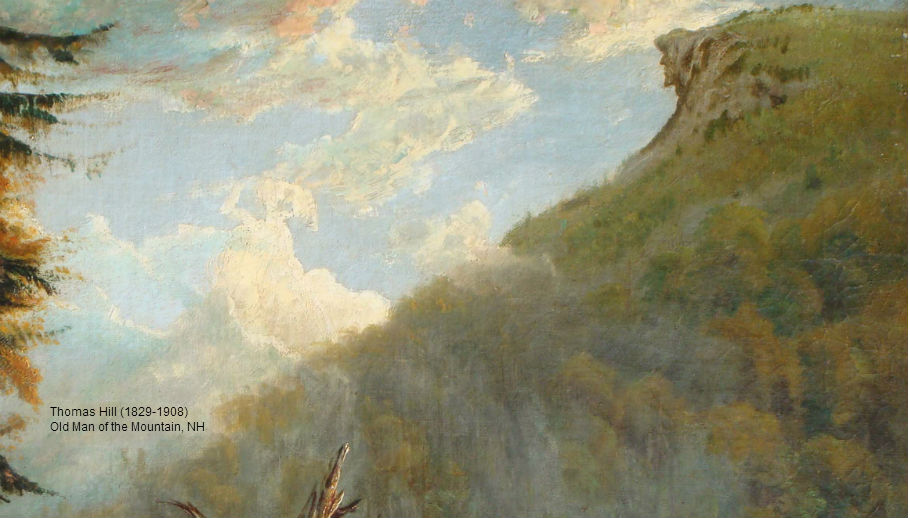
We love our pareidolia moments. The human brain is continuously at work interpreting the world around us, judging incoming information and stimuli on a range of choices and a spectrum of notions, ranging from food or not-food? to friend or foe? to Do I know you? Look at those clouds. Do you see what I see?

Artists have taken advantage of this for centuries. Were I to draw a circle, put two dots toward the top side, a short vertical line under these, and a horizontal half-circle under that, most people would say that I had sketched a smiley human face, even though hardly any human being that any of us knows looks like that. Some neuroscientists say that our brains are hard-wired to look for faces and to quickly identify friend or foe, even with only a part of a face visible. Those ancient humans who survived because of this skill survived to pass that skill on, genetically. Those with superior facial recognition skills today have their ancient ancestors to thank.
Read More