Your Inner Bliss Moonlight and Madness: Follow It

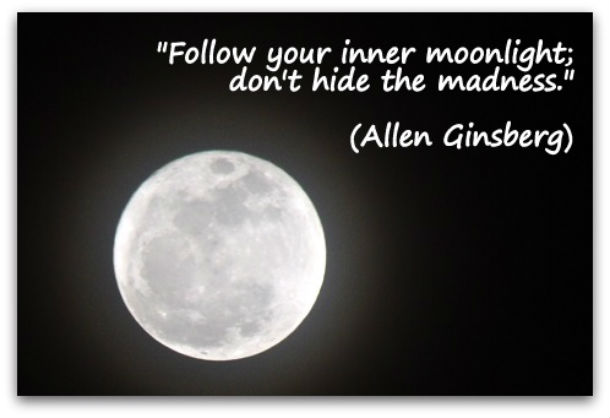
In his published works, Allen Ginsberg wrote not one single thing about moonlight and madness, yet there is a popular Internet meme—an Internet poster—usually seen with a handsome photo of our moon and the rousing declaration credited to him that you should “Follow your inner moonlight; don’t hide the madness.” (See above.)

It is a Bizarro World version of a speech given by a football coach at halftime. “Follow your inner moonlight, boys, and let’s win one for State! Don’t hide the madness!” (The team huddles together and starts to chant, quietly and slowly at first, but then they build it to a hypnotic intensity: “Don’t. Hide. The. Madness. Don’t. Hide. The. Madness.”)

But did Ginsberg, the bard of the Beats, ever write or say such a thing? Yes, no, and yes. According a post in the blog The Allen Ginsberg Project, exactly 25 years ago Ginsberg’s biographer Michael Schumacher interviewed Ginsberg about writing and inspiration and submitted the answer to a Writer’s Digest publication, “On Being a Writer,” which was a book that read more like a calendar of daily inspirations than a book. The writer at The Allen Ginsberg Project did the footwork and even wrote to Schumacher in the search for an answer, so credit must be given to that blog. The full piece is here: “The Mystery of the Inner Moonlight.”

What Ginsberg wrote to Schumacher was:

“It’s more important to concentrate on what you want to say to yourself and your friends. Follow your inner moonlight; don’t hide the madness. Take [William Carlos] Williams: until he was 50 or 60, he was a local nut from Paterson, New Jersey, as far as the literary world was concerned. He went half a century without real recognition except among his friends and peers.
“You say what you want to say when you don’t care who’s listening. If you’re grasping to get your own voice, you’re making a strained attempt to talk, so it’s a matter of just listening to yourself as you sound when you’re talking about something that’s intensely important to you.”

Long before, he had used one half of the declaration and wrote “Don’t hide the madness” in a poem in 1954. While he was editing William S. Burroughs’ novel “Naked Lunch” with Jack Kerouac, Ginsberg wrote “On Burroughs’ Work”:

On Burroughs’ Work
The method must be purest meat
and no symbolic dressing,
actual visions & actual prisons
as seen then and now.

Prisons and visions presented
with rare descriptions
corresponding exactly to those
of Alcatraz and Rose.

A naked lunch is natural to us,
we eat reality sandwiches.
But allegories are so much lettuce.
Don’t hide the madness.

For a writer who found his voice in compound nouns and lists of the super-specific details of his humdrum day (some graduate student must have tallied up the many grocery and other kinds of bills that he so frequently includes in his work; perhaps they won an assistantship), the minutiae of his existence, “reality sandwiches” was a great turn of phrase, so good it appears to have surprised the poet. He brings the work to its swift conclusion right there, lest he pile on some allegorical lettuce and bury the meat.

But moonlight? “Inner moonlight,” no less? That was a new one. In 1955, he had already written his best known, best regarded, poem, the long “Howl,” which was published the next year. Its opening line, “I saw the best minds of my generation destroyed by madness,” seems to tell of a hard-earned caution about the lunacy of following any moonlight, inner or not. But the madness in “Howl” is the pain of those “best minds” attempting to fit in with repressed and repressive society and finding their outlet in self-inflicted agony, trying to find a fix.

By 1989, Ginsberg knew that a phrase like “inner moonlight” voiced a sentiment akin to the similar—and similarly purposefully over-simplified— “follow your bliss” of Joseph Campbell. Both are inscribed in the long history of mal-understood phrases used by people to excuse bad, or self-centered, behavior. Neither one deserves that fate; neither phrase deserves many of the people who declare them as personal credos. (I am happy to report that every post I read in response to this question was an example of a writer genuinely not declaring anything, not anything at all. Writers follow their bliss and do not need to tell the world that they are doing so.)

A writer’s life is not often a conventional one and a writer’s wisdom is often a hard-earned one. Any writing that declares its “wisdom” as “hard-earned” or to be the product of following an inner blissful moonlight is usually missing its own point, and is thus conventional enough to be put on an Internet poster. But the “crazy wisdom” that Ginsberg and Corso and many of the Beats did manage to sometimes touch upon and stare directly at and give to their readers, that is always worth encountering for the first time over and over again.

* * * *
What did Allen Ginsberg’s voice sound like, his poet’s voice? Here is a recording, with music said to be by Tom Waits underneath.

____________________________________________
The WordPress Daily Prompt for October 3 asks, “‘Follow your inner moonlight; don’t hide the madness.’—Allen Ginsberg. Do you follow Ginsberg’s advice—in your writing and/or in your everyday life?”


I, Toward a Metrics of Me

In the interest of full self-disclosure, what follows will disclose nothing about me.

I am a Twitterer. I Tweet. Once a year or so, I will participate in the nightly cocktail party, the veritable Algonquin Round Table, of online wordplay and games that can be found on that social media outlet. Perhaps you’ve seen these games, in which people follow the instruction given in a catchy hashtag, like hashtag (which is this symbol: #) “Add A Word Ruin A Movie.” As in: #AddAWordRuinAMovie. And then a participant, me let us say, will snarkily add a word to a famous movie title to ironically change the entire complexion of the movie. “Midnight in the Olive Garden of Good and Evil” is one that I love but can not claim credit for.

One day last year, the wit-fest of hashtag joking, the hive mind of Twitter intellect, had come up with #DrabFilms, and this was my contribution, and it was met with universal silence:

Not one single re-Tweet on there. Not one “favorite.” Bupkiss.

There is little in the world sadder or lonelier than a one-liner delivered to no one in a crowded room crammed with people ignoring the joke-maker’s contributions. “If a Tweet falls in a forest,” someone philosophically minded might ask, “with no one to re-Tweet it, did it make a sound? Nay, did it even exist?” (There are a handful of congressmen who might have their own answers to this question.)

“I Tweet, therefore I know that I am doing what I told you I am doing once I tell you what I am doing because others tell me that they say that they approve.”

Do I know what I am doing, where I have been, where I am going, who I am with—who I am, even?—without social verification, approval, disapproval, a certain number of thumbs-ups or stars or re-Tweets?

The American corporate world introduced the idea of measuring everything many decades ago but in the late 1990s employees discovered that their continued employment was dependent on finding new ways to measure everything. I remember my revulsion upon hearing the word “metrics” used in a sentence the first time. (For months, I heard the ghost-word “system” every time I heard “metric.”) The precise sentence was, “We are using all available metrics,” and I quickly noticed that no one else at the meeting table was laughing and they were still scribbling notes more furiously than students in a freshman philosophy seminar. For a while, the number of documents I was actively working on was my key metric, I was told by my employer. Then it was the total number of pages. It changed, often, but the accumulated number of metrics used to measure my metrics was never itself added up and counted. For a year or two I was publishing the average number of pages per document completed. Then it was pages per document per day.

Some time after that one, I was let go. A bad attitude has no metrics.

The social media revolution was long in coming and I enjoy it very much, but metrics have infiltrated our lives, even our fun-filled social lives. “How many ‘likes’ did that get?” Does my employment hinge on it? No? Why does it feel like it does?

When a celebrity or otherwise important person finds him or herself in an online controversy, the number of re-Tweets of the news-worthy posting is supplied in news accounts about the contretemps. The fact that a number is available and can be reported does not make it a statistic, much less a statistic worth reporting.

Sadly, I find myself watching the likes and numbers of visits to this web site right here, the one in your hands, every night. “The Gad About Town” is not my employment, it is something I want to do and share. But the fine people at WordPress make the information so easy to find and digest. It is information after all and it looks like an impressive collection of live statistics and it makes me want to have a boss to report it to every night. (So I Tweet it out sometimes, to attract more readers.) “This number of visitors read my work last night, but it is a smaller number tonight. Whycome is that, world?” Sad face.

(Sigh.) Metrics.

Never before in my life have I known how many friends I have, but if I wanted to, I could look and see every morning if the number of my online friends is larger or smaller than yesterday’s. Metrics.

Am I my numbers? Am I my metrics of me? Everything in the world can be counted, and that number can be known and disclosed, but more often than not this one fact does not make it information.
____________________________________________
The WordPress Daily Prompt for October 1 asks, “To be, to have, to think, to move—which of these verbs is the one you feel most connected to? Or is there another verb that characterizes you better?” I Tweet.

Deus Ex

In classical drama, the term deus ex machina refers to a plot device wherein a plot problem is suddenly solved by the arrival of a previously unannounced character who supplies the answer or solution. “But don’t you know? That’s your brother!” would be a typical line delivered by a deus ex machina character, thus helping our heroes avert a troublesome situation.

When a playwright or novelist needs to fix an intractable plot puzzle, he or she might resort to the tool, which is Latin for “god from the machine,” or “you couldn’t figure it out for yourself with the characters you’d created, so you punted,” but audiences since ancient times have tended to see through the fix. “Where did HE come from?” More often than not nowadays, it is used ironically, but when you find yourself reading a book and seeing lines delivered by a character that you do not remember being introduced to, your inattentive reading is not to blame. That character really was not there 20 pages earlier.

A more restrained writer might use a deus ex machina-type character to do something simpler than solve everything; the character might supply background information. Or another character might do something like get a character who knows a secret drunk to spill the story, turning that character into the god-machine. In vino veritas, the Latin expression declares, and I do not think anyone needs it translated here.

Any deus ex machina fixes that you might encounter in real life are more rightly known as surprises. Anyone who reveals something that they claim to have known about all along is either a busybody or a breaker of confidences, and you ought to do everything in your imagination to make sure they get stuck with the bill for every lunch for a year.

But what if you could learn something secret from one of your friends by administering some sort of truth serum? (I would hope, for all of our sakes, that if we could learn what our friends truly think of us that we would learn they hold us in higher esteem than we think they do. Nothing worse. One hopes one’s friendships are that open-faced and honest.)

There in fact is a drug that some consider a truth serum. It is sodium thiopental, better known by its Abbott Laboratories brand name of Sodium Pentothal, and it is a barbiturate that is used as a general anesthetic. Because it is such a strong anesthetic, it is more frequently administered to induce a coma than it is to knock someone out for a tooth extraction; further, it is usually the first drug injected into the arm of a prisoner as he or she is being put to death.

On and off for many decades, police in certain countries (including this one) have administered the drug to get prisoners to talk, to spill the beans, to yack away the location of whatever it is the police are looking for but can not find. Nothing would help in crime solving or crime prevention more than a real-life deus ex machina, and in sodium thiopental veritas goes the thinking. More often than not, the beans that were spilled under the effects of the drug were hallucinations and dreams and probably more revealing of a psyche under duress and being put to sleep than the location of an un-apprehended bad guy’s house.

But police forces keep searching: for bad guys and evildoers as well as for the perfect drug that would get the apprehended bad guys to talk and thus create a real life deus ex machina. For some, Steven Spielberg’s film of Philip K. Dick’s “Minority Report” depicts one man’s unnecessary interference with a fine legal system rather than the hopeful end of dystopian nightmare.

* * * *
“What’s that, sweetness? Oh, we’re going to dinner? Now? Okay. I’ll finish typing this right about n- -”

____________________________________________
The WordPress Daily Prompt for September 30 asks, “You’ve come into possession of one vial of truth serum. Who would you give it to (with the person’s consent, of course)—and what questions would you ask?”