Sick Transit, Gloria, on a Monday

One could define Hell as the experience of the sensation of wanting to be any place other than where one is at that moment. In the proper wrong circumstances, your bed could be rendered almost as uncomfortable as an MRI tube.

If I convince myself that the seat next to mine presents a better view of the movie screen and I can not slide into it because you are there, ask me in a couple hours what the film was about or who was in it.

Walk through any strip mall shopping plaza on a Sunday afternoon: not only is the place bereft of customers, not one single employee wants to be there, even for the money. Or a Walmart after midnight. Every employee is elsewhere, Walter Mitty’ing their way through life, perturbed to be where they are. Perturbed to be. That is a variety of Hell.

Sic transit gloria mundi, there goes the beauty of the world, in four-hour half-shifts working at a job one does not hate exactly—because hate is a strong enough emotion to inspire actions towards real change—but dislikes, detests, disdains. I detested myself when I disdained my jobs.

* * * *
One could also define Hell as the Albany, New York, Greyhound bus station. No one appears happy to be in a bus station, neither the transiting passengers nor the employees. An extended stay in a bus station is the experience of boredom minus information.

Airports present a vast panoply of human experiences, from the fear of permanent change to the excitement of temporary reunions. I have experienced emotions that I have not encountered elsewhere in my life in airports. I realized that I had fallen in love with someone 60 seconds too late in an airport once upon a time. (More correctly, I think that I thought I ought to have gotten a phone number.) I almost missed my next flight in indecisively wandering around O’Hare while debating whether I should run “just like in a movie” to what I thought was the terminal my desired companion had told me her flight was leaving from. If you did not know, O’Hare is too large an airport to be indecisive in.

A wait in a train station is boredom plus information, as the trains are usually on time and people willingly, even happily, strike up conversations. Grand Central Station or Penn Station in New York, South Station in Boston—look at this photo:

South_Station_Terminal_Inside

Boston’s South Station: Filled with sunlight and advertising and well-stocked newsstands. Look at that happy place. (Photo from Wikipedia.)

In memory, this is truly what South Station looks like: full of light. In truth, I remember once sitting beside the late journalist David Halberstam as he waited next to the Martin’s News Shop (see above) for the Acela train to whisk him off to New York City and the two of us watched a man throw up on himself on a bench not eight feet away. I was rendered mute by both seeing someone I idolized and that sight. The great writer was spared an embarrassing “I’m a big fan” speech from me, but maybe I missed making the scene into a conversation-opener. (Mr. Halberstam has since passed away, something that was perhaps hastened by the incident.)

In America, there are only a couple reasons one is in a bus station for an extended period—overnight, say—and two are the side effects of unhappy circumstances, like not knowing anyone in town. A typical long distance bus journey includes a couple changeovers and long breaks between legs in the trip. A traveler has to stay somewhere and if one is the only person one knows in Cleveland, Ohio, (for example) one might spend eight hours walking around the neighborhood, which looks a lot like this photo that I did not take one overnight stay in Cleveland in June 2000:

But the Albany Greyhound Station? No one wants to be there. No traveler or bus driver wants to spend more than 27 seconds there (I have never seen a driver enter the facility; they remain beside the bus even after passengers have collected all bags and boxes, as if afraid the vehicle will be stolen), and no one in a position to change things in that great city wants it to be there, either. For almost 30 years it has sat atop both Greyhound’s list of buildings that need to be replaced or rebuilt and Albany’s. Each wants to see what the other will do before acting. The building’s continued existence is the picture of a stand-off, as no one will invest time, money, or care in the place if it is always about to be razed and rebuilt by the other entity. Greyhound wants to see what Albany will do, and vice-versa. (Here is a recent article.)

Photo by Michael P. Farrell/Times Union. From www.timesunion.com/local/article/Churchill-Albany-s-Greyhound-station-is-a-5320974

Any photo will make the Albany bus station appear benign. Do not be fooled. (Photo by Michael P. Farrell/Times Union. From http://www.timesunion.com/local/article/Churchill-Albany-s-Greyhound-station-is-a-5320974.php)

Yet there it stands, dingy and apart. It is a reminder that life ends, but bus stations are not supposed to be memento mori.

(Photo by Michael P. Farrell/Times Union. From http://www.timesunion.com/local/article/Churchill-Albany-s-Greyhound-station-is-a-5320974.php)

Hell’s waiting room, the Albany bus station. (Photo by Michael P. Farrell/Times Union. From http://www.timesunion.com/local/article/Churchill-Albany-s-Greyhound-station-is-a-5320974.php)


____________________________________________

The WordPress Daily Prompt for October 6 asks, “Train stations, airport terminals, subway stops: soulless spaces full of distracted, stressed zombies, or magical sets for fleeting, interlocking human stories?”

‘Not from around Here, Are You?’

One of the unique things common to most people is a stated belief that their hometown is no place special. This often masks a fierce inner secret belief that their hometown is the best place to be from and (insert name of higher power believed in here) please help those who chose to be born somewhere else, especially those unlucky ones from the nearest next town. Those people are the unluckiest of all, perhaps because they were born so near to greatness, but were not, rendering the failure all the more dramatic.

By the oldest of old-fashioned reckoning, counting on my fingers, I have resided in more than 20 homes in six counties across three states in two time zones. This is not any sort of record-setting achievement, but it has given me a lot of hometowns. Poughkeepsie, New York, population not me, is my birth hometown and I lived there every day and night past age 21, which must be some sort of international record.

Poughkeepsie is known for a few things, most of them to do with it not being worth knowing about, much less reside in or be from. It is one of the nation’s minor punchline cities, partly because the name is longish and amusing to say and hear and partly because it is Poughkeepsie. (See what I did there? It is sometimes too easy. The word is a punchline by itself.) Sheboygan, Wisconsin, a city that I came t-h-i-s c-l-o-s-e to residing in, ranks one place ahead of Poughkeepsie in the list of punchline American cities, according to international surveys of What I Am Thinking Now.

Something that I noticed early on was the city’s fascination with itself. Its media outlets love to recount every punchline, every occasion in which our jewel on the Hudson has been ridiculed. It is perverse. Because there are so few mentions of Poughkeepsie in the national or international media, those examples, those few mentions are treated as precious, are subjected to a sort of Sportscenter slo-mo instant replay.

Any Poughkeepsian can recount some of them. There was a “Friends” episode. There was a vaudeville song, “I’m a Gypsy from Poughkeepsie.” Now you know how to pronounce it. Jimmy Fallon is from near here, so the name probably appears as a punchline in his monologues.

It is either a perverse civic pride in being a small joke or we have professionalized the art of setting expectations low for the entire planet, just in case someone might visit and report that they were pleasantly surprised. (“You know something? Those people in Poughkeepsie eat food! They walk with both of their feet!”)

Any attention is better than no attention, someone, probably from Poughkeepsie, once said. And woe will befall anyone from Wappingers Falls, the next nearest town, since they are unlucky enough to be from a place near to such famous not-greatness yet reside in a place that is not-so not-great itself.

But ask me where I am from and sometimes I can sound like I am applying for a job with the Poughkeepsie Chamber of Commerce and begin to rattle off sights and sounds and memories. (“Halloween in Poughkeepsie.”) The man who invented Scrabble was from here. Smith Brothers Cough Drops were invented here. IBM’s history here. The colleges. It is perverse.

* * * *

[…] And after it rains there’s a rainbow
And all of the colors are black
It’s not that the colors aren’t there
It’s just imagination they lack

Everything’s the same
Back in my little town
My little town, my little town

Nothing but the dead and dying
Back in my little town.
—”My Little Town,” Paul Simon

____________________________________________
The WordPress Daily Prompt for October 5 asks, “Think about the town where you currently live: its local customs, traditions, and hangouts, its slang. What would be the strangest thing about this place for a first-time visitor?”

Stop Stressing Me Out!

The same friend who used to reply to my complaints about old pains and new aches with a cheerful, “But you’ve never been 45 (or whatever) before,” also used to say, “Remember, it’s just Tuesday (or whatever day)” when a person would confess to feeling anxious about an upcoming big event or holiday.

“It’s only a Saturday. Same as all the other ones. Sunday will come next.”

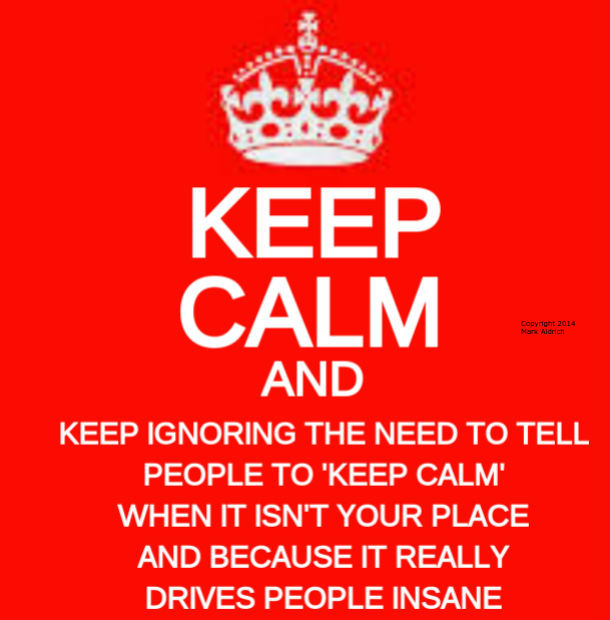
Yes, yes, it is the same, definitely the same as all the other Saturdays, indeed, but it is a Saturday with the addition of my wedding or taking the GRE or LSAT or … . An event-focused Saturday is an impersonation of all the other Saturdays. An awards ceremony is not just another setting for a mediocre hotel meal, even though it is that, too. So thanks for not helping us out there, not even one bit, Mister Calm Guy.

How does one keep that inner calm, that sense of appropriate perspective? The answer lies in that word “perspective,” and there is only one thing that adds perspective to one’s life: Doing things. Experience gives one a chance to develop some perspective about whether or not something is worth worrying over or not.

Chaucer’s Wife of Bath says experience gives us no authority to speak on anything but our own experience of life, but it is sufficient.

In “Stress,” a memoir I wrote about my own anxious life lived in anxiety and anxious worries about the possibility of future anxieties brought on by past worries of anxieties that I may be too anxious, I recounted several hilarious escapades involving my personal levels of tension, including giving myself a black eye while mis-tying my shoe.

Thus, my advice to me when faced with a big journey or a ceremonial event or a test is to acknowledge that I will be anxious, remind myself that the fun/important part is in the journey, that I will most likely discover new ways to be flabbergasted and to flabbergast, and to enjoy the ride. Whenever I attempt to deny myself my anxiety, I deny myself feelings, and I re-learn that repressed feelings will explode.

Don’t tell me what to do. Don’t you dare tell me to keep calm, I tell myself. And then calm follows.
____________________________________________
The WordPress Daily Prompt for October 4 asks, “It’s the night before an important event: a big exam, a major presentation, your wedding. How do you calm your nerves in preparation for the big day?”